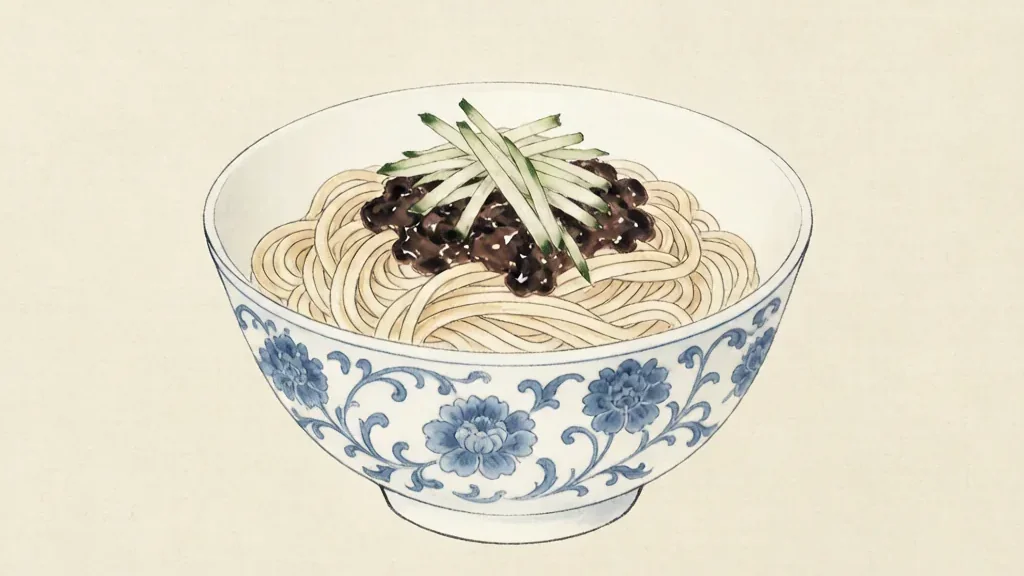
If Beijing had an official weekday lunch, it might well be 炸酱面 () — noodles with soybean paste. The dish is gloriously plain in concept: chewy wheat noodles topped with a dark, glossy mound of fried soybean paste and ground pork, then buried under a colorful pile of raw and blanched vegetables. Yet in that simplicity lies a meal of remarkable texture and balance. For Beijingers, a bowl of zhajiangmian is nostalgia made edible, a taste of courtyard homes, summer evenings, and the unhurried pleasure of mixing everything together by hand.
The Heart: Fried Soybean Paste
The soul of the dish is the 炸酱 (), literally "fried sauce." It is made by slowly frying a fermented soybean paste — usually a mix of sweet bean paste (甜面酱, ) and thicker soybean paste (黄酱, ) — with ground pork in oil until it turns deep brown, fragrant, and jam-like. The long, low fry removes raw sharpness and coaxes out a caramelized, umami-rich depth.
Good zhajiang is neither too salty nor too sweet, with a glistening sheen from rendered pork fat. Some cooks add a little rock sugar, Shaoxing wine, or diced mushrooms for umami. The paste is cooked in quantity and kept on hand, so assembling a bowl is quick — a boon for home cooks. The contrast between the dark, savory sauce and the bright vegetables is what makes the dish sing.
Noodles and the "Code" of Toppings
Traditionally the noodles are 抻面 (), hand-pulled or rolled wheat noodles, boiled until just firm and rinsed briefly to keep them springy. They are drained and piled in a bowl, then topped with a spoonful of zhajiang. The magic is the "eight treasures" of vegetables — though the exact count varies — typically including blanched soybeans, diced cucumber, shredded radish, cooked celery, scallion, garlic sprouts, and sometimes carrot and tofu.
Each topping adds a different note: cucumber for cool crunch, radish for peppery bite, soybeans for creaminess. The diner stirs everything together, coating each strand. Eating zhajiangmian is interactive and communal in spirit, even when eaten alone; the mixing is half the fun, and everyone develops a preferred ratio of sauce to vegetables to noodles.
Beijing Roots and Home Cooking
Zhajiangmian is quintessentially Beijing, born of northern wheat-eating culture and the pantry of a typical courtyard household. Unlike elaborate banquet fare, it is humble home cooking, the kind grandmothers perfected without measuring. During hot summers, a cool bowl of noodles with crunchy vegetables was a practical, satisfying meal that required little time at a hot stove beyond frying the paste.
The dish also reflects northern thrift: a small amount of pork stretches far when bound with paste and vegetables. Over time it became a restaurant staple too, with shops competing on the smoothness of their noodles and the richness of their sauce. Yet its heart remains the family kitchen, where the rhythm of chopping vegetables and stirring the paste marks a familiar kind of care.
Variations Across Regions
While Beijing zhajiangmian uses a dark soybean paste, southern and Korean versions differ. In Shandong, the sauce may be slightly lighter and the vegetable list longer. The Korean-Chinese 炸酱面 (Korean: jajangmyeon / 자장면) descends from this dish, using a black bean paste (chunjang) and a sweeter, thicker sauce, often served with diced pork and onions — a beloved comfort food in Korea.
Within China, some cooks swap the pork for beef or make it vegetarian with extra mushrooms and fermented tofu. Noodle choice also shifts: thinner noodles in the south, broader in the north. These variations show how a single concept — noodles plus fried bean paste plus vegetables — travels and adapts while keeping its comforting core.
How to Build a Bowl at Home
To make zhajiangmian at home, start the sauce: heat oil, add ground pork, and once it loses its pink color stir in the mixed pastes. Fry on low heat, stirring often, for fifteen to twenty minutes until glossy and dark. Meanwhile, boil the noodles and prepare the vegetables, cutting everything into matchsticks or small cubes for easy mixing.
Assemble by placing noodles in a bowl, spooning the sauce on top, and arranging the vegetables around it. Serve with a little smashed garlic and, if you like, a dash of vinegar. The dish is endlessly customizable, which is why it suits both weeknight speed and weekend indulgence. Leftover sauce keeps for days and only improves as flavors meld.
Why It Endures
Zhajiangmian endures because it is cheap, filling, and deeply satisfying without being heavy. It celebrates the northern love of wheat and the Chinese genius for turning a few preserved ingredients into something greater than the sum of its parts. The dish also invites participation — the act of mixing your own bowl — which makes it feel personal every time.
In a fast-changing Beijing, zhajiangmian is a reassuring constant, served in glitzy food courts and tiny alley shops alike. It reminds eaters that refinement is not required for a meal to be loved. Sometimes the best food is a bowl of noodles, a spoon of fried paste, and a garden of vegetables, stirred together with chopsticks and eaten with contentment.
Zhajiangmian in Beijing Today
Walk through Beijing today and zhajiangmian is everywhere, from gleaming food courts to hole-in-the-wall alley shops that have served the same bowl for decades. The dish sits comfortably at two ends of the city: as a quick, affordable lunch for office workers, and as a nostalgic specialty that restaurants pride themselves on. Some shops let you choose your noodle width and pile on as many vegetable 'codes' as you like, while others guard a single family recipe for the fried paste. During summer the cold version draws long lines, and during festivals the warm bowl returns as home cooking. Television shows and social media have turned a few old shops into destinations, yet the experience stays personal: you are handed a bowl, a spoon of dark sauce, and a mountain of vegetables, and the rest is up to you. The dish's steadiness is its charm in a city that keeps reinventing itself.
A Bowl That Follows the Seasons
Although the fried paste stays much the same, the vegetable topping changes with the calendar, which is part of zhajiangmian's quiet genius. In early summer, tender cucumber and fresh soybeans dominate; as autumn arrives, cooks add blanched celery, carrot, and the last of the scallions. The cold 'passed-through-water' version belongs to the hottest weeks, when a chilled noodle cools the eater without a long time at the stove. In winter, a warm bowl with a dash of vinegar feels restorative. This seasonal shifting means the dish never quite repeats itself, and it teaches the eater to notice what is fresh at the market. The 'code' of vegetables is thus less a fixed rule than a running conversation with the seasons, letting one humble sauce carry a whole year of local produce.
❓ Frequently Asked Questions
📝 Chinese Vocabulary
炸酱面 — : noodles with fried soybean paste.
炸酱 — : fried bean paste sauce.
甜面酱 — : sweet wheat bean paste.
黄酱 — : fermented yellow soybean paste.
抻面 — : hand-pulled wheat noodles.
菜码 — : The assortment of diced raw and blanched vegetables placed on top.
拌 — : To mix or toss the noodles, sauce, and vegetables together before eating.
老北京 — : Old Beijing, referring to the traditional local style of the dish.
🎉 Fun Facts
- Beijing zhajiangmian is traditionally served with a "code" of eight or more different vegetables.
- The fried paste can be made in bulk and kept for days, making weekday assembly fast.
- Korean jajangmyeon, a national comfort food, evolved from this northern Chinese dish.
- The dish is mixed by hand at the table, so no two bowls are stirred exactly alike.
- On hot Beijing summer days, zhajiangmian is often served cold, the noodles given a quick rinse so the bowl stays refreshing rather than heavy.
- Beijing holds informal contests where chefs race to pull the smoothest noodles and balance the sauce, showing off skills passed down in courtyard kitchens.