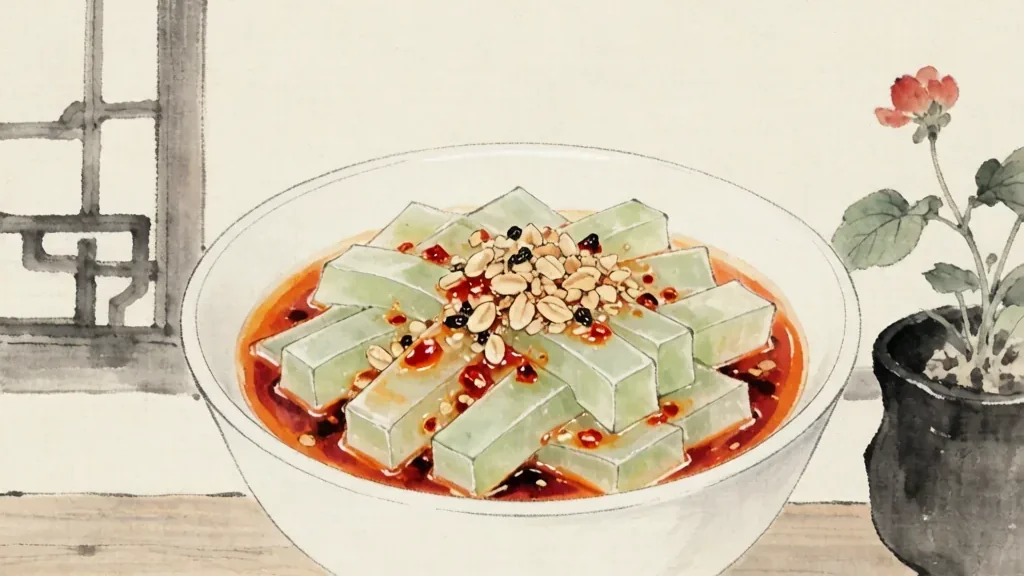
Liangfen is a cold jelly made from the starch of mung beans (or sometimes pea, potato, or sweet potato), set into a quivering, translucent block and eaten dressed with a sharp, savory sauce. A staple of northern and southwestern Chinese summers, it is sliced or torn into ribbons and bathed in garlic, vinegar, chili oil, and sometimes a salty fermented broth, yielding a dish that is cooling, slippery, and bracingly flavorful. Distinct from liangpi, which is a wheat noodle, liangfen is a pure starch gel with no gluten, prized for its clean, trembling mouthfeel. From the street stalls of Beijing and Tianjin to the famous "hot and sour" liangfen of Sichuan, it is a versatile canvas that regional cooks season in strikingly different ways.
What Liangfen Is
The name liangfen means "cool starch" or "cold powder," an apt description of a food that is essentially a savory jelly. Starch is mixed with water, heated until it thickens, then cooled and set into a soft, jiggly mass. Eaten cold, it delivers a unique texture — dense yet yielding, slick but not slimy — that Chinese diners describe with the word "jin" (tender-resilient).
Unlike noodles, liangfen contains no protein structure, so it carries sauce rather than chew. Its appeal is precisely this neutral, cooling base that lets a bold dressing shine. It is a dish of contrast: plain gel, fierce sauce.
Raw Materials
The classic and most esteemed liangfen uses mung bean starch (lü dou), which gives a pale, faintly greenish, clean-tasting gel. Pea starch produces a firmer, more translucent jelly common in the north, while potato or sweet-potato starch yields a softer, whiter product. The choice of starch changes both taste and texture.
Mung bean liangfen is often considered the most refined because of its subtle flavor and smooth set. In markets, dried starch powder lets home cooks recreate the gel, though achieving the right consistency takes practice with heat and stirring.
How It Is Made
The process is a starch pudding. Starch is slurried with cold water, then cooked over medium heat with constant stirring until it turns translucent and thick. The hot mass is poured into a container, smoothed, and left to cool and firm. Once set, it is turned out and cut or torn into pieces.
Tearing by hand (rather than cutting) is traditional for some styles, producing irregular edges that hold more sauce. Good liangfen should hold its shape on the plate yet quiver when shaken — a sign of correct starch ratio and gentle setting.
Northern Styles
In Beijing, Tianjin, and Hebei, liangfen is often dressed simply with garlic water, vinegar, soy, sesame paste, and chili oil, served as a summer appetizer or snack. A related "lüdou fen" may be paired with shredded cucumber. The northern approach favors a nutty sesame note and restrained heat.
Another northern form is "chaihu fen," scraped into thin strands with a special comb, eaten with a savory broth — closer to a cold noodle than a dressed jelly. These variations show how one gel supports many presentations across the wheat-eating north.
Sichuan Hot and Sour Liangfen
Sichuan's most famous version is suanla liangfen, "hot and sour jelly," doused in a punchy sauce of black vinegar, chili oil, garlic, soy, and often a little Sichuan pepper for tingle. The result is tongue-tingling, sour, and fragrant — a concentrated hit of the province's flavor logic in a spoonable form.
Street vendors in Chengdu sell it as a cheap, refreshing bite, often topped with crushed peanuts or scallions. Its intensity makes it a favorite accompaniment to rice or a palate-resetter between heavier dishes, and it is a common item at cold-dish counters.
Other Regional Takes
Beyond north and Sichuan, similar starch jellies appear widely: the northwest has liangfen dressed with local vinegar; Guizhou and Yunnan versions lean on sour fermented condiments and herbs; and Himalayan-border regions use pea starch gels akin to Tibetan foods. The principle — a cool starch set, then sauced — is pan-Chinese.
In each place the local pantry reshapes the dish, so "liangfen" is less one recipe than a family of cold starch preparations unified by texture and temperature rather than ingredient.
Cultural and Seasonal Role
Liangfen is quintessentially a warm-weather food, its coldness a relief in summer and its vinegar a traditional appetite stimulant in heat. It features at night markets, temple fairs, and as a home-prepared cold dish for family meals, sitting among the "liang cai" (cold dishes) that open a Chinese table.
As a vegetarian, gluten-free food, it also fits abstinence days and Buddhist-influenced meals, broadening its role beyond mere refreshment. Its modest cost and easy scaling make it a democratic street staple.
Nutrition and Health
Being almost pure starch, liangfen is energy-dense in carbohydrates but low in protein and fat, with whatever nutrition the sauce adds. Mung bean starch is considered light and "cooling" in traditional Chinese food theory, which is why the dish is prescribed for summer heat.
Modern vendors may reduce oil or add more vegetables, but the classic version is a treat rather than a health food. Eaten in moderate portions with a balanced meal, it offers texture and flavor variety more than sustenance.
Making Liangfen at Home
Home preparation uses starch powder and water in a ratio tuned by experience, cooked to a glossy translucence and cooled. The main skill is avoiding lumps and stopping the heat at the right thickness so the set is firm yet tender.
Once made, the block keeps in the refrigerator and can be dressed to order, making it convenient for hot days. A good sauce — garlic, vinegar, chili oil, and a little sugar — is all that stands between the plain gel and a satisfying bowl.
❓ Frequently Asked Questions
What is liangfen made of?
It is a jelly made from starch — usually mung bean, sometimes pea, potato, or sweet potato — set with water and eaten cold.
Is liangfen the same as liangpi?
No. Liangfen is a starch jelly with no gluten, while liangpi is a wheat noodle; they differ in texture and base.
How is liangfen served?
Cut or torn into pieces and dressed with garlic, vinegar, chili oil, and sometimes sesame paste or a savory broth.
Is liangfen spicy?
It can be; Sichuan hot-and-sour liangfen is chili-laced, while northern versions are milder with sesame notes.
Is liangfen healthy?
It is mostly carbohydrate and low in protein and fat; mung bean starch is considered light and cooling in summer.
Can I make liangfen at home?
Yes, by cooking starch powder with water to a translucent thickness, cooling it to set, then dressing to taste.