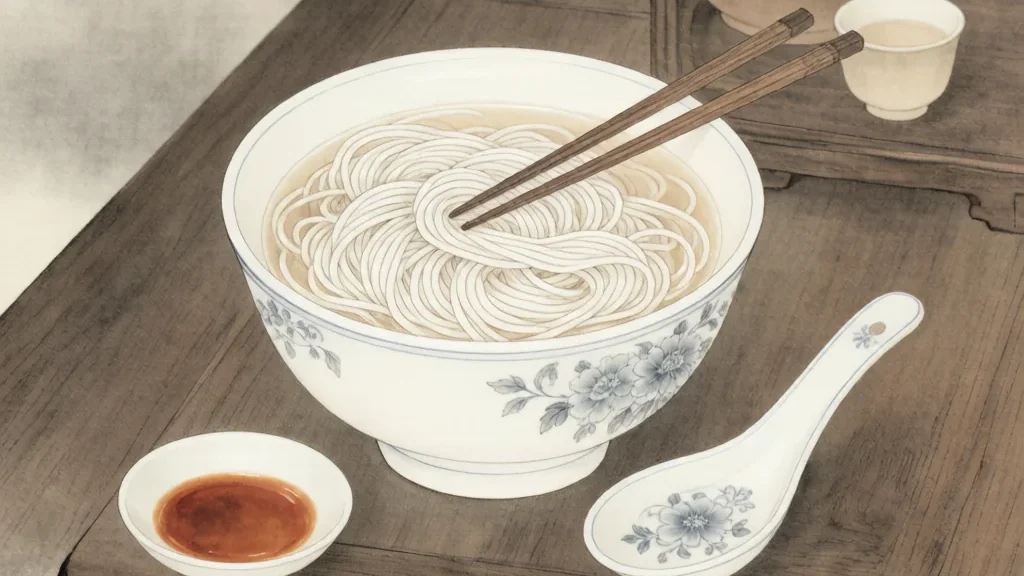
Mifen are Chinese rice noodles — thin, white strands made from rice flour and water, prized across southern China and the diaspora for their soft, slippery texture and their ability to carry broths and sauces. Unlike wheat noodles, mifen are gluten-free and uniquely southern, forming the backbone of breakfasts and suppers from Guangxi to Hunan to the overseas Chinatowns of Southeast Asia. They appear in many guises: a plain bowl of rice-noodle soup with clear broth, the famous Guilin mifen topped with fried peanuts and pickles, the pungent luosifen, or the dry-tossed "mixian" of Yunnan. As a humble, cheap, and endlessly adaptable staple, mifen is both everyday sustenance and a regional point of pride, with whole cities identifying themselves by their noodle style.
What Mifen Are
The term mi fen means "rice vermicelli" or "rice noodles," describing strands extruded from a batter of rice flour and water, steamed into sheets or pushed through a press, then cut or formed into threads and dried or kept fresh. Fresh mifen are soft and cook in moments; dried versions are rehydrated before use.
Because they are rice-based, mifen are naturally gluten-free and have a mild, clean taste that takes on the flavor of whatever broth or sauce they meet. Their delicacy contrasts with the chew of wheat lamian, making them a distinctly southern pleasure.
How Rice Noodles Are Made
Traditional production soaks rice, grinds it to a fine slurry, and either steams the batter into sheets that are rolled and cut, or presses the wet dough through holes to form strands that are briefly cooked and rinsed. The fresh noodles are then used at once or dried for storage.
The quality depends on rice variety and water; a slightly higher-amylose rice gives noodles that hold shape without turning mushy. Home and small-shop makers still use stone mills in some regions, valuing the smoother texture over industrial powder-based mixes.
Guangxi and Guilin Mifen
Guangxi province is the heartland of mifen, and Guilin mifen is its most celebrated export. Served in a clear, savory broth made from pork bones and sometimes cured meat, it is topped with fried peanuts, scallions, and a crucial spoonful of pickled long beans or mustard greens for sour crunch. Locals eat it for breakfast, often standing at a stall.
The dish is so identified with Guilin that the city is sometimes summed up by it. Vendors let customers choose additions, and a good bowl balances the mild noodle, rich broth, and sharp pickle — a template repeated across Guangxi with local tweaks.
Luosifen and Bold Flavors
Also from Guangxi — specifically Liuzhou — luosifen ("snail rice noodles") has exploded in popularity for its assertive character: a broth built on river snails and spices, topped with fermented bamboo shoots (suancai) whose funky aroma divides first-timers. Despite the name, the snails typically flavor the broth rather than appearing whole.
Luosifen's rise from regional curiosity to national craze, aided by instant-cup versions, shows how mifen can carry strong local identity into mass markets. Its acquired-taste aroma is part of the appeal for devotees, who prize the depth behind the funk.
Hunan and Other Southern Styles
Hunan's mifen are often served dry-tossed or in beef broth, reflecting the province's love of chili and preserved flavors; the city of Changsha is known for breakfast mifen with braised beef. Guangdong uses thin rice vermicelli in soups and with seafood, while Fujian's versions feed into cross-strait noodle culture.
Each region tunes the broth, topping, and width of the strand, so "mifen" covers a spectrum from delicate Viet-style threads to broader, chewier ribbons. The common thread is rice and a southern climate of eating.
Yunnan Mixian
In Yunnan, rice noodles are called mixian and treated as a daily staple. The famous "guoqiao mixian" (crossing-the-bridge rice noodles) is a DIY hot-pot style: a bowl of near-boiling broth arrives with separate plates of raw slices, which the diner slides in to cook at the table, then adds the noodles.
The legend of a scholar's wife carrying noodles across a bridge to feed her studying husband gives the dish its name and romance. Yunnan's ethnic diversity also yields many minority-style rice noodles, from sour to herbal, enriching the national picture.
Diaspora and Southeast Asia
Chinese migration carried mifen throughout Southeast Asia, where it merged with local tastes: in Vietnam it underlies pho and bun; in Thailand it appears in boat noodles and pad thai's rice-stick cousins; in Malaysia and Singapore it shows up in wanton soup and curry noodle stalls. The rice noodle is thus a shared substrate of regional Asian cuisines.
In Western Chinatowns, mifen soup is a comfort breakfast and late-night food, often paired with youtiao. Its gluten-free nature has also boosted its popularity among health-conscious diners outside Asia.
Cultural and Daily Role
Mifen is above all a people's food: cheap, fast, and filling, eaten at dawn by workers and at midnight by students. It marks regional belonging — to be from Guilin or Liuzhou is partly to eat a certain noodle — and it travels as nostalgia for the diaspora.
Festivals and family trips home often revolve around a bowl from a favorite stall, so the noodle carries memory as much as nutrition. Its simplicity is its strength: a blank rice canvas for local flavor.
Nutrition and Modern Forms
Rice noodles are mostly easily digested carbohydrate, low in fat and (unless enriched) modest in protein, making them gentle on the stomach — a reason they suit breakfast and convalescence. Toppings and broth add the rest of the meal's nutrition.
Today mifen spans fresh-market and instant formats; luosifen cups and Guilin mifen packets let anyone recreate regional bowls at home. Despite industrialization, the fresh-stall original remains the gold standard for texture and broth depth.
❓ Frequently Asked Questions
What are mifen?
They are Chinese rice noodles made from rice flour and water, soft and gluten-free, used in soups and tossed dishes.
Are mifen gluten-free?
Yes, because they are made from rice rather than wheat, they contain no gluten.
What is the difference between mifen and lamian?
Mifen are rice-based and delicate; lamian are wheat noodles that are hand-pulled and chewier.
What is Guilin mifen?
A Guangxi rice-noodle soup in clear broth topped with fried peanuts and pickled vegetables, eaten for breakfast.
What is luosifen?
A Liuzhou snail rice noodle whose broth is flavored with river snails and funky fermented bamboo shoots.
How are rice noodles made?
Rice is soaked, ground to a slurry, steamed into sheets or pressed into strands, then cut, cooked, and dried or used fresh.