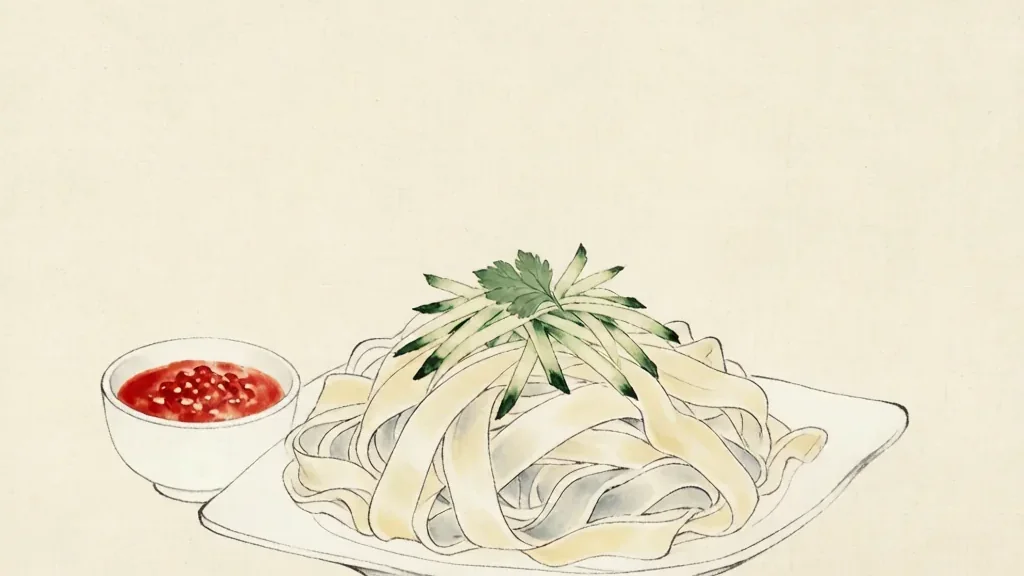
Liangpi, literally "cold skin," is a cold noodle dish from the northwestern Chinese province of Shaanxi that has spread to become a summertime staple across the country. Made from wheat flour or sometimes starch, the sheets are steamed, cooled, and cut into ribbons, then dressed with a savory, aromatic sauce built on black vinegar, garlic water, chili oil, and a distinctive nutty-sweet fermented wheat paste. Chewy, slippery, and refreshingly cool, liangpi is eaten as a light meal or snack, prized above all for the textural contrast between the springy noodles and the bright, pungent dressing. Though humble in origin, it is now found everywhere from street carts to upscale restaurants, and regional variations reveal much about local taste.
Origins in Shaanxi
Liangpi is traditionally traced to the Guanzhong plain of central Shaanxi, the heartland around the old capital of Chang'an, where wheat has been the dominant grain for millennia. The dish is closely associated with the city of Hanzhong in southern Shaanxi as well as with Xi'an, the provincial capital. Folk accounts often link its creation to the height of summer, when cooks sought ways to make wheat palatable without hot soup, and to the practical need to feed laborers and travelers a portable, refreshing meal.
The name "cold skin" is evocative rather than literal: the noodle has no skin, but its smooth, pale surface and cool serving temperature gave rise to the poetic label. Historical records of cold-prepared wheat foods appear in various forms across northern China, but the seasoned, sauced version recognizable today coalesced as a regional specialty of the Shaanxi culinary world.
How Liangpi Is Made
The traditional method begins with a soft wheat-flour dough that is kneaded and then washed in water to separate the gluten from the starch, much like the process for making gluten (mianjin) and starch noodles. The starchy water is left to settle, the clear liquid poured off, and the remaining paste steamed in shallow trays to form opaque sheets. After cooling, the sheets are rolled and cut into broad ribbons.
In the "steamed" style, the gluten portion is also cooked and added as chewy nuggets. A shortcut "flour-washed" or blended-starch method uses starch directly to skip the long washing step, while commercially produced dried liangpi can simply be rehydrated. Each approach yields a slightly different bite, but all rely on the same balance of springiness and sauce absorption.
Major Regional Styles
Shaanxi alone boasts several named styles. "Hanzhong liangpi" is often made with a touch of rice or a finer starch and dressed lightly. "Qishan liangpi" from the Qishan area is known for a more pronounced vinegar sharpness and the use of local lacquer-tree sauce. "Majiang liangpi" is mixed with a sesame paste (majiang) that lends a creamy, nutty body to the bowl.
Beyond Shaanxi, the dish has been adapted widely. In Gansu and Ningxia it is common with extra garlic and cumin notes; in Beijing and the northeast it appears as a cooling counterpoint to heavy winter food; and in the south, rice-based versions approximate the texture for those more accustomed to rice than wheat.
The Signature Sauce
What truly defines liangpi is not the noodle but the sauce. A proper bowl layers several components: a spoonful of black vinegar for sourness, garlic water for pungency, salt, a little sugar, sometimes soy, and crucially chili oil (la you) infused with spices that glows red without necessarily being fiery. The "secret" in many shops is the addition of a fermented wheat or malt syrup paste that gives a gentle sweetness and sheen.
Good chili oil is prepared by slowly heating oil with star anise, cassia, Sichuan pepper, and dried chilies so the fat carries aroma rather than raw heat. The cook tosses the cut noodles with the gluten and vegetables, pours the sauce over, and mixes at the table so each strand is coated. The result should be tangy, garlicky, lightly sweet, and fragrant.
Serving and Accompaniments
Liangpi is almost always served cold or at room temperature, making it a quintessential summer dish, though it is eaten year-round. It is typically topped with shredded cucumber for crunch and often with blanched mung bean sprouts. Some versions add a few leaves of cilantro or a sprinkle of toasted sesame.
It is commonly sold as a street food portion in a shallow bowl or taken away in a plastic clamshell. Vendors frequently offer to adjust the spice and vinegar levels, and a bowl is often eaten alongside other cold snacks or a warm mantou. In restaurants it may be plated more elaborately but the flavor logic stays the same.
Cultural Place in Northwestern Food
Within Shaanxi cuisine, liangpi sits among a family of wheat preparations — biangbiang noodles, roujiamo, and paomo among them — that express the region's identity as a wheat-eating culture distinct from the rice south. It is a dish of everyday people, celebrated for being cheap, fast, and satisfying, yet it carries local pride.
During hot months, families across the northwest will buy liangpi from a familiar neighborhood shop rather than cook, and the dish features in descriptions of Xi'an's famous Muslim Quarter food street. It has become a symbol of the casual, bold flavors of the region for visitors.
Liangpi and Health Perceptions
Because it is served cold, lightly dressed, and plant-forward, liangpi is often regarded as a relatively light choice compared with fried or braised dishes. The wheat starch is mostly carbohydrate, while the garlic, vinegar, and chili bring modest metabolic and digestive associations in traditional Chinese food thinking, where cooling foods are balanced against warming ones in summer.
Nutritionally the dish is moderate in calories but low in protein unless the gluten nuggets are included. Modern health-minded vendors sometimes add more vegetables or reduce oil, though purists argue the sauce is non-negotiable. Either way, it occupies a niche as a refreshing, not heavy, meal.
Modern Popularity and Spread
From the 1990s onward, migration and the rise of Chinese restaurant culture carried liangpi to major cities worldwide, especially wherever Shaanxi and Gansu diaspora settled. Pre-made refrigerated liangpi now appears in Asian supermarkets, and recipe videos online have taught home cooks the washing-and-steaming technique.
It has also inspired fusion presentations, such as liangpi salads with avocado or in deconstructed restaurant plates, though the classic street version remains the reference point. Food tourists listing "must-eats" in Xi'an almost invariably include it, securing its place in the national imagination as a representative cold noodle.
Making Liangpi at Home
Home preparation rewards patience. A common approach is to mix wheat starch with a little flour and water into a thin batter, then steam it in an oiled plate set over boiling water until opaque, repeating to build several sheets. After cooling, the sheets are cut into ribbons and dressed.
The key home challenges are achieving the right thickness and not skimping on the sauce. Many cooks prepare a batch of chili oil in advance, since the same oil elevates noodles, dumplings, and cold dishes across the kitchen. With a settled batter and a good sauce, a convincing liangpi is well within reach of an amateur cook.
❓ Frequently Asked Questions
What is liangpi made from?
Traditionally it is made from wheat flour that is washed to separate starch, which is then steamed into sheets and cut into ribbons. Some versions use rice or pure starch.
Is liangpi served hot or cold?
It is served cold or at room temperature, which is why it is especially popular in summer as a refreshing meal.
Is liangpi very spicy?
It can be adjusted to taste. The chili oil is aromatic and red but not always fiery; you can ask for more or less heat.
Where does liangpi come from?
It originates in Shaanxi province in northwestern China, particularly associated with Xi'an and Hanzhong.
What does liangpi taste like?
It is tangy from vinegar, pungent from garlic, lightly sweet from fermented paste, and fragrant from chili oil, with a chewy texture.
Can I make liangpi at home?
Yes. A common method steams a thin wheat-starch batter into sheets, which are then cooled, cut, and dressed with the sauce.