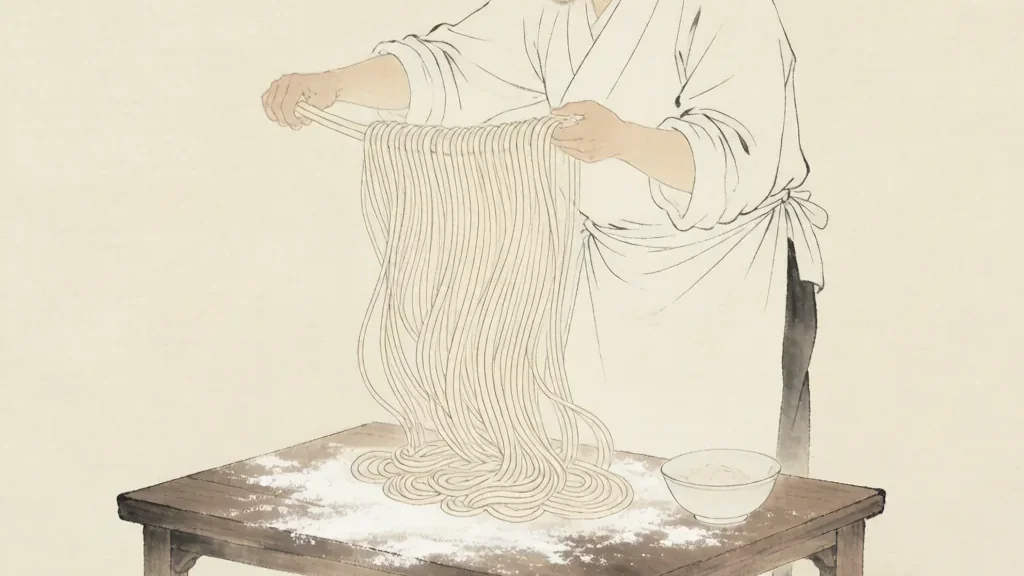
There is perhaps no dish in China that turns cooking into theater quite like 拉面 (), the hand-pulled noodle. Watch a skilled cook and you see a rope of dough lifted, slapped, and stretched into thinner and thinner strands until it becomes a cascade of noodles dancing through the air. Born on the windswept plains of the northwest, lamian is more than a meal; it is a demonstration of skill passed from master to apprentice, a proof that flour and water, handled with knowledge, can become something extraordinary. For travelers along the ancient Silk Road, a bowl of lamian was warmth, protein, and wonder in a single bowl.
What Makes a Noodle "Hand-Pulled"
Lamian begins not with a machine but with a single lump of dough made from wheat flour, water, and a small amount of salt and sometimes alkali (often in the form of 蓬灰, , a mineral-rich ash). The alkali gives the dough its characteristic elasticity and a faint yellow tint, and it is the secret that lets the strands stretch without breaking. The cook repeatedly folds and pulls the dough, each pass doubling the number of strands, until the desired thickness is reached.
A master can produce strands from thick as a chopstick to thin as hair, and the number of folds determines the name: for example, "one thin" or "two thin" and even "threads of dragon beard." The whole performance takes seconds and ends with the noodles dropped directly into boiling broth. Because they are pulled, not cut, lamian has a unique rounded cross-section and a pleasantly chewy bite that machine-extruded noodles struggle to match.
Origins on the Silk Road
Hand-pulled noodles are most associated with the Hui (Chinese Muslim) communities of Gansu and Qinghai, especially the city of Lanzhou, home of the famous 兰州牛肉面 (). The technique likely traveled along the Silk Road, influenced by Central Asian noodle traditions, and took root where wheat and mutton were staples. Muslim vendors refined it into a halal dish, using beef or lamb and avoiding pork.
From the northwest, lamian spread across China and into the wider world through Hui migrant cooks who opened tiny noodle shops in every major city. By the twentieth century, the sight of a lamian master at the window had become a fixture of Chinese street food. The dish's portability of skill — a cook needs only dough, a board, and a pot — helped it travel farther than almost any other regional specialty.
Lanzhou Beef Lamian
The most iconic version is Lanzhou lamian: a clear, beef-bone broth, hand-pulled noodles, a few slices of poached beef, a spoonful of chili oil, and a handful of cilantro and scallion. Tradition holds that the bowl should show "one clear, two white, three red, four green, five yellow" — the clear soup, white radish, red chili oil, green herbs, and yellow noodles. The broth is simmered for hours with spices like star anise and cassia bark.
What makes Lanzhou lamian special is balance. The noodles are ordered by thickness, from "capillary" to "wide belt," and cooked for mere seconds so they stay springy. Diners often add black vinegar and more chili to taste. A proper bowl is light yet deeply savory, neither greasy nor heavy, which is why it is eaten at any hour — for breakfast, lunch, or a late-night snack — across China.
Regional and Muslim Variations
Beyond Lanzhou, the northwest offers lamian in hearty mutton broth with cumin and dried chili, reflecting the region's love of lamb and spice. In Xinjiang, the Uyghur 拉条子 () is a related pulled noodle stir-fried with mutton, tomatoes, and green peppers. Hui cooks elsewhere fold in pickled vegetables or serve the noodles dry with a meat sauce.
Because lamian culture is halal, it introduced many Han Chinese to beef as a noodle topping and to the clean, spice-forward flavors of northwestern Islamic cooking. Today you can find lamian shops run by Hui families in nearly every Chinese city, each guarding its broth recipe like a family heirloom. The dish thus became a quiet ambassador of China's Muslim communities to the national palate.
The Craft of the Pull
Becoming a lamian master takes years. Apprentices begin by learning to knead dough to the exact feel — too dry and it tears, too wet and it sticks. They practice the rhythm of the pull: lift, stretch, fold, slap, repeat. The "slap" against the counter is not for show; it shakes out air and aligns the gluten. A cook must judge by touch when the dough is ready and how many pulls it needs.
Modern shops sometimes use a helping machine to mix dough, but the final pull remains human. Watching it, customers trust the freshness: the noodles they eat were literally made to order, seconds before cooking. This transparency is part of lamian's charm and a reason the open kitchen, with the cook flinging dough, remains the genre's signature stage.
Lamian Beyond China
Chinese migrants carried lamian to Japan, where it evolved into ramen; to Central Asia; and to Chinatowns worldwide. In cities from London to Los Angeles, Lanzhou beef noodle shops now draw lines of customers eager for an authentic bowl. The dish has even inspired theatrical "noodle pulls" at food festivals, where cooks stretch a single dough into the longest strand possible.
Yet for all its global fame, lamian stays rooted in simplicity: flour, water, salt, and a cook's two hands. It is a reminder that Chinese cuisine values not only ingredients but technique — the human skill that transforms the ordinary into the unforgettable. A bowl of lamian is, in the end, a small monument to patience, strength, and the long road that brought it to your table.
The Five-Color Standard Bowl
A proper Lanzhou beef lamian is judged by a simple color code: one clear, two white, three red, four green, five yellow. The clear broth comes from hours of simmering beef bone with spices, the white from tender radish slices, the red from chili oil, the green from cilantro and scallion, and the yellow from the alkaline-tinged noodles themselves. This formula is more than description; it is a quality check that diners and cooks both use, ensuring no element is missing. The balance is deliberate, light yet deeply savory, never greasy. Customers fine-tune it at the table with black vinegar and extra chili, but the five colors set the baseline. Because the standard is so widely known, even a stranger to northwestern China can recognize an authentic bowl on sight, which helps the dish keep its identity as it spreads from Lanzhou to every major city.
Lamian in the Street and Abroad
The genius of lamian is that it travels on skill alone. A cook needs only dough, a board, and a pot, so Hui migrant vendors carried it from Gansu and Qinghai to cities across China and onward to Chinatowns worldwide. In London, Los Angeles, and Sydney, Lanzhou beef noodle shops now draw long lines, and food festivals stage theatrical pulls that stretch a single dough to record lengths. The dish also reached Japan centuries ago, where it evolved into ramen, a separate tradition with its own broths and toppings. What keeps lamian rooted is its honesty: flour, water, salt, and two human hands. Even as machines mix the dough, the final pull remains a person's craft, performed in an open kitchen where customers watch their noodles being born seconds before they are cooked. That transparency is the genre's enduring charm.
❓ Frequently Asked Questions
📝 Chinese Vocabulary
拉面 — : hand-pulled noodles.
兰州牛肉面 — : Lanzhou beef noodle soup.
蓬灰 — : alkaline ash used in dough.
拉条子 — : Xinjiang pulled noodles, often stir-fried.
清真 — : halal (Islamic dietary).
抻面 — : another term for hand-pulled noodles
辣椒油 — : chili oil, the red element of a Lanzhou bowl
拉面师傅 — : the lamian master who pulls the dough by hand
🎉 Fun Facts
- A single piece of lamian dough can be pulled into thousands of strands through repeated folding.
- The "slap" of dough on the board aligns gluten and is essential, not just for show.
- Lanzhou beef noodle soup is judged by "one clear, two white, three red, four green, five yellow."
- Ramen in Japan grew out of Chinese wheat-noodle traditions including lamian.
- Lamian shops run by Hui families guard their broth recipes like heirlooms, often passed down through generations.
- In Xinjiang the related pulled noodle called latiaozi is commonly stir-fried with mutton, tomatoes, and green peppers rather than served in soup.