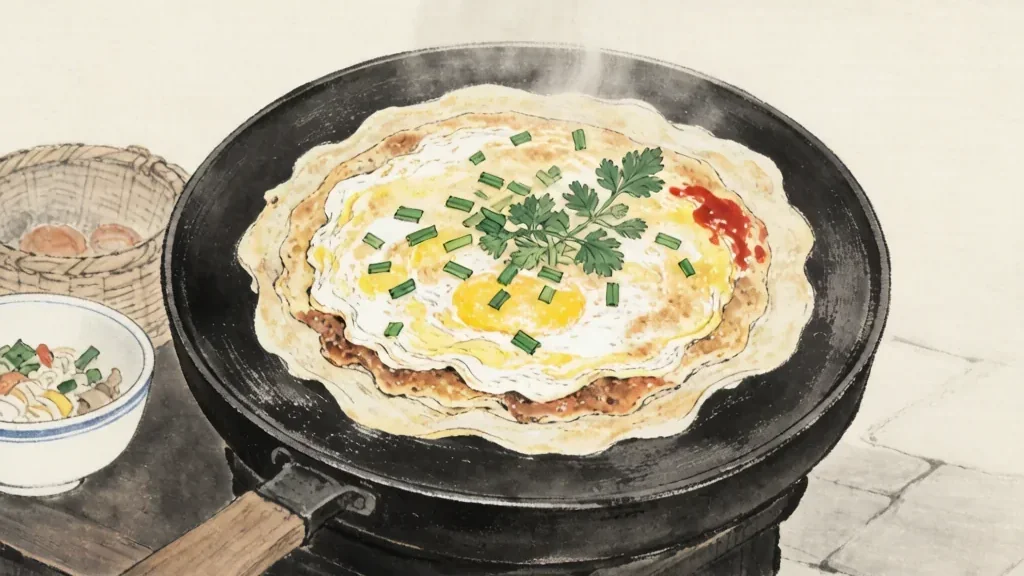
At a Beijing street corner at seven in the morning, a vendor spreads a pale batter onto a sizzling griddle in one fluid circular motion, cracks an egg over it, sprinkles scallions and cilantro, flips it, brushes on sweet bean sauce, and folds it into a warm parcel — within ninety seconds you hold a jiān bǐng (煎饼), China's savory breakfast crepe. The name means "fried pancake," but the result is closer to a crispy-edged, egg-topped wrap that puts many Western breakfast sandwiches to shame. Eaten hot from the griddle, jianbing is the fuel of commuters from Tianjin to Shanghai, a portable, customizable, and deeply satisfying start to the day. It is also a perfect example of northern Chinese street food at its most choreographic and efficient.
What Is Jianbing?
Jianbing is a thin crepe made from a batter of mung bean flour and wheat flour (sometimes with millet), cooked on a flat griddle, then topped with egg, scallions, cilantro, and a crisp fried cracker (bàocuì or guōbēi), and seasoned with sweet bean sauce (tiánmiànjiàng), chili sauce, and sometimes hoisin. The cook folds it into a rectangular packet you hold in paper. The texture is the magic: a tender-eggy top over a lacy, slightly crisp crepe, with a crunchy strip running through the middle from the fried cracker.
Though called a pancake, jianbing is closer to a French crêpe in thinness, but distinctly Chinese in flavor — savory, slightly sweet from the sauce, aromatic from the herbs. It is eaten immediately while hot and crisp; within minutes the cracker softens and the magic fades. This perishability is part of its street-food identity: a jianbing is made for the moment, not for later.
Origins in Shandong and Tianjin
Jianbing is said to originate in Shandong province, with a popular legend placing its invention in the Tianjin area during a time of famine, when a clever cook fed soldiers by spreading batter on a shield over a fire — making a quick, filling flatbread. Whether or not the legend is true, the dish became firmly associated with Tianjin and Shandong before spreading to Beijing and nationwide. The mung bean component reflects the north's love of bean-based batters for their light, crisp quality.
By the late twentieth century, jianbing stalls were fixtures of northern cities, feeding workers who needed a hot, cheap, handheld breakfast. The format proved endlessly scalable: a single griddle and a batter bucket could serve a queue in minutes. Its migration southward and abroad has made jianbing one of the most recognized Chinese street foods, even inspiring "jianbing burritos" in Western cities — a testament to its portable appeal.
The Batter and the Griddle
The foundation is the batter, traditionally a blend of mung bean flour and wheat (or millet) flour thinned with water to a pourable consistency. Mung bean flour gives the crepe its characteristic lacy, crisp edges and a subtle nutty flavor; wheat adds structure. The cook ladles a scoop onto the oiled griddle and spreads it with a bamboo or metal "comb" (a t-shaped scraper) into a perfect circle — a skill that looks easy and is not.
Heat control is crucial. The griddle must be hot enough to set the batter quickly into lace but not so hot that it burns before the egg goes on. After the egg is cracked and spread, the crepe is flipped so the egg side cooks against the griddle, then flipped back to apply sauces and fillings on the cooked surface. The whole ballet takes under two minutes and is repeated dozens of times each morning by a busy vendor.
Fillings and the Crunch
The signature filling is the bàocuì (also called guōbēi), a thin, bubbly sheet of fried dough that shatters when you bite the finished jianbing, providing the essential crunch. Without it, a jianbing feels incomplete. On top go scallions and cilantro for freshness, and the sauces — sweet bean sauce as the base, chili sauce for heat, sometimes hoisin or sesame paste — are brushed in streaks across the surface before folding.
Variations exist by region and vendor. Some add lettuce, pickled vegetables, or a different cracker; Tianjin-style is considered the benchmark. The balance is key: too much sauce and it goes soggy, too little and it tastes flat. A great jianbing balances egg richness, herb brightness, sauce sweetness, and cracker crunch in every bite — a small engineering feat performed on a street corner.
How to Eat Jianbing
Jianbing is eaten standing up, immediately, with both hands, the paper wrapper keeping the heat in. You bite through the folded packet so you get egg, crepe, sauce, and cracker together. Because it is handheld and substantial, it doubles as breakfast and a commute companion. Pair it with a cup of soy milk or a warm soybean drink, and you have a classic northern Chinese morning.
The etiquette is simply speed. Order, watch the performance, take the packet, and eat within a block's walk. Trying to save it for later disappoints, as the cracker softens and the crepe steams itself limp. This immediacy is part of the pleasure: a jianbing is a fresh, hot, personal transaction between cook and eater, renewed with every order.
Jianbing Goes Global
In the past decade, jianbing has broken out of China, appearing at food trucks and fast-casual spots in New York, London, and beyond, sometimes with fusion fillings like roast duck or avocado. Purists grumble, but the adaptations testify to the format's strength: a customizable, freshly cooked wrap is universal. The basic equation — crisp crepe, egg, sauce, crunch — translates across cultures.
For travelers to China, a street jianbing is a must-try, ideally from a stall with a long local queue. It distills northern Chinese street culture into one handheld item: fast, cheap, hot, and made to order. Whether eaten in a Tianjin alley or a Brooklyn truck, the jianbing remains a small monument to the art of the quick, savory breakfast.
Jianbing as a Northern Breakfast
In northern Chinese cities, jianbing is the default morning food for commuters who need something hot, cheap, and handheld. The stall appears at subway exits and street corners before the workday begins, and a single vendor can feed a long line in minutes with one griddle and a bucket of batter. Its appeal is speed and freshness: the crepe is made to order in under two minutes, then handed over still warm in paper. Pair it with soy milk and you have the classic northern morning. Unlike congee or buns, the jianbing feels like a performance as much as a meal, the cook's circular sweep and flip drawing a small crowd. That daily theater, repeated in every city, is why the crepe is so deeply tied to the idea of a Chinese breakfast on the go.
The Street Vendor's Craft
Making jianbing looks effortless but rests on practiced skill. The cook ladles batter, spreads it into a perfect circle with a bamboo scraper, cracks an egg, flips the crepe, brushes on sauces, lays in the crisp cracker and herbs, and folds it, all in about ninety seconds. Heat control is the quiet difficulty: the griddle must set the batter into lace without burning it before the egg goes on. The spread itself is the make-or-break moment, and newcomers tend to leave ragged edges or tears. Vendors who master the rhythm develop a loyal queue, because regulars can taste the difference between a evenly crisp crepe and a sloppy one. The craft is portable and low-cost, which is precisely why jianbing spread from Shandong and Tianjin to every corner of China and, eventually, to food trucks abroad.
❓ Frequently Asked Questions
📝 Chinese Vocabulary
煎饼 — : fried pancake / savory crepe.
薄脆 — : the crispy fried dough strip inside.
甜面酱 — : sweet bean sauce.
绿豆 — : mung bean, used in the batter.
摊 — : to spread (batter) / a street stall.
煎饼果子 — : the fuller Tianjin name for the egg-topped crepe
刮板 — : the scraper used to spread the batter into a thin circle
鸡蛋 — : egg, cracked on top to enrich the crepe
🎉 Fun Facts
- A skilled jianbing vendor can make a complete crepe in about 90 seconds, batter to folded packet.
- The mung bean in the batter gives jianbing its signature lacy, crisp edges.
- A legend credits jianbing's invention to a famine-era cook who fried batter on a soldier's shield over a fire.
- Outside China, jianbing has inspired fusion versions with duck, avocado, and other non-traditional fillings.
- Jianbing vendors often run a single griddle and a batter bucket, letting one cook serve a long queue in minutes.
- The egg spread on top not only adds richness but helps seal the crepe so the sauces do not soak through.