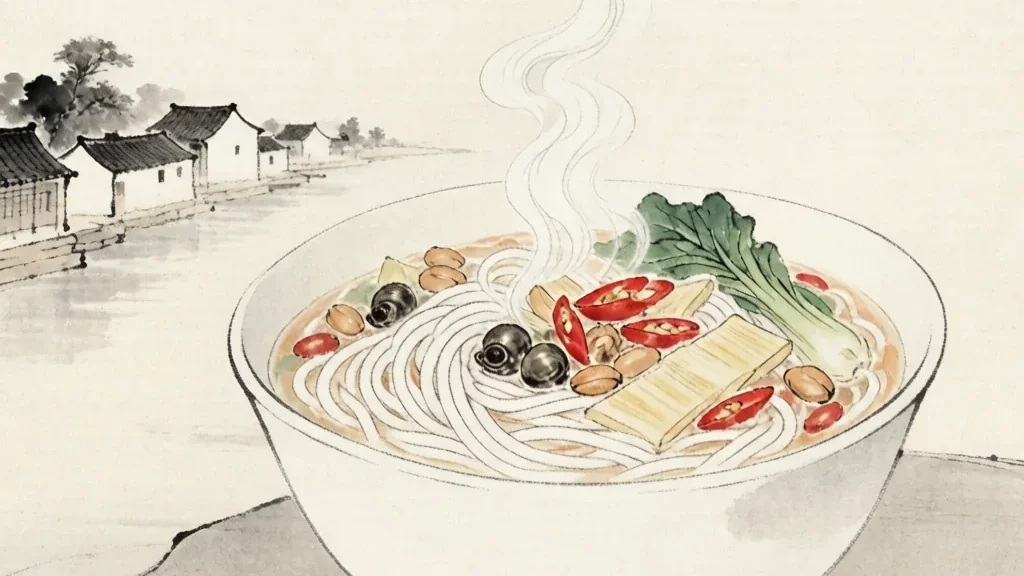
Some foods announce themselves before they are seen, and luó sī fěn (螺蛳粉) — the snail rice noodle soup of Liuzhou — is the undisputed champion of aromatic entrance. Steam rising from a bowl carries a funk that has launched a thousand jokes and a great many addictions. The name means "river snail rice noodles," and the broth is built on simmered freshwater snails, but the dish's infamous odor comes from a fermented bamboo shoot called suāncài. Loved fiercely in its home city of Liuzhou in Guangxi and now a national sensation, luosifen is proof that in Chinese food, "smells strong" and "tastes amazing" are not contradictions. It is a lesson in how fermentation creates flavor that plain ingredients never could.
Where Luosifen Comes From
Luosifen is the signature dish of Liuzhou, a city in the Guangxi Zhuang Autonomous Region in southern China, where the Liu River supplies abundant freshwater snails. The dish rose to local prominence in the late 1970s and 1980s as a late-night street food, sold from small stalls to workers and students. Its combination of cheap river snails, rice noodles, and preserved vegetables suited a working city with a love of bold, sour flavors. For decades it remained a regional secret, beloved by Liuzhou residents who carried the taste with them wherever they moved.
The turning point came in the 2010s, when instant packaged luosifen made the dish shippable across China, and a wave of food broadcasts and social media turned its notorious smell into a viral marketing asset. Liuzhou municipal authorities embraced it, setting standards for the packaged product and promoting the city as the home of luosifen. In 2020, the dish's preparation was listed among Guangxi's provincial intangible cultural heritage, cementing its status from humble street snack to cultural icon.
The Snail Broth
The soul of luosifen is its broth, traditionally made by simmering river snails (often with pork bones) for hours with ginger, scallion, and a mix of spices. The snails lend a deep, mineral savoriness that forms the backbone of the soup. Importantly, the snails themselves are usually strained out; the broth carries their essence while the bowl is topped with other proteins. Some versions keep a few snails in the bowl, but the liquid is where the snail work pays off.
What makes the broth sing, though, is balance. A good luosifen broth is salty, slightly sweet from the bones, and rounded by the acidity of the fermented vegetables. It is not merely "fishy" — when made well it is clean and savory, with the snail providing umami rather than a heavy seafood note. The skill of a luosifen cook lies in taming the raw snail edge into something comforting, a process that rewards patience more than expensive ingredients.
The Famous Funk: Suan Cai and Peanuts
The odor that defines luosifen comes largely from suāncài (酸笋), bamboo shoots fermented in water until they develop a sharp, sour, almost barnyard aroma. To the uninitiated this smell is shocking; to devotees it is the perfume of home. The fermented bamboo is not merely for scent — it cuts the richness of the broth and adds a crunchy, tangy counterpoint to the soft noodles. Removing it would leave a competent but soulless soup.
Around the suancai sit the other toppings that complete the bowl: fried peanuts for crunch, crisp yuba (tofu skin) or fried tofu puffs, shredded wood ear mushrooms, fresh cilantro, and often a few pieces of duck feet, pig trotters, or luó sī (snails) for the adventurous. A spoonful of red chili oil is almost mandatory, lending heat that plays against the sour. The assembly is layered and deliberate, each element chosen for a contrasting texture or taste.
The Noodles and the Eating Ritual
Luosifen uses round, chewy rice noodles (mǐfěn), distinct from wheat noodles, with a springy bite that holds up in hot broth. They are cooked separately and dropped into the bowl before the broth is poured over. The noodles should be slippery but resilient, never mushy — a sign of proper rice-flour formulation and careful timing. In instant versions, the noodles are pre-cooked and dried, then rehydrated in boiling water.
Eating luosifen is a full-sensory event. You slurp the noodles, crunch the peanuts, and sip the broth, adjusting with extra chili oil or vinegar on the side. The ritual in Liuzhou often happens at night, at a roadside stall with friends, the funk hanging cheerfully in the air. First-timers are advised to push through the initial smell; the second spoonful usually converts them, and the "stinky but delicious" paradox becomes clear.
Instant Luosifen and Going National
The packaged instant luosifen boom transformed the dish from a local specialty into a pantry staple across China and among the Chinese diaspora. Factories in Liuzhou standardized the components — dried noodles, seasoning packets, dehydrated suancai, peanuts, and chili oil — so that anyone could approximate the street-stall experience at home. Sales exploded during the early 2020s, with the industry valued in the tens of billions of yuan, and Liuzhou became a destination for food pilgrims.
This commercial success brought scrutiny and pride in equal measure. The city published a local standard for "Liuzhou luosifen" to protect authenticity, and producers compete on broth quality and the pungency of their suancai. For travelers, the instant pack is a convenient introduction, but aficionados insist the fresh-stall version — with its fuller broth and crisp toppings — remains the real thing. Either way, luosifen has earned its place among China's most distinctive regional foods.
Why the Smell Is Worth It
To outsiders, the reputation of luosifen can be a barrier. But Chinese food culture is full of prized "stinky" delicacies — fermented tofu, stinky tofu, and certain cheeses among them — where fermentation is valued precisely because it transforms. The funk of luosifen is a feature, not a flaw, signaling live, complex flavor. Learning to enjoy it is like acquiring a taste for blue cheese or natto: a small cultural door opens.
For the people of Liuzhou, luosifen is identity and comfort, a taste of home that travels in a packet. For the curious eater, it is a delicious challenge and a story to tell. The dish reminds us that the most memorable foods are rarely the most polite, and that a strong first impression can hide a deeply satisfying one.
Luosifen and the Culture of Stinky Foods
China has a long, proud tradition of beloved foods that smell challenging to the uninitiated, and luosifen sits at the friendly end of this family. Fermented tofu, stinky tofu, and certain preserved vegetables share the same logic: controlled fermentation creates complex, savory depth that plain fresh ingredients cannot. Rather than a flaw, the odor is read as proof of living flavor and skilled preparation. This cultural comfort with strong smells helps explain why luosifen conquered the nation instead of repelling it. For many eaters, the first encounter is a small adventure, and the reward is a rich, sour, savory bowl that lingers in memory. Understanding luosifen means understanding that in Chinese food culture, a bold smell is often a promise, not a warning.
Ordering Luosifen Like a Local
Ordering luosifen is a small act of customization. At a Liuzhou stall you choose your portion size and then fine-tune the bowl: ask for extra suancai if you love the funk, less chili if you prefer sour over fire, and add-ins such as a braised egg, duck feet, or extra peanuts. The cook ladles broth to order, so the same dish arrives differently for each person. First-timers are often advised to start mild, then adjust next time. Eating is hands-on and noisy: slurp the noodles, crunch the peanuts, sip the broth, and dab on extra vinegar or chili from the side condiments. Whether at a roadside stall late at night or from a packaged instant version at home, the ritual is the same: build it your way and enjoy the mess.
❓ Frequently Asked Questions
📝 Chinese Vocabulary
螺蛳粉 — : river snail rice noodle soup.
酸笋 — : fermented bamboo shoots, source of the signature aroma.
米粉 — : rice noodles.
螺蛳 — : river snail.
柳州 — : the city in Guangxi where the dish originated.
柳江 — : The Liu River of Liuzhou, source of the freshwater snails used in the broth.
酸辣 — : Sour and spicy, the defining flavor balance of the dish.
广西 — : Guangxi Zhuang Autonomous Region, the province where luosifen originated.
🎉 Fun Facts
- Luosifen's preparation was added to Guangxi's intangible cultural heritage list in 2020.
- The packaged instant version turned the dish into a multi-billion-yuan industry, with Liuzhou setting official quality standards.
- The infamous smell comes from fermented bamboo shoots, not the snails.
- Liuzhou built a museum dedicated to luosifen, celebrating the city's most famous export.
- During the early 2020s, instant luosifen became a surprise export hit, with overseas Chinese students and food fans ordering it worldwide, briefly causing domestic shortages in China.
- In Liuzhou, luosifen is treated as an everyday staple eaten at any meal, and many locals joke that a day without it feels incomplete.