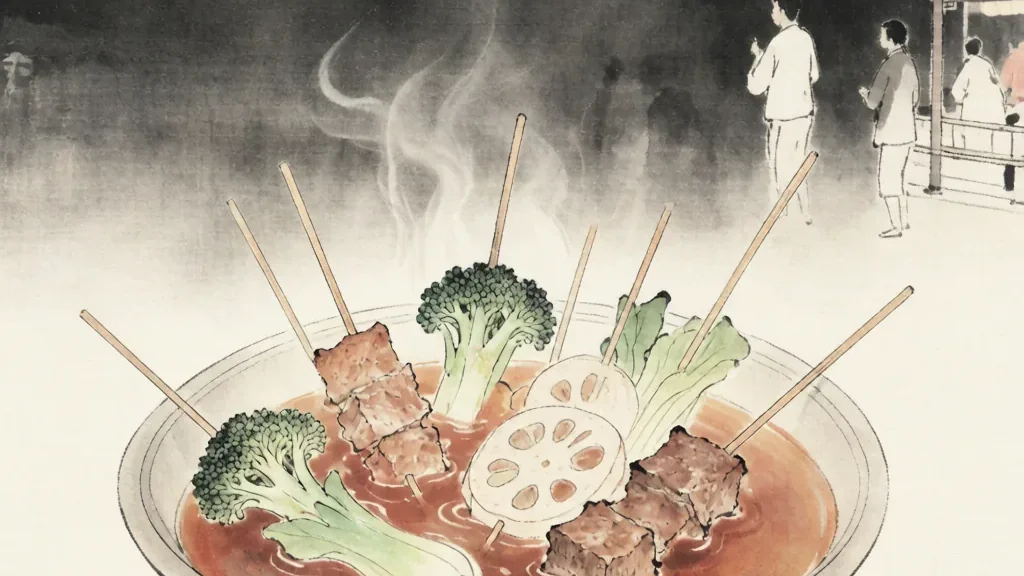
Walk into any Chinese food street in the evening and you will likely meet a steamy, fragrant cloud rising from a row of simmering pots — that is má là tàng (麻辣烫), the "numbing-spicy hot broth" that turns choosing dinner into a hands-on game. The name says it plainly: má (numbing) from Sichuan peppercorn, là (spicy) from chili, and tàng (hot, both in temperature and in the broth sense). Unlike a fixed recipe dish, malatang is built by the eater, who picks ingredients from a display, watches them cooked in a shared spicy broth, and pays by weight. It is fast food, comfort food, and a social ritual all at once, and it reveals a great deal about how Chinese casual dining balances personal choice with bold, shared flavor.
What Is Malatang?
Malatang is a customizable street dish: you select raw ingredients — vegetables, tofu products, meats, offal, noodles, and meatballs — from a refrigerated case, and the cook blanches or simmers them in a central pot of numbing-spicy broth. The cooked items are lifted out, placed in a bowl, and ladled with more broth and seasoning. You eat it with chopsticks from the bowl, drinking the broth at the end. In its home region of Sichuan and Chongqing, the broth is ferociously spicy; in northern China it is often tamed with milder seasoning and more sesame or tomato.
The genius of malatang is that a single pot serves infinite combinations. A vegetarian gets the same broth as a meat eater; a spice lover and a cautious eater can both be satisfied because the broth is shared but the chosen ingredients differ. This makes it ideal for groups and for indecisive diners. The dish is usually priced by the weight of the selected raw items, so you control both the content and the cost of your meal.
Roots in Sichuan and Chongqing
Malatang grew out of the dock culture of the Yangtze River, particularly around Chongqing, where boatmen and laborers needed cheap, hot, filling food that could be eaten quickly. A related origin story ties it to má là huǒguō (numbing-spicy hotpot): vendors would sell single portions of hotpot-style ingredients to workers who could not afford a full table hotpot. Malatang is essentially "hotpot for one," assembled à la carte rather than communally.
The dish spread northward and eastward over the past few decades, mutating as it traveled. In northeastern cities it absorbed local tastes, becoming soupier and less fiery, sometimes with a milky bone broth base. Today malatang chains operate across China and abroad, but the soul remains: a hot, spicy, personal bowl drawn from a communal pot. Its working-class origins are part of its charm — it has never pretended to be refined.
The Broth and the Spice
The broth is the heart of malatang. A traditional Sichuan base starts with beef or pork bone stock, into which go chili, Sichuan peppercorn, doubanjiang (fermented chili bean paste), and a bouquet of aromatics like ginger, garlic, and star anise. Some shops keep a perpetual master broth, topping it up daily, much like a stockpot that gains depth over time. The defining sensation is má là: the chili brings heat, the huājiāo brings a citrusy, tingling numbness that is not pain but a gentle electric buzz.
Modern shops often offer a choice of broth strengths and even non-spicy options (such as tomato or mushroom) for those who want the format without the fire. But the canonical malatang broth is red, oily, and fragrant enough to announce itself from across the street. The spices are not merely for heat; they are chosen to stimulate appetite and, in traditional Chinese food logic, to warm the body in cold weather.
Choosing Your Ingredients
The ingredient spread is where malatang becomes personal. Common choices include leafy greens, lotus root slices, wood ear mushrooms, tofu skin, fried tofu puffs, kelp, quail eggs, fish balls, beef rolls, and various noodles. In Sichuan, you might also find tripe, squid, and other offal; in the north, more processed meats and dairy-based items appear. The trick is balance: a mix of something crunchy (lotus root), something spongy (tofu puff), something green, and something protein-rich.
Because everything cooks in the same broth, the ingredients absorb the spice and aroma, unifying the bowl. Noodles or wide vermicelli are often added last so they soak up the liquid. A well-built malatang has variety in texture as well as flavor — the cook's only job is to time each item so nothing overcooks, which is why experienced malatang cooks work with remarkable speed during the dinner rush.
How Malatang Is Served and Eaten
After you pick your items (often in a basket or on a tray), the cook weighs them, drops them into the boiling broth in a mesh ladle, and times the cook. Out they come into a bowl, finished with a ladle of broth, a drizzle of chili oil, and sometimes sesame paste, crushed peanuts, or cilantro. You carry the bowl to a seat and eat immediately while hot. Many shops also offer a "dry" version where the ingredients are tossed in mala sauce rather than served in broth.
Eating malatang is informal and tactile. There is no etiquette of courses; you simply fish out what you want, sip the broth between bites, and sweat a little. It is the kind of meal that ends with a satisfied looseness of collar and a cleared sinus. For many Chinese students and workers, a bowl of malatang is the ultimate cheap comfort after a long day.
Malatang Versus Hotpot
The line between malatang and hotpot is thin but real. Hotpot is a shared table experience: a pot of broth in the center, diners cooking their own selections over time, lingering for hours. Malatang is individual, fast, and cooked by the staff in a matter of minutes. Think of malatang as hotpot's quick, solo cousin — same flavor world, different social tempo. Both rely on the má là broth, but malatang trades ceremony for convenience.
This distinction matters for travelers. If you want a leisurely group meal, hotpot is the choice; if you want a personal, filling, spicy bowl on a budget, malatang delivers. Increasingly, franchises blur the two, offering malatang that you then "upgrade" with hotpot-style dipping sauces. Either way, the numbing-spicy broth is the star that ties the family of dishes together.
The Numbing Mystery of Sichuan Pepper
The ma in malatang comes from Sichuan peppercorn, a spice that is not actually related to chili and produces no heat. Instead it delivers a tingling, almost electric numbness across the lips and tongue, caused by compounds that briefly scramble the nerve signals for touch. This sensation is prized in Sichuan cooking precisely because it makes the mouth feel alive without burning, letting the chili's heat and the broth's savor come through clearly. Many first-time eaters are surprised that the spicy feeling has two separate sources: the chili's burn and the peppercorn's buzz. Understanding this split is the key to enjoying malatang, where the goal is a balanced dance of numbing and spicy rather than mere fire.
Malatang Across China and Abroad
As malatang traveled from Sichuan and Chongqing, it bent to local taste. Northeastern cities softened the fire and sometimes added milkier bone broths, while coastal shops leaned into seafood and lighter seasoning. Today the dish is a national franchise phenomenon, with chains offering self-serve ingredient bars and consistent broth by weight. Abroad, Chinese communities from Southeast Asia to North America run malatang shops that often dial down the numbing spice for newcomers while keeping the build-your-own format. The result is a dish that is both stubbornly regional in spirit and endlessly adaptable in practice. Whether at a Chongqing alley stall or a Sydney food court, the core promise holds: a hot, personal, spice-forward bowl drawn from a shared pot.
❓ Frequently Asked Questions
📝 Chinese Vocabulary
麻辣烫 — : numbing-spicy hot broth.
麻 — : numbing (from Sichuan peppercorn).
辣 — : spicy (from chili).
花椒 — : Sichuan peppercorn.
火锅 — : hotpot.
豆皮 — : Tofu skin, a common spongy ingredient in malatang.
莲藕 — : Lotus root, a crunchy sliced ingredient in malatang.
川渝 — : The Sichuan-Chongqing region, the heartland of malatang.
🎉 Fun Facts
- Malatang is often described as "hotpot for one" because it delivers the same numbing-spicy broth in an individual, fast format.
- The dish originated among Yangtze river boatmen and dock laborers who needed cheap, hot, filling food quickly.
- Some malatang shops keep a master broth simmering for days, topping it up like a perpetual stock.
- Tofu puffs are a favorite because they act like little sponges, soaking up the spicy broth.
- In many Chinese universities, malatang counters are a campus staple, letting students build a cheap, filling, personalized bowl between classes.
- The dish has spread abroad through Chinese communities, with shops from Southeast Asia to North America serving localized versions that tone down the numbing spice for new eaters.