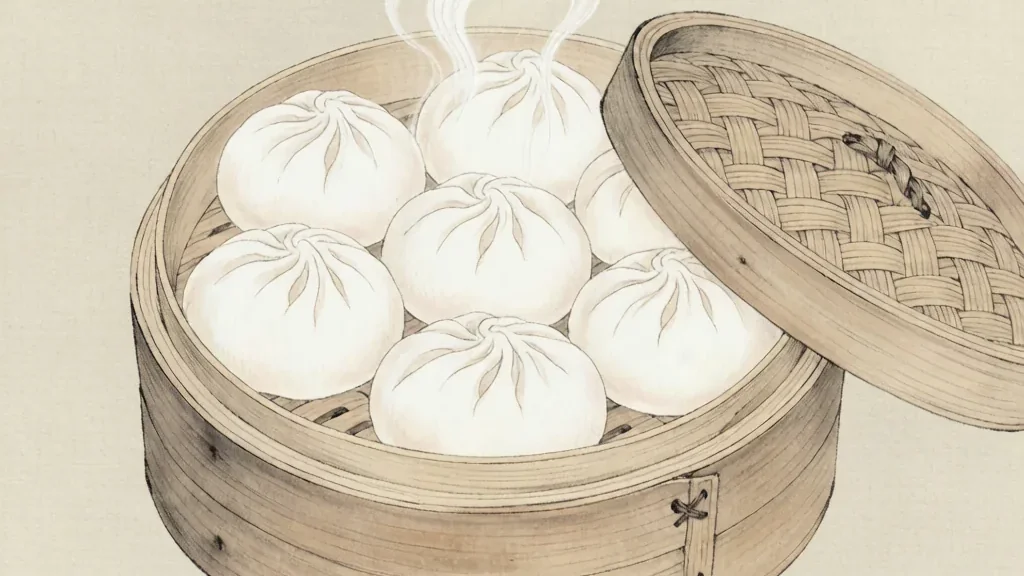
Before there were dumplings, noodles, and elaborate banquets, there was the 馒头 () — the plain steamed bread that has fed northern China for well over a thousand years. Shaped like a rounded dome of pure white dough, mantou contains no filling and no sugar, relying entirely on the gentle sweetness of fermented wheat and the soft, cloud-like crumb that steaming produces. It is the quiet backbone of the Chinese table: not the star of the meal, but the dependable companion to every stir-fry, stew, and pickle. To overlook mantou is to miss the foundation on which much of northern Chinese eating is built.
The Simplest Bread in China
Mantou is made from just four things: wheat flour, water, a leavening agent, and sometimes a touch of sugar. The dough is kneaded until smooth, left to rise until doubled, then shaped into oval or round loaves and steamed over boiling water. There is no oven, no oil, and no crust — only a moist, tender interior with a faint sheen on the surface. A well-made mantou springs back when pressed and pulls apart in soft, even strands, the signature of properly developed gluten.
Because it is so plain, mantou is the perfect foil for bold dishes. Northerners tear a piece and use it to soak up the sauce of braised pork or to balance the heat of a chili dish. It can be eaten plain for a light breakfast, toasted until golden, or sliced and fried with egg. Its neutrality is precisely its strength, allowing the flavors around it to shine while still providing satisfying fullness from the wheat.
Where Mantou Came From
The origin of mantou is wrapped in legend. The most famous story credits Zhuge Liang, the strategist of the Three Kingdoms period, who supposedly invented filled and unfilled wheat "heads" to replace the practice of sacrificing enemies' heads to river gods during a crossing. Whether or not the tale is true, historical texts from the Han and later dynasties describe steamed wheat cakes as staples of the north, where wheat grew more easily than rice.
By the Song dynasty, mantou were a documented food of both commoners and court. The word itself once referred to filled buns as well, and only gradually came to mean the unfilled version we know today, while the filled kind took the name baozi. Through famines and feast alike, mantou remained a food of survival and comfort, cheap to make and filling enough to sustain a hard day's labor in the fields.
Mantou Across the North
In Shandong, mantou are often large, dense, and chewy, made with a sourdough starter that gives them a gentle tang. In Beijing, smaller, softer versions are standard breakfast fare, sometimes sweetened slightly. The northwest produces hearty, hand-torn loaves eaten with lamb, while Manchuria and the northeast favor big, snow-white rounds that keep well through cold winters when stored frozen outdoors.
Some regions add twists: colored mantou using pumpkin or spinach puree, or flower- and animal-shaped mantou for children and festivals. In Shanxi, a province proud of its wheat, mantou can be works of folk art, sculpted into peaches and fish for birthdays and weddings. These decorative buns are often not eaten but displayed, then later steamed again or given as gifts, blurring the line between food and craft.
How to Make Mantou at Home
Homemade mantou begins with activating yeast in warm water, mixing it into flour with a little sugar, and kneading until the dough is silky. The first rise takes about an hour in a warm spot. The dough is then punched down, divided, and rolled into smooth shapes — a key step, since any cracks will show after steaming. A short second rest follows before the buns go into the steamer.
Steam over high heat for fifteen to twenty minutes, then let the lid sit ajar for a few minutes before lifting, which prevents the sudden temperature drop that causes sinking. Fresh mantou are best the day they are made, but they reheat well and freeze for months. Many northern families still make a week's supply at once, a habit born of necessity that now reads as devotion to tradition.
Mantou as Comfort and Culture
For many Chinese, mantou is the taste of childhood and hometown. Students away at university and migrants in big cities speak of missing the simple steamed bread of their villages. During the Lunar New Year, elaborately shaped mantou appear on altars and dining tables as symbols of fullness and good fortune. The round form echoes the full moon and the ideal of reunion.
Mantou also carries a lesson in restraint. In a cuisine celebrated for complexity, the plain steamed bun teaches that not every food needs a filling, a sauce, or a story. Sometimes the clean taste of fermented wheat, coaxed into softness by steam, is enough. That quiet confidence is why mantou has outlasted countless food fashions and remains, quite literally, on the daily menu of hundreds of millions.
Health and Modern Life
Steamed rather than fried, mantou is low in fat and provides steady energy from its wheat carbohydrates. Whole-wheat and multigrain versions now appear in cities for health-conscious eaters, adding fiber without changing the familiar form. It is also naturally vegan and, when made without cross-contamination, safe for many special diets.
Modern bakeries sell individually wrapped mini mantou, and frozen sections stock them next to baozi. Yet the essential character is unchanged: a humble, honest bread that asks nothing but flour, water, and time. In an age of ever more elaborate snacks, mantou stands as a reminder that simplicity, done well, is its own kind of luxury.
Mantou in the South and at the Table
Although mantou is a northern staple, it appears across China wherever a neutral bread is needed to balance a rich dish. In southern restaurants it often arrives as a side to braised dishes, and the Cantonese flower roll twists a scallion- or sesame-oiled mantou dough into a spiral worth pulling apart by hand. In home kitchens south of the Yangtze, mantou is less daily bread and more a comforting occasional buy, yet it remains the dependable partner for stews and stir-fries. Its plainness is the point: it absorbs sauce without competing, making it a universal foil. Even in regions built on rice, a basket of mantou can anchor a meal, proving that the simplest steamed bread travels as readily as the flavors it accompanies.
Mantou in the Modern Kitchen and Diaspora
Today mantou is as likely to come from a freezer aisle as from a steamer basket. Individually wrapped mini mantou and frozen family packs sit beside baozi in supermarkets, and overseas Chinese communities rely on them as a taste of home. Creative cooks have also reimagined the plain bun: sliced and fried with condensed milk, stuffed with custard, or toasted for a crisp breakfast. Health-minded brands offer whole-wheat and multigrain versions that keep the familiar form while adding fiber. Yet the essentials are unchanged: flour, water, yeast, and steam. Whether reheated in a Manhattan apartment or fresh from a Shandong steamer, mantou remains the quiet backbone of the Chinese table, a humble bread whose simplicity is exactly its strength.
❓ Frequently Asked Questions
📝 Chinese Vocabulary
馒头 — : plain steamed wheat bread.
窝窝头 — : cornmeal conical bun.
花馍 — : decorative folk-art steamed bread.
蒸 — : to steam.
面粉 — : wheat flour.
包子 — : Baozi, the filled version of the bun that mantou is not.
山东 — : Shandong, a northern region known for dense, chewy mantou.
发酵 — : To ferment or leaven, the step that gives mantou its rise.
🎉 Fun Facts
- The word mantou once meant filled buns too; the unfilled version only later took the name exclusively.
- In Shanxi, artisans sculpt mantou into fish and peaches for weddings and birthdays as edible folk art.
- Mantou was historically a survival food because wheat kept and the buns could be stored frozen through northern winters.
- Because it is steamed with no oil, mantou is naturally low in fat and vegan-friendly.
- In parts of northern China, a single giant mantou can be as large as a dinner plate, meant to be torn and shared across a family meal.
- Mantou features in folk sayings and children's rhymes, and its round shape is sometimes used in wedding games symbolizing a full, united life.