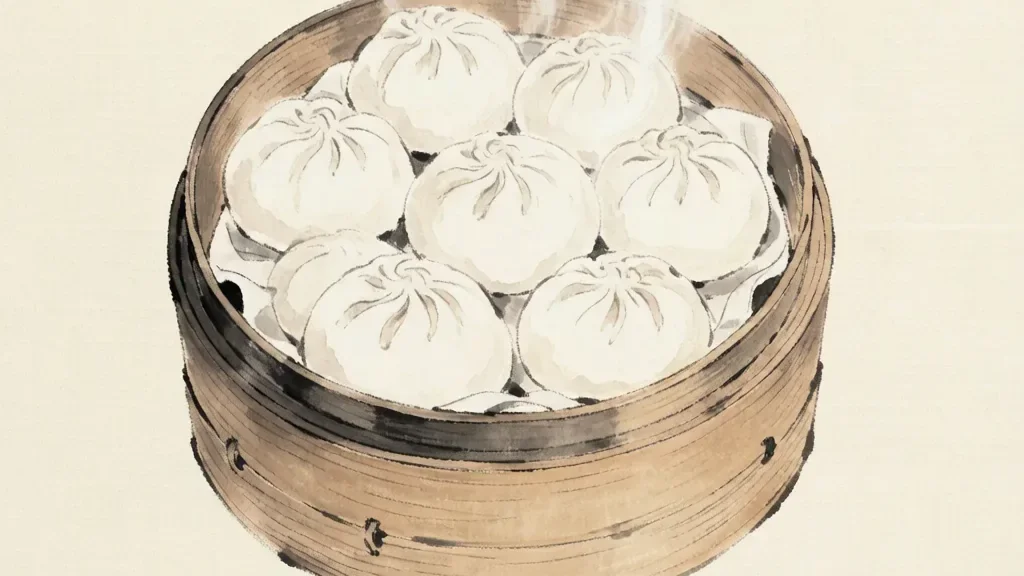
Ask any traveler in China what they ate for breakfast, and the answer is often the same: a warm, pillowy 包子 (), a steamed bun with a savory or sweet filling tucked inside a soft, snow-white shell. More than a snack, the baozi is a daily companion to millions, sold from street carts at dawn, stacked in bamboo steamers outside subway stations, and folded by hand in family kitchens. To understand baozi is to understand a core truth of Chinese food culture: that the humblest staple can carry the greatest comfort, and that a single bite of dough and filling can bridge regions, classes, and generations.
What Exactly Is a Baozi?
A baozi is a leavened wheat-flour dough wrapped around a filling and steamed until puffed and tender. The dough is made from wheat flour, water, a little sugar, and a leavening agent — traditionally yeast or a starter culture, and today often commercial yeast or baking powder. Unlike the plain 馒头 (), its unfilled cousin, a baozi hides a treasure within: minced pork, beef, chicken, vegetables, red bean paste, or custard. The bun is sealed with a twist at the top, then steamed over boiling water in a bamboo or metal basket, which keeps the surface moist rather than browned.
The result is a bun that is pale, glossy, and faintly sweet from the dough itself. A good baozi should be light enough to tremble when lifted with chopsticks, with a filling that is juicy but not greasy. Regional styles vary the ratio of filling to dough, the seasoning, and the size — from bite-sized 小笼包 () to giant, plate-sized buns meant for sharing. The baozi proves that steaming, one of China's oldest cooking methods, can produce both everyday food and refined delicacy.
A Long History of Filled Buns
The filled steamed bun has roots stretching back more than a thousand years. The scholar and gastronome Meng Yuanlao, writing in the Southern Song dynasty, described vendors in the capital selling 灌汤包 () and other buns. Legend attributes the popularization of the bun to the Three Kingdoms-era strategist Zhuge Liang, who is said to have replaced human sacrifices with flour figures shaped like heads to appease river spirits — though this tale is more folklore than fact. What is certain is that by the Song dynasty, filled buns were a documented urban street food.
During the Ming and Qing dynasties, baozi spread along trade routes and into both northern wheat-eating heartlands and southern cities, where wheat was once a luxury. Steamed buns proved ideal for busy laborers: they could be made ahead, carried, and eaten cold or reheated. Imperial kitchens refined the form into elaborate banquet items, while commoners kept it cheap and filling. The baozi thus became a rare food that sat comfortably on both the peasant's bench and the noble's table.
Regional Varieties Across China
Northern China favors substantial buns. In Beijing, 猪肉包 () are large, stuffed with pork and scallions, while Tianjin's 狗不理 () brand became famous for thin-skinned, eighteen-fold buns. Shanghai and the Yangtze delta gave the world the delicate soup bun, 小笼 (), filled with pork and a gelatinous broth that melts into soup when steamed. Southern Guangdong (Cantonese) kitchens produce 叉烧包 (), a sweet barbecue-pork bun with a cracked, flower-like top.
Vegetarian and sweet versions flourish too. Red bean paste buns (豆沙包, ) and custard buns (奶黄包, ) are breakfast staples in the south. In the northwest, buns may hold cumin-spiced lamb. Each region seasons the filling with its own pantry — soy sauce, sesame oil, Shaoxing wine, ginger, and white pepper in the east; chili and Sichuan pepper in the west — making the baozi a map of Chinese taste in edible form.
How Baozi Are Made at Home
Making baozi at home is a satisfying ritual. The cook begins by activating yeast in warm water with a pinch of sugar, then mixes it into flour to form a smooth dough. After kneading and a first rise of about an hour, the dough is divided into rounds, each rolled into a thick disc with a thinner center. A spoonful of filling goes in the middle, and the edges are pleated upward and twisted shut. A second, shorter rest lets the shaped buns puff before they meet the steam.
Steaming takes only twelve to fifteen minutes over vigorously boiling water, with a layer of cabbage leaf or parchment under each bun to prevent sticking. The key is not to peek: lifting the lid too early can collapse the delicate dough. Once done, baozi are best eaten immediately, dipped in a little black vinegar with shredded ginger. Leftovers freeze beautifully, which is why many Chinese home cooks make them in large batches on weekends.
Baozi in Daily Life and Festivals
In Chinese cities, the baozi is the quintessential on-the-go breakfast. Office workers queue at hole-in-the-wall shops where a bun and a cup of soy milk cost less than a dollar, fueling the morning rush. During the Lunar New Year, families may make 包子 together as a bonding activity, and in some areas round buns symbolize reunion and fullness. The portability of the bun also made it a travel food for migrants and students far from home.
Beyond China, baozi have become global ambassadors of Chinese cuisine, found in Chinatowns from New York to Sydney and increasingly in fusion cafes. The rise of soup dumpling restaurants abroad has turned a humble street food into a culinary destination. Yet for most Chinese people, the baozi remains what it has always been: a warm, affordable, deeply familiar bite that tastes like home.
Nutrition and Modern Trends
A steamed pork baozi is moderate in calories and provides carbohydrate from the wheat, plus protein and fat from the filling. Because it is steamed rather than fried, it contains far less oil than many Western fast foods, which is one reason it endures as a breakfast choice. Modern variations include whole-wheat dough, mushroom-and-tofu fillings for vegetarians, and even colorful buns dyed with vegetable juices.
Health-conscious vendors now offer smaller portions and leaner fillings, while frozen-food aisles stock dozens of varieties for busy households. Yet the soul of the baozi is unchanged: a simple envelope of dough that delivers warmth and satisfaction. Whether bought for a few coins at a corner cart or folded by a grandmother's hands, the baozi reminds us that the best food is often the most generous and the least pretentious.
Baozi Around the World
Baozi have traveled far beyond China, becoming a familiar sight in Chinatowns from New York to Sydney and increasingly in fusion cafes and fast-casual restaurants. The soup dumpling, in particular, turned a humble street snack into a culinary destination that draws lines of diners abroad. Yet for most Chinese people the baozi remains an everyday comfort rather than a special occasion food. What makes it travel so well is its simplicity: a single envelope of dough that can hold countless fillings and still taste like home. Whether bought for a few coins at a corner cart or folded by a grandmother's hands, the bun carries the same message of warmth and generosity wherever it is eaten.
The Pleat as a Craft
Folding a baozi is a small craft passed down in kitchens rather than taught in schools. The cook rolls a thick-centered disc, spoons in the filling, and pleats the edge upward into a twisted peak that seals the bun for steaming. The number of pleats, the tightness of the seal, and the evenness of the shape all signal a cook's experience. A well-folded bun keeps its filling locked in and its dome intact while it puffs in the steamer. Children often learn on oversized, lopsided versions that draw laughter at the table. Though machines now form uniform buns for frozen-food aisles, the hand-pleated baozi is still the one families associate with festivals, weekend batches, and the patient rhythm of cooking together.
❓ Frequently Asked Questions
📝 Chinese Vocabulary
包子 — : steamed filled bun.
馒头 — : plain steamed bread, no filling.
小笼包 — : small soup dumpling.
叉烧包 — : barbecue-pork steamed bun.
豆沙包 — : red bean paste bun.
馅 — : filling, the savory or sweet mixture enclosed in the dough
蒸笼 — : bamboo steamer basket used to cook buns over boiling water
发面 — : leavened dough, risen with yeast or another agent
🎉 Fun Facts
- The word baozi was already recorded as a street food in the Southern Song dynasty capital more than 800 years ago.
- Tianjin's famous Goubuli brand claims its name means "dogs ignore," from a distracted founder, though the story is playful legend.
- A master xiaolongbao maker can pleat a single bun with eighteen folds and keep the soup sealed inside.
- Because they are steamed, baozi contain little oil, making them lighter than most fried fast foods.
- In many northern Chinese offices and campuses, a warm baozi with a cup of soy milk is the most common grab-and-go breakfast, sold from steam carts before eight in the morning.
- A home-made baozi is usually pinched shut with a dozen or more pleats at the top, and skilled cooks use the number and neatness of those pleats as a quiet mark of quality.