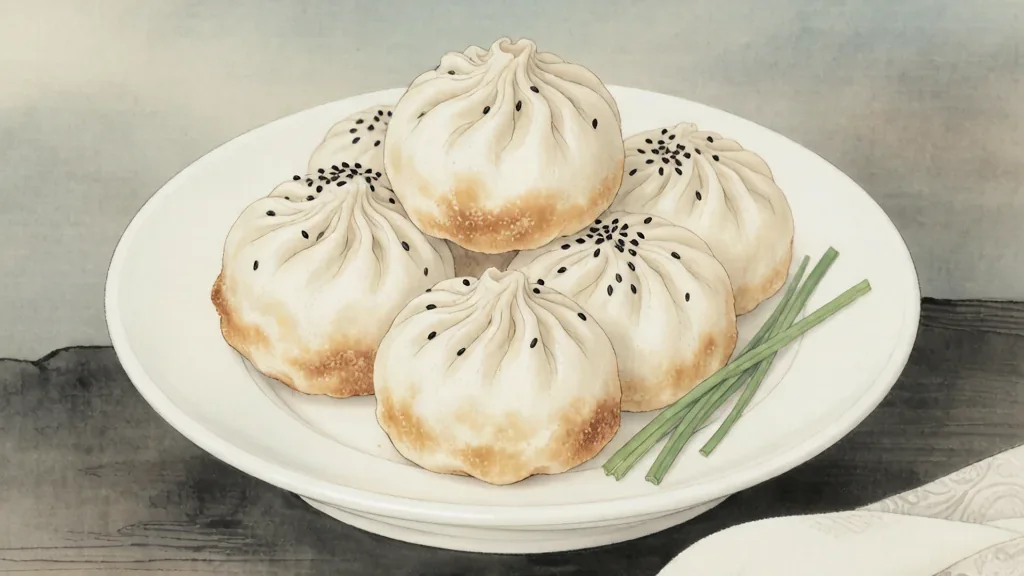
Shengjian (生煎, shēngjiān), often written "shengjian mantou" (生煎馒头), is a Shanghai street-food icon: a small leavened bun with a juicy pork filling, pan-fried bottom-up until the base is shatteringly crisp while the top stays soft and steamed. Finished with sesame seeds and chopped scallion, it is eaten piping hot, usually for breakfast or as a snack, in clusters of four or eight. Deceptively simple, the shengjian balances three textures—crisp, tender, and soupy—and demands a particular eating technique to avoid scalding. Alongside xiaolongbao and guotie, it is one of the great stuffed snacks of the lower Yangtze and a daily ritual for millions of Shanghainese.
What Shengjian Is
The name means literally "raw fry"—the buns go into the pan uncooked, then are fried and steamed in the same step. Unlike a baked bun or a pure dumpling, shengjian is both: a bread-like dome with a fried, golden floor.
Traditionally square or round, each bun is a couple of inches across, pleated at the top (or, in some shops, sealed smooth) and dense with filling. The dough is lean and slightly chewy, more bread than pasta.
The defining feature is the contrast: bite the top and it is soft and savory; bite the bottom and it crackles. Few snacks deliver so many textures in one mouthful.
Shanghai Origins
Shengjian developed in Shanghai in the early twentieth century as a working-class breakfast, sold from street carts and tiny shops in the city's growing neighborhoods. It drew on Yangtze stuffed-bun traditions but adapted them to the wok and the rush of the morning.
Over decades it became a civic staple, with famous old houses—such as the long-running shops near the old city and transport hubs—training dynasties of makers. The craft passed orally, shop to shop.
Today the dish is inseparable from Shanghai identity, as iconic in the city as the xiaolongbao of nearby suburbs, and a must-try for visitors.
The Dough
The wrapper is a yeast-leavened wheat dough, softer and more bread-like than dumpling skin. It is rolled thick enough to stay pillowy after steaming yet thin enough at the base to crisp.
Proofing matters: under-proofed dough is dense; over-proofed collapses in the pan. Good makers judge by feel and weather, since humidity changes the timing daily.
Some shops add a little sugar to the dough for a faint sweetness that plays against the savory filling, a subtle Shanghainese touch.
The Filling and the Soup
The classic filling is seasoned ground pork, often with a little gelatin-rich stock or "pi-dong" (meat aspic) folded in so that, as the bun cooks, the aspic melts into hot broth trapped inside. This is what makes a shengjian "soup-bearing."
Seasoning leans Shanghainese: soy, a touch of sugar, ginger, and scallion, sometimes a hint of sesame oil. The meat is juicy rather than dry, engineered to release broth on the first bite.
Vegetable or pork-and-shrimp versions exist, but pork remains the standard and the benchmark of a shop's skill.
The Cooking Technique
Shengjian is cooked in a wide, shallow pan with a lid. The buns are placed close together, sealed-side up, in a film of oil; water is added and the pan covered so the tops steam while the bottoms fry.
When the water is gone, the remaining oil crisps the bases to a deep gold. Just before serving, sesame and scallion are scattered on top, and the lid comes off to finish. The whole process is quick and theatrical.
The skill is in the water ratio and timing: too much and the tops go soggy; too little and the bases burn before the centers cook.
The Crispy Bottom
The fried base is the soul of the shengjian. A great one is thin, even, and audibly crisp, with a toasty, almost caramelized flavor from the rendered dough and oil. Weak versions are pale and greasy.
Some shops achieve a lacy "net" of crispness where the buns touch, a prized effect. The bottom also holds a little of the escaped broth, marrying crunch and juice.
Connoisseurs eat the crisp bottom deliberately, savoring it as the textural payoff of the whole snack.
How to Eat It
Shengjian arrives scalding. The safe method: pick one up with chopsticks or a spoon, nibble a small hole in the top, and sip the broth before eating the rest. Biting straight in risks a jet of hot soup and a burnt tongue.
Seasoning at the table is common—a dab of vinegar and a smear of chili, though purists eat them plain to judge the maker's seasoning. The bun is best in the first minutes, before the crisp softens.
They are eaten in multiples, never singly; four is a light snack, eight a meal with a bowl of soy-milk alongside.
Variations and the "Shengjian Bao"
Modern menus sometimes call them "shengjianbao" to signal the soupy filling clearly. Fillings have diversified to include crab roe in season, chicken, or vegetable, though pork still dominates.
Regional cousins appear elsewhere in the Yangtze delta, but Shanghai's version—small, rounded, sesame-flecked—is the reference. Some chains now freeze and reheat them, to mixed reviews.
The essential form, however, has changed little in a century: fried bottom, steamed top, juicy middle.
Cultural Role in Shanghai Life
For Shanghainese, shengjian is breakfast and comfort and nostalgia at once. Office workers queue at dawn; grandparents bring grandchildren; late risers grab a bag from the corner shop.
It features in the city's snack culture alongside youtiao, doufuhua, and congee, and represents the everyday excellence of Shanghai's street food rather than its banquet side.
Festivals and tourism have boosted its profile, but its heart remains the weekday morning queue and the paper tray of four hot buns.
Modern Shops and Chains
Once purely a cart food, shengjian now ranges from heritage single shops to polished chains with standardized recipes and clean dining rooms. The best still fry to order in visible pans.
Delivery has arrived, though the crisp suffers in transit; aficionados insist on eating at the counter. Some makers experiment with whole-wheat dough or leaner fillings for health-conscious customers.
Through all the modernization, the test remains the same: a crisp base, a soft crown, and a spoonful of hot broth within.
❓ Frequently Asked Questions
What is shengjian?
A Shanghai pan-fried bun with juicy pork filling: steamed soft on top and fried crisp on the bottom, finished with sesame and scallion.
How is it different from xiaolongbao?
Shengjian is bread-dough and pan-fried with a crisp base; xiaolongbao is a delicate steamed soup dumpling with a thin wrapper.
Why is there soup inside?
Gelatin-rich meat aspic is mixed into the filling and melts into hot broth during cooking, trapped by the sealed dough.
How should I eat it safely?
Nibble a hole in the top, sip the broth, then eat the rest; the filling is scalding right out of the pan.
Where did it come from?
It emerged in early-twentieth-century Shanghai as a street breakfast and became a civic staple.
Is it the same as guotie?
No. Guotie are crescent dumplings with a thinner skin; shengjian are round, doughier, and deliberately soup-bearing.