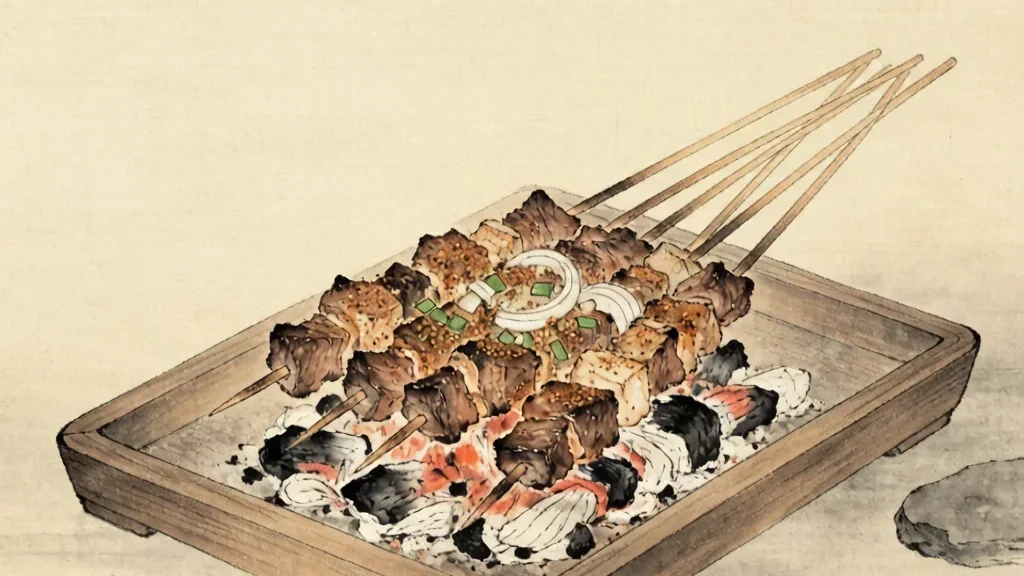
Follow the smoke and the rhythm of sizzling fat on coals in almost any northern Chinese city after dark, and you will find yáng ròu chuàn (羊肉串) — mutton skewers, the quintessential street barbecue of the northwest. These are not dainty kebabs; they are chunks of lamb threaded on slender metal or bamboo sticks, dusted with cumin, chili, and salt, and blasted over open flame until the edges char and the fat renders. The dish is a direct inheritance from the nomadic and Muslim cultures of Xinjiang and the broader western frontier, carried eastward along the Silk Road until it became a national late-night ritual. To eat yangrou chuan is to taste the meeting point of steppe and city, and to understand how cumin and lamb became a Chinese street-food language of their own.
Origins on the Silk Road
Yangrou chuan traces its lineage to the Uyghur and other Turkic peoples of Xinjiang, where grilling lamb over open fire is ancient practice. The form — small cubes of mutton alternated on a skewer and cooked over coals — mirrors the chüánr (串儿) tradition of the northwest. As trade and migration moved along the Silk Road, the technique traveled into the interior, reaching Beijing and other northern cities where it fused with local tastes. The Han Chinese adaptation kept the lamb and the skewer but added the now-iconic trio of cumin, chili, and salt.
In Beijing, the dish became a fixture of night markets and alleyways by the late twentieth century, sold by Hui (Chinese Muslim) vendors who maintained halal preparation. The sizzling carts, with their racks of dozens of skewers turning over glowing charcoal, became a sensory landmark of the city's summer nights. What began as frontier food is now woven into the everyday leisure of hundreds of millions, proof of how openly Chinese cuisine borrows and localizes.
The Lamb and the Cut
Authentic yangrou chuan uses mutton or lamb with a good proportion of fat, because the fat is what bastes the meat as it cooks and delivers the prized crisp-edged, juicy bite. In Xinjiang, fat-tailed sheep breeds provide the rich, lamb-y flavor that defines the region's meat. The cubes are cut moderately small — usually two to three centimeters — so they cook quickly and develop maximum seared surface. Too lean, and the skewer dries; too large, and the inside lags behind the outside.
In many traditional preparations, especially in the northwest, the fat is threaded between the meat cubes rather than trimmed away, so each bite carries both. Northern city vendors sometimes use a mix of lamb and a little lamb fat to mimic this. The quality of the lamb matters: grass-fed northwestern lamb has a cleaner, less gamey profile that needs little more than salt and spice to shine. This respect for the ingredient is central to the dish's appeal.
The Spice Trinity: Cumin, Chili, Salt
If lamb is the body of yangrou chuan, cumin is its soul. The use of cumin (zīrán) is the clearest Silk Road fingerprint, distinguishing these skewers from the soy-and-garlic profile of eastern Chinese grilling. Toasted cumin is crushed and shaken over the meat, its earthy, slightly citrusy aroma blooming in the heat. Chili powder adds heat without overwhelming, and salt concentrates the savory juices. Some vendors add a pinch of sesame or a brush of spice oil.
The order of seasoning is part of the craft. Salt is often applied before cooking to penetrate; cumin and chili go on near the end so they toast rather than burn. A skilled grill cook works both hands, turning rows of skewers and dusting them in a continuous motion, reading doneness by color and sound. The final result should be fragrant first, then spicy, then richly meaty — a sequence that the spice layering is designed to produce.
From Xinjiang to the Night Market
Across China, yangrou chuan has been absorbed into local street culture with minor variations. In Xinjiang and Gansu, the skewers tend to be larger, meatier, and seasoned more simply, often with just salt, cumin, and chili, sometimes with a sprinkle of "jīngyán" (special spiced salt). In eastern cities, portions shrank into the bite-sized "chuanr" sold by the string, priced per stick, and eaten by the handful. The social format — standing, chatting, eating several at once — is consistent everywhere.
The dish also signals a particular kind of leisure: the summer evening, the cold beer, the friend leaning over the smoke. In Beijing and beyond, "chi chuanr" (eating skewers) is shorthand for relaxed hangout time. The portability and speed of the skewer make it perfect for this, and the open flame gives it a campfire intimacy even in the middle of a metropolis. It is street food that builds community around a grill.
How to Eat Yangrou Chuan
Yangrou chuan is eaten by hand, straight off the stick, ideally within moments of leaving the coals while the fat is still crisp. The customary method is to hold the stick, bite or slide the meat off with your teeth, and discard the empty skewer into a communal container — the piles of spent sticks at a busy stall are a badge of its popularity. Cold beer, suān méi tāng (sour plum drink), or a cold soft drink are the standard companions, cutting the richness of the lamb.
Etiquette is minimal and the mood is casual. Order by the dozen, share across the table, and reorder as the night goes on. Vegetable skewers — eggplant, pepper, potato, or mushroom — are often available for balance, and many stalls also grill flatbread (náng) the same way, cumin-dusted, to scoop up the experience. The dish rewards appetite over formality, which is exactly the point.
Cultural Significance and the Northwest
More than a snack, yangrou chuan is a culinary ambassador of China's northwest and of its Hui and Uyghur Muslim communities, who have long specialized in halal lamb cookery. It represents one of the clearest examples of how Islamic Central Asian foodways shaped mainstream Chinese street eating. The dish's nationwide popularity has also supported livelihoods for northwestern migrants in eastern cities, where lamb-skewer carts are often family-run enterprises.
For travelers, yangrou chuan is an accessible entry into northwestern flavors without the need for a formal meal. It also pairs naturally with other frontier foods like náng bread and pilaf (zhúfàn). In an era when Chinese cuisine is often reduced abroad to a few Cantonese dishes, the skewer stands as a reminder of the country's vast internal diversity — a single stick that carries the history of the Silk Road to a neon-lit corner store.
The Craft of the Grill
A great skewer is mostly a matter of fire and timing. The cook works over glowing charcoal, turning rows of skewers continuously so the cubed lamb browns evenly without burning the outside before the inside cooks. Salt often goes on early to season through, while cumin and chili are dusted near the end so their aromas bloom rather than scorch. Fat is the unsung hero: a little renders over the coals and self-bastes each piece, giving the prized crisp-edged, juicy bite. Reading doneness by color and the sizzle takes years to master, and a busy stall owner handles dozens of sticks at once with both hands. The result looks casual but is tightly controlled, and that control is exactly why the simplest lamb and spice can taste so good.
Yangrou Chuan on the National Table
From its northwestern roots, yangrou chuan has become a national habit. Hui and Uyghur vendors carried it into eastern cities, where it now anchors night markets, summer streets, and late-night hangouts from Beijing to Shanghai. Family-run carts turned the frontier grill into a small business that supports migrant communities, and the sight of smoking charcoal racks is a seasonal landmark. The dish also travels lightly: similar cumin-lamb skewers appear across Central Asia, a reminder of shared steppe foodways. For eaters, it is an easy entry into northwestern flavor without a formal meal, and for the country it is a single stick that carries the history of the Silk Road into a neon-lit street corner, unchanged in spirit.
❓ Frequently Asked Questions
📝 Chinese Vocabulary
羊肉串 — : lamb/mutton skewers.
孜然 — : cumin.
串 — : skewer / string (of things).
新疆 — : Xinjiang, the northwestern region of origin.
馕 — : Xinjiang flatbread, often grilled with cumin.
烤 — : To grill or roast over open flame.
辣椒面 — : Chili powder, the spice dusted over the skewers.
维吾尔 — : Uyghur, the Central Asian people whose grilling tradition shaped the dish.
🎉 Fun Facts
- The piles of discarded skewers at a busy stall are sometimes used by vendors to gauge the night's sales at a glance.
- Cumin is not native to eastern China; its presence in these skewers is a direct Silk Road legacy.
- In Xinjiang, skewers can be much larger than the bite-sized city version, sometimes featuring big chunks of tail fat.
- "Chi chuanr" (eating skewers) is a common Chinese phrase for a relaxed evening hangout.
- In northern cities, yangrou chuan is priced per skewer and ordered by the dozen, making it a communal, share-as-you-go food rather than a plated meal.
- The open charcoal grill gives the skewers a campfire intimacy even in a busy metropolis, which is why they are tied to summer nights and cold drinks.