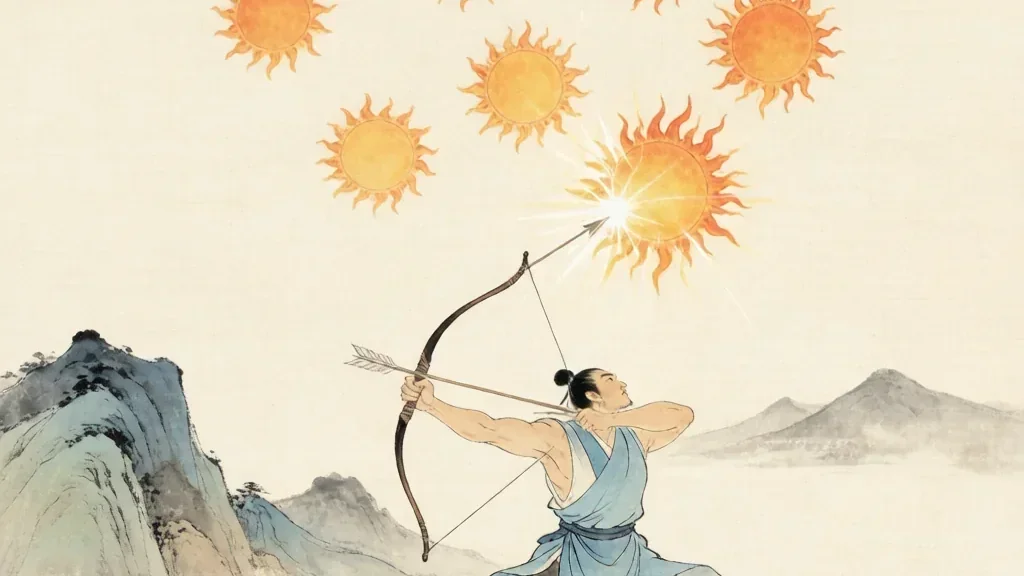
Imagine waking up one morning to find not one, but ten suns blazing in the sky. The heat is unbearable — rivers evaporate, crops wither into dust, and the very earth cracks open beneath your feet. This was the terrifying reality of ancient China according to one of its most dramatic myths, and it would take a hero of extraordinary skill and courage to set things right. That hero was Houyi, the greatest archer who ever lived.
The tale of Houyi (后羿) stands among the most beloved stories in Chinese mythology — a sweeping epic of divine punishment, mortal heroism, star-crossed love, and bittersweet sacrifice. It's a story that has captivated Chinese audiences for thousands of years and continues to inspire art, literature, and even space exploration to this day.
The Ten Suns of Dijun
In the earliest days of the world, the ten suns were not the chaotic force they would become. They were the children of Dijun, the supreme god of the eastern heavens, and his wife Xihe, the sun goddess. Each morning, Xihe would bathe one of her solar children in the Sweet Springs of the East and then carry it across the sky in her dragon-drawn chariot, bringing light and warmth to the world below. The other nine suns would wait patiently in the branches of the Fusang, a great mulberry tree that grew in the eastern sea.
This orderly routine continued for eons. But the suns were not machines — they were living beings, and like all children, they eventually grew restless with their prescribed roles. One day, tired of taking turns, all ten suns decided to rise into the sky together. They thought it would be a grand adventure, a chance to stretch their fiery wings and see the world in all its glory.
They could not have imagined the devastation they would cause. With ten suns blazing simultaneously, the earth's temperature soared to unimaginable levels. Oceans began to boil, forests erupted into spontaneous flames, and the soil turned to baked clay. Crops died in the fields, and the people — Nüwa's precious creation — suffered terribly. Famine and thirst swept across the land, and monsters that had hidden in the deepest shadows emerged to prey upon the weakened populace.
A Hero Descends from Heaven
The Jade Emperor, ruler of heaven, looked down and saw the catastrophe unfolding. He summoned Houyi, a divine archer of peerless skill, and commanded him to discipline the unruly suns. Houyi was not merely a talented bowman — he was a celestial being, blessed with supernatural strength and precision. His bow had been forged by the gods themselves, and his arrows could strike any target, no matter how distant or fast-moving.
Houyi descended to the mortal realm with his wife Chang'e, a beautiful and graceful goddess. What they saw upon arrival shocked them. The once-verdant land was a scorched wasteland. Skeletal figures stumbled through the heat haze, their eyes hollow with despair. Houyi's heart hardened with resolve. He climbed to the highest peak he could find, strung his divine bow, and addressed the ten suns.
Legend says he called out to them, demanding they return to their proper rotation. But the suns — arrogant in their collective power — only laughed and burned brighter. They did not believe any being, mortal or immortal, could threaten them. They were wrong.
Nine Arrows, Nine Suns
Houyi drew his bow. The string hummed with celestial energy as he took aim at the first sun. He released — and the arrow flew true. With a sound like the tearing of the sky itself, one of the suns exploded into a shower of golden feathers and fell from the heavens, transforming into a three-legged crow as it plunged to earth. The remaining suns shrieked in terror, but Houyi did not pause. He fired again, and again, and again.
One by one, the suns fell — nine arrows, nine blazing deaths. The earth's temperature dropped with each fallen sun, and the people below began to feel hope stir in their hearts for the first time in years. As Houyi prepared to loose his tenth and final arrow, a wise elder shouted from below, begging him to stop. Without the last sun, the world would be plunged into eternal darkness — just as deadly as the scorching heat. Houyi hesitated, then lowered his bow. One sun remained, and it would learn its lesson well.
The surviving sun was terrified and humbled. It promised to rise and set on a proper schedule, never again straying from its appointed path. To this day, it keeps that promise — rising faithfully in the east each morning and setting in the west each evening.
The Price of Heroism
Houyi was hailed as a hero, the savior of humanity. But there was a terrible price for his actions. The suns he had slain were the children of Dijun, the supreme god. Enraged by the death of his sons, Dijun stripped Houyi and Chang'e of their immortality and banished them to live as mortals on earth. The hero who had saved the world was now condemned to die in it.
Determined to reclaim immortality for himself and his beloved wife, Houyi embarked on a perilous quest. He traveled to the Kunlun Mountains, the dwelling place of the immortals, and sought an audience with the Queen Mother of the West, Xiwangmu. Moved by his courage and his love for Chang'e, Xiwangmu gave him a single dose of the elixir of immortality — enough for one person to ascend to heaven, or for two people to share and live forever on earth.
Houyi brought the elixir home and told Chang'e of his plan: they would drink it together on the fifteenth day of the eighth lunar month and live as immortals upon the earth. But fate had other plans. While Houyi was away, his treacherous apprentice Fengmeng broke into their home and demanded the elixir. Rather than let the precious potion fall into evil hands, Chang'e drank it all herself. Her body became light as a feather, and she began to float upward — past the rooftops, through the clouds, and all the way to the moon, where she resides to this day.
A Love That Spans the Heavens
When Houyi returned and discovered what had happened, his grief was immeasurable. He looked up at the moon and saw the shadow of his beloved wife upon its surface. In her honor, he began to set out offerings of mooncakes and fruits on the night of the full moon — a tradition that would eventually grow into the Mid-Autumn Festival, one of China's most important celebrations.
The story of Houyi and Chang'e is a tale of many layers. It speaks of heroism and the courage to defy even the gods when justice demands it. It speaks of love that transcends the boundary between heaven and earth. And it speaks of the bittersweet nature of sacrifice — that sometimes, doing the right thing costs us everything we hold dear.
Today, Houyi is remembered not just as a mythological figure but as a symbol of the human spirit's capacity to overcome impossible odds. His name is invoked when discussing courage, skill, and the willingness to stand against tyranny. And every Mid-Autumn Festival, when families gather to gaze at the full moon and share mooncakes, they are continuing a tradition that began with a grieving archer looking up at his lost love.
Houyi the Historical Archer
Scholars have long noted that the divine archer overlaps with a semi-historical figure called Yi, an archer who served a ruler of the early Xia dynasty and was famed for his skill with the bow. Ancient texts such as the Classic of Documents mention this Yi in political contexts quite separate from the ten suns, suggesting that a real or legendary strongman was later fused with the solar myth. This blending of history and folklore is common in Chinese tradition, where culture heroes accumulate deeds across centuries of retelling. The result is a Houyi who is at once a cosmic savior who shot down the suns and a worldly warrior-king, a layering that gave later storytellers rich material for both admiration and tragedy, and that helps explain the darker turn his legend sometimes takes.
The Bow of the Gods
Houyi's power rested on his legendary bow, said to have been forged by the gods and strung with dragon sinew or a rainbow cord, depending on the version. With it he could strike any target, near or far, and the arrows themselves were often described as trailing celestial fire. In art he is shown drawing the bow on a mountain peak, the ten suns blazing before him, an image that has become one of the most reproduced scenes in Chinese mythological painting. The bow also marks the boundary between the divine and the mortal in his story: it is what lets a heavenly archer act, and what he loses the right to wield once he is punished and made human. The weapon, more than the man, became the symbol of righteous intervention.
Houyi on Stage and Screen
The archer's tale has traveled far beyond ancient texts. Traditional operas dramatize the moment he spares the last sun, while modern films and animations revisit his love for Chang'e and his betrayal by Fengmeng. The Mid-Autumn Festival keeps his memory alive through mooncakes and the tale of a grieving husband watching the moon, and twentieth-century writers often recast him as a reluctant hero caught between duty and personal cost. In children's books he appeared as a model of self-sacrifice, and today his story is retold in comics, television, and games, each generation finding new meaning in the archer who saved the world and lost everything he loved. In the visual arts he appears on temple murals and porcelain, bow drawn against a blazing sky, while folk storytellers still open the Mid-Autumn gathering with his name. The endurance of his legend lies in this flexibility, letting each age reshape the archer to its own hopes and fears.
❓ Frequently Asked Questions
📝 Chinese Vocabulary
后羿 — : The divine archer who shot down nine suns; one of the greatest heroes in Chinese mythology.
射日 — : "Shoot the suns" — refers specifically to Houyi's legendary feat of shooting down the nine suns.
嫦娥 — : Houyi's wife who drank the elixir of immortality and ascended to the moon; China's Moon Goddess.
不死药 — : "Elixir of immortality" — the magical potion given to Houyi by Xiwangmu.
帝俊 — : Dijun, the supreme god of the eastern heavens and father of the ten suns whom Houyi was sent to discipline.
西王母 — : Xiwangmu, the Queen Mother of the West who gave Houyi the single dose of the elixir of immortality.
逢蒙 — : Fengmeng, the treacherous apprentice who broke into Houyi's home and forced Chang'e to drink the elixir.
玉兔 — : The Jade Rabbit, the companion who joined Chang'e on the moon and pounds the elixir of immortality with a mortar.
🎉 Fun Facts
- China's lunar exploration program is named "Chang'e" after Houyi's wife, and the Yutu (Jade Rabbit) rover that explored the moon is named after her companion in the lunar palace.
- The three-legged crow that the fallen suns transformed into is a recurring motif in East Asian art, representing the sun itself in ancient Chinese, Korean, and Japanese iconography.
- The Mid-Autumn Festival, directly tied to Houyi and Chang'e's story, is celebrated by over a billion people worldwide and is a public holiday in China, Taiwan, and several other countries.
- Scholars have long noted that the divine archer overlaps with a semi-historical figure called Yi, an archer who served a ruler of the early Xia dynasty and was famed for his skill with the bow.
- The motif of a divine archer shooting suns appears across Eurasia, but the Chinese Houyi tale uniquely ties the feat to the moon and the Mid-Autumn Festival.
- In later folklore Houyi himself was eventually killed by his apprentice Fengmeng, a detail that turns the hero's story into a darker cautionary tale about misplaced trust.
🌙 Try Our Daily Fortune Tool
Curious what the stars have in store for you? Just as Houyi looked to the heavens, you can discover your daily fortune with our free Chinese zodiac-based fortune tool.
Get Your Daily Fortune →