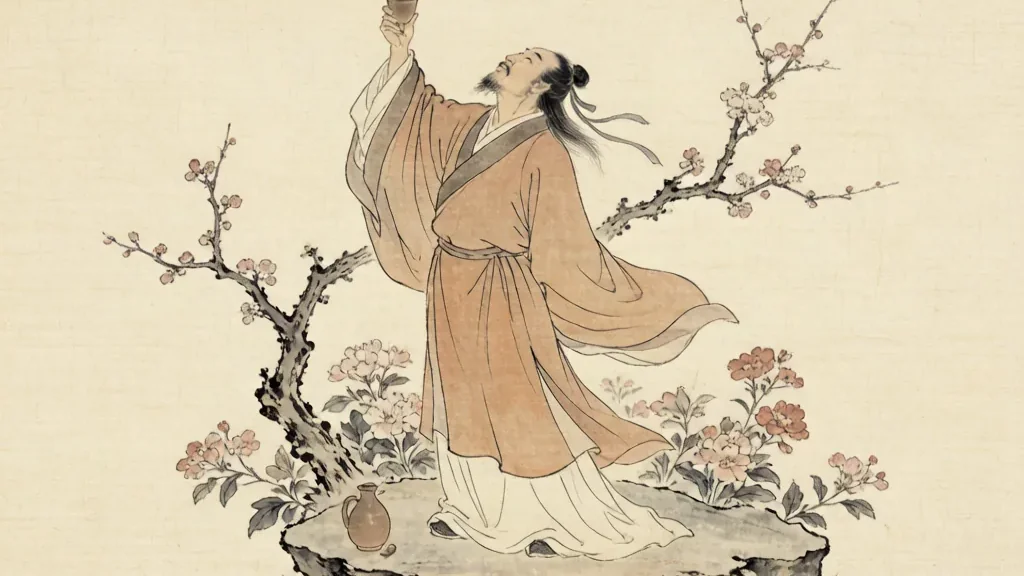
If Chinese poetry has a single face, it is the face of Li Bai—raised to the moon, wine cup in hand, hair disheveled by the wind, laughing at the absurdity of existence while somehow capturing its deepest truths in lines of breathtaking beauty. Known as the "Immortal Poet" (诗仙), Li Bai is not merely the greatest poet of the Tang Dynasty, widely considered China's golden age of poetry—he is arguably the most beloved poet in all of Chinese history, a figure whose verses are memorized by schoolchildren and quoted by scholars, whose life has become legend, and whose spirit of wild freedom continues to inspire more than thirteen centuries after his death.
Li Bai wrote about what he loved: wine, moonlight, friendship, solitude, the grandeur of nature, and the bittersweet passage of time. His poems leap from cosmic visions to intimate moments, from Daoist mysticism to drunken revelry, from profound melancholy to exuberant joy—sometimes within the space of a single stanza. He was not a poet of careful craft and scholarly refinement but of raw inspiration, claiming to compose hundreds of lines in a single sitting while thoroughly intoxicated. Whether or not this was literally true, it captures the essence of his genius: a seemingly effortless channeling of experience into verse that feels as fresh and urgent today as when it was first written.
A Wandering Youth
Li Bai's origins are appropriately mysterious for a man who would become a figure of legend. He was born in 701 CE, possibly in Suyab, a frontier town in what is now Kyrgyzstan—a detail that reflects the cosmopolitan reach of the Tang Empire at its height. His family moved to Sichuan when he was a child, and it was there, in the lush and mountainous southwest of China, that he grew up.
From an early age, Li Bai displayed both prodigious talent and an aversion to conventional paths. He studied the Confucian classics, as all educated young men did, but he was far more drawn to Daoist texts, swordplay, and the company of unconventional characters. He claimed to have killed several men in sword fights during his youth—a boast that may be exaggeration but that captures his self-image as a knight-errant as much as a scholar.
Rather than sitting for the imperial examinations, the standard route to official position and social respectability, Li Bai chose to wander. In his mid-twenties, he left Sichuan and embarked on a life of travel that would take him across the length and breadth of the Tang Empire. He journeyed down the Yangtze River, visited the great cities of the eastern coast, climbed sacred mountains, and sought out Daoist masters in remote retreats. Everywhere he went, he wrote poetry, and his reputation began to spread.
At the Imperial Court
Li Bai's fame eventually reached the imperial capital of Chang'an, where he was summoned to the court of Emperor Xuanzong around 742 CE. The circumstances of his arrival are the stuff of legend: according to one account, he was so drunk when the imperial summons arrived that he had to be splashed with cold water to sober up enough to present himself. Once at court, he made an immediate impression, and the emperor appointed him to the Hanlin Academy, an institution of distinguished scholars who served as imperial advisors and secretaries.
At the height of his court career, Li Bai enjoyed extraordinary privileges. The emperor himself is said to have personally stirred his soup to cool it, and the emperor's favorite concubine, the legendary beauty Yang Guifei, is said to have ground ink for his brush. He was given free access to the imperial wine cellars and encouraged to compose poetry for court occasions. For a brief, glorious period, Li Bai lived the life of a poet-prince at the very center of the world's most sophisticated court.
But Li Bai was fundamentally unsuited to court life. He was too proud to flatter, too drunk to be reliable, too free-spirited to navigate the intricate politics of the palace. The famous story of his downfall involves the powerful eunuch Gao Lishi, whom Li Bai allegedly humiliated by forcing him to remove his boots while the poet composed verses for the emperor. Whether this incident actually occurred, it captures the essential conflict: Li Bai's insistence on treating the powerful as equals was both his greatest charm and his political undoing.
After only a few years at court, Li Bai left—or was encouraged to leave—Chang'an. He departed with the emperor's gifts and returned to the wandering life that suited him better. The experience gave him some of his most memorable poetry, including verses that contrast the falseness of court life with the authenticity of nature and friendship.
The Poetry of Wine and Moonlight
Two themes dominate Li Bai's poetry above all others: wine and moonlight. Wine, for Li Bai, was not merely a pleasure but a spiritual necessity—a way of dissolving the ego, transcending social constraints, and accessing a state of creative freedom. His most famous wine poem, "Drinking Alone by Moonlight," begins with a situation that could be pathetic—a man drinking alone—and transforms it into a cosmic celebration:
"A cup of wine, under the flowering trees; / I drink alone, for no friend is near. / Raising my cup I beckon the bright moon, / For her, with my shadow, will make three men." In Li Bai's imagination, the moon becomes a drinking companion, and his own shadow completes the party. When the moon refuses to drink and the shadow merely imitates his movements, he shrugs off the disappointment and declares that he will find his true friends in the Milky Way. What begins as loneliness ends as transcendence.
Moonlight serves a similar function in his poetry: it is the light that reveals the true nature of things, the bridge between the earthly and the celestial. His most anthologized poem, "Quiet Night Thoughts," captures this in just four lines that every Chinese schoolchild learns: "Before my bed, the moonlight is so bright, / It seems like frost upon the ground. / Lifting my head, I gaze at the bright moon; / Lowering my head, I think of home." In its deceptive simplicity, the poem connects the universal experience of seeing moonlight with the equally universal experience of homesickness, creating an emotional resonance that transcends time and culture.
Nature is another constant presence in Li Bai's work, but it is rarely nature observed with scientific detachment. Instead, his landscapes are charged with emotion and meaning—waterfalls that seem to pour from the Milky Way, mountains that touch the sky, rivers that carry the poet's thoughts across thousands of miles. His most famous landscape poem, "Viewing the Waterfall at Mount Lu," describes a waterfall as a river of silver descending from heaven, a cosmic event rather than a merely geographical one.
Friendship and Farewell
Li Bai's poetry is also deeply social. He wrote constantly for and about his friends, and his farewell poems are among the most moving in the Chinese tradition. In a world where travel was slow and separation often permanent, saying goodbye carried a weight that modern readers can barely imagine. Li Bai's parting poems acknowledge this sadness while refusing to be crushed by it.
His poem "Seeing Off Meng Haoran at Yellow Crane Tower" is a masterpiece of the genre. Meng Haoran was another great poet and a close friend, and the poem describes his departure down the Yangtze River in spring: "My old friend leaves Yellow Crane Tower in the west, / Going down to Yangzhou in the mist of March flowers. / The lonely sail, a distant shadow, vanishes in the blue void; / All I see is the Yangtze River flowing to the edge of the sky." The image of the solitary sail disappearing into infinity is both a precise description and a metaphor for the finality of parting—the friend recedes until he becomes one with the vastness of the world.
Li Bai's most famous friendship was with Du Fu, the other titan of Tang poetry. The two met in 744 CE, when Li Bai was in his forties and Du Fu was in his early thirties. They traveled together, shared wine and poetry, and formed a bond that would become legendary in Chinese literary history. Du Fu, the more careful and scholarly poet, was in awe of Li Bai's wild genius and wrote several poems about him, including one that captures his friend's essence: "Li Bai, a hundred poems for a gallon of wine, / Sleeps in a tavern in the city of Chang'an. / The Son of Heaven calls him but he will not board the boat; / He declares himself a wine immortal."
Daoism and the Quest for Immortality
Li Bai was deeply influenced by Daoist philosophy and practice. He studied with Daoist masters, practiced breathing exercises and meditation techniques, and was formally initiated into the Daoist priesthood in his forties. Daoism gave him a vocabulary for expressing his deepest intuitions about the nature of reality: the sense that the visible world is a veil over something deeper, that the ego is an illusion to be transcended, and that true freedom lies in harmonizing with the Dao rather than struggling against it.
But Li Bai was never a systematic philosopher, and his Daoism was as idiosyncratic as everything else about him. He combined Daoist ideas with a love of wine that would have horrified more ascetic practitioners, and his pursuit of immortality was less a matter of dietary restrictions and alchemical formulas than of living so intensely in the present moment that time itself seemed to dissolve. "Since life is but a dream," he wrote, "why toil to no avail?"
This embrace of impermanence rather than resistance to it is one of the most appealing aspects of Li Bai's worldview. He was acutely aware of mortality—the poems are full of references to white hair, passing seasons, and the brevity of human life—but he responded not with despair but with a determination to savor every moment. "Let us drink and be merry," he urges, "for we know not what tomorrow brings." It is a philosophy as old as poetry itself, but Li Bai expressed it with unmatched vividness and charm.
War, Exile, and Decline
The later years of Li Bai's life were darkened by the political chaos that engulfed the Tang Dynasty. The An Lushan Rebellion of 755 CE shattered the empire's peace and sent the imperial court fleeing from Chang'an. Li Bai, now in his fifties, found himself caught up in the conflict. He attached himself to the entourage of Prince Lin, one of the emperor's sons, who was leading a military campaign in the Yangtze region.
It proved to be a catastrophic misjudgment. Prince Lin was accused of rebellion against the newly enthroned emperor, his forces were crushed, and his followers were arrested. Li Bai was imprisoned and sentenced to death. Only the intervention of powerful friends—including the general Guo Ziyi, who offered to trade his own rank for the poet's life—saved him. The sentence was commuted to exile in the remote southwestern region of Yelang.
Li Bai never reached Yelang. While traveling into exile, an imperial amnesty arrived, and he was permitted to return. His poem "Leaving White Emperor City at Dawn," written on this occasion, transforms his reprieve into one of the most joyful poems in the Chinese language: "In the morning I leave White Emperor City amidst the colored clouds; / A thousand miles to Jiangling, I arrive in a single day. / The gibbons on both banks cannot stop crying; / My light boat has already passed ten thousand mountains." The speed of the boat mirrors the lightness of a heart released from the shadow of death.
The final years were difficult. Li Bai was aging, ill, and largely dependent on the generosity of friends and admirers. He continued to wander and to write, but the exuberance of his youth had been tempered by loss and hardship. His last poems speak of loneliness, regret, and the approach of death with a directness that is all the more powerful for being so rare in his earlier work.
The Legendary Death
Li Bai died in 762 CE, at the age of sixty-one. The historical cause of death was likely illness—perhaps cirrhosis of the liver, the predictable consequence of a lifetime of heavy drinking, or possibly mercury poisoning from Daoist elixirs. But the popular imagination could not accept such a mundane end for the Immortal Poet. Instead, a legend arose that has become inseparable from his legacy.
According to the legend, Li Bai was drinking in a boat on the Yangtze River one moonlit night. Gazing at the moon's reflection in the water, drunk and overcome by its beauty, he leaned over the side to embrace it—and fell into the river and drowned. Some versions add that he was trying to catch the moon, others that he saw the reflection as the real moon and tried to join it. In all versions, his death is not an accident but a final act of poetry: the poet who had spent his life drinking with the moon at last merged with it, becoming one with the celestial companion who had inspired his greatest verses.
This story is almost certainly apocryphal, but its persistence tells us something important about how Li Bai has been remembered. He was not merely a great writer but a figure who seemed to transcend ordinary human limitations—a poet whose life itself was a work of art, whose death could only be imagined as a transformation rather than an ending. The legend of the moon-embrace is the culture's way of insisting that Li Bai did not really die; he simply returned to the realm of immortals from which he had briefly descended.
The Immortal Poet's Enduring Light
Li Bai's influence on Chinese culture is immeasurable. His poems are among the most memorized and recited texts in the language. His image—the drunken genius, the knight-errant poet, the friend of the moon—has become one of the defining archetypes of the Chinese literary imagination. Every Chinese poet who followed him has written in his shadow, and his lines have been quoted, alluded to, and adapted by generations of writers, painters, and calligraphers.
Beyond China, Li Bai has been embraced by world literature. His poems have been translated into dozens of languages, inspiring poets from Ezra Pound to Pablo Neruda. The German composer Gustav Mahler set his poetry to music in Das Lied von der Erde. His work appears in anthologies, on posters, in films, and on social media. In an age of global connection, Li Bai has become a citizen of the world—a poet whose vision of freedom, beauty, and the bittersweet brevity of life speaks across all boundaries of language and culture.
Perhaps the deepest reason for Li Bai's enduring appeal is that he reminds us of something we are always in danger of forgetting: that life, for all its sorrows and limitations, is also a source of inexhaustible wonder. The moon still rises over the mountains. Wine still warms the heart of friendship. The river still flows to the edge of the sky. And somewhere, in the words of a poet who died thirteen centuries ago, these simple things are still being celebrated with a freshness that time cannot diminish. Li Bai did not achieve physical immortality—no one does—but he achieved something perhaps more remarkable: he became the voice of the eternal in the fleeting, the immortal poet whose verses make us feel, however briefly, that we too might live forever.
❓ Frequently Asked Questions
📝 Chinese Vocabulary
- 李白 (Lǐ Bái) — Li Bai, also known as Li Po, the "Immortal Poet"
- 诗仙 (Shīxiān) — "Immortal Poet," Li Bai's honorific title
- 静夜思 (Jìng Yè Sī) — "Quiet Night Thoughts," Li Bai's most famous poem
- 月下独酌 (Yuè Xià Dú Zhuó) — "Drinking Alone by Moonlight," one of his best-loved works
- 黄河之水天上来 (Huánghé zhī shuǐ tiān shàng lái) — "The Yellow River's waters come from heaven," a famous line from his poem "Bring in the Wine"
🎉 Fun Facts
- Li Bai claimed to have killed several men in sword fights as a young man—whether true or not, it contributed to his image as a knight-errant poet.
- The legendary story of his death—drowning while trying to embrace the moon's reflection—has inspired countless paintings and poems over the centuries.
- Li Bai's poetry was set to music by Gustav Mahler in Das Lied von der Erde (The Song of the Earth), one of the greatest works of classical music.
- A crater on the planet Mercury is named Li Bai, one of many craters there honoring famous writers and artists from around the world.
- He and Du Fu met only briefly in 744, yet the pair became known as 'Li-Du,' a fixed pairing in Chinese literary criticism ever since.
- Li Bai's verse strongly shaped Japanese poetry, and Tang-style poems were prized at the Japanese court for centuries after his death.