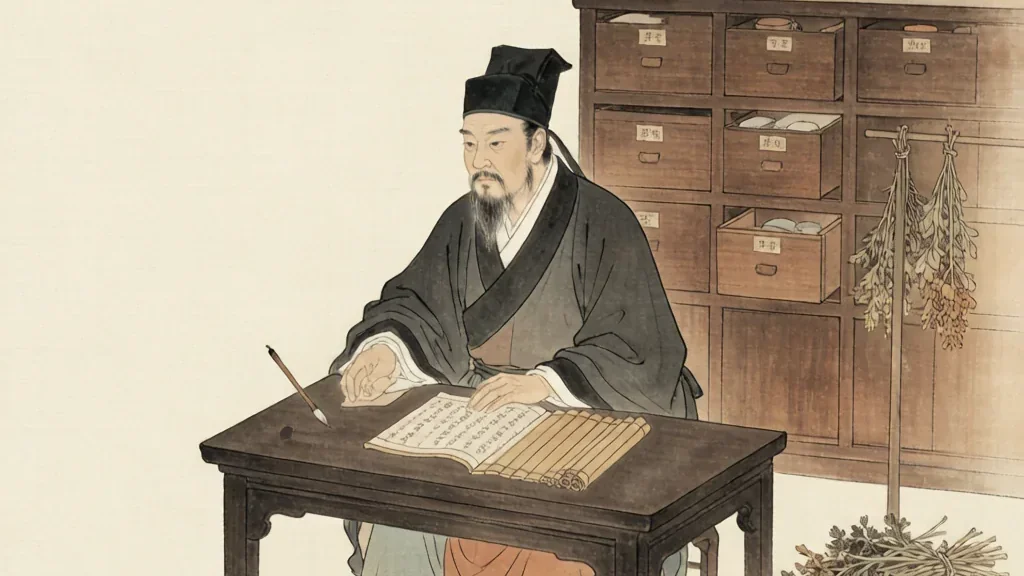
In the pantheon of medical history, certain names stand above all others: Hippocrates in Greece, Galen in Rome, Avicenna in Persia. In China, that name is Zhang Zhongjing—a physician of the Eastern Han Dynasty whose work has saved countless millions of lives across nearly two thousand years. Revered as the "Medical Sage" (医圣, Yī Shèng), Zhang Zhongjing authored the Treatise on Cold Damage and Miscellaneous Diseases (伤寒杂病论, Shānghán Zábìng Lùn), a monumental work that systematized the diagnosis and treatment of diseases with a rigor and comprehensiveness unmatched in his era.
What makes Zhang Zhongjing's story truly remarkable is not just his medical genius, but the compassion that drove it. He lived in an age of devastating epidemics, when disease swept through communities like wildfire and the art of medicine was as much superstition as science. Watching his own family decimated by illness, Zhang dedicated his life to creating a medical system that was practical, systematic, and accessible to all. His work would become the foundation of Traditional Chinese Medicine as it is practiced today, influencing everything from herbal formulations to the diagnostic method of "pattern differentiation" that remains central to Chinese medical practice.
A World Ravaged by Disease
Zhang Zhongjing was born around 150 CE in Nanyang, in what is now Henan Province, during the waning years of the Eastern Han Dynasty. It was an era of profound crisis. The empire was crumbling under the weight of corruption, peasant rebellions, and warlord conflicts. But perhaps the most devastating force of all was invisible: epidemic disease. Historical records describe wave after wave of "cold damage disorders" (伤寒, shānghán)—a broad category of febrile illnesses that likely included typhoid, influenza, and various viral infections—sweeping through the population.
The impact on Zhang's own family was catastrophic. In the preface to his masterpiece, he wrote with heartbreaking precision: "My clan was once large, numbering over two hundred members. But within less than ten years, two-thirds of them died, and seven out of ten of those deaths were from cold damage disorders." This personal tragedy transformed Zhang from a promising scholar-official into a physician with a burning sense of mission. If the established medical knowledge of his time could not save his family, then that knowledge needed to be revolutionized.
Zhang was uniquely positioned to undertake this revolution. He had received a classical Confucian education and had even served as the prefect of Changsha, but he had also studied medicine intensively under the renowned physician Zhang Bozu. He was deeply read in the medical classics of his time, including the Yellow Emperor's Inner Canon (黄帝内经, Huángdì Nèijīng) and the Classic of Difficult Issues (难经, Nàn Jīng). Yet he found existing medical texts to be fragmented, contradictory, and often too theoretical to be useful in actual clinical practice. What the world needed, he believed, was a comprehensive manual that a physician could actually use at the bedside.
The Treatise That Changed Medicine Forever
The result of Zhang's lifelong labor was the Shanghan Zabing Lun, a work so influential that it has been described as the single most important text in the history of Chinese medicine. The treatise is divided into two major sections: one dealing with "cold damage" (externally contracted febrile diseases) and another covering "miscellaneous diseases" (internal disorders). What set this work apart from all previous medical literature was its revolutionary methodology.
Zhang introduced the "Six Channel Differentiation" (六经辨证, Liù Jīng Biànzhèng) system, a diagnostic framework that classified febrile diseases into six progressive stages based on the depth of pathogen invasion and the body's response. Beginning with the Taiyang (Greater Yang) stage, when the disease is still on the surface, through the Yangming, Shaoyang, Taiyin, Shaoyin, and finally the Jueyin stage, this system allowed physicians to track the progression of illness and apply appropriate treatments at each stage. It was a remarkably sophisticated model that anticipated modern understanding of disease progression by nearly two millennia.
For each stage, Zhang provided precise diagnostic criteria, treatment principles, and specific herbal formulas. The book contains over 260 formulas, many of which remain in clinical use today with their original compositions virtually unchanged. Formulas like Guizhi Tang (Cinnamon Twig Decoction) for early-stage external conditions, Mahuang Tang (Ephedra Decoction) for more severe exterior conditions, and Xiao Chaihu Tang (Minor Bupleurum Decoction) for the intermediate Shaoyang stage are prescribed millions of times daily in clinics across China and beyond. The longevity of these formulas—many still effective after 1,800 years—testifies to the depth of Zhang's clinical insight.
The Art of Formula Composition
One of Zhang Zhongjing's greatest contributions was his systematic approach to herbal formula design. Before his time, Chinese herbal medicine often consisted of single herbs or simple combinations applied according to tradition rather than principle. Zhang transformed this practice by developing what is known as the "sovereign, minister, assistant, and envoy" (君臣佐使, Jūn Chén Zuǒ Shǐ) theory of formula composition.
In this elegant system, each ingredient in a formula plays a specific role. The "sovereign" herb (君药, Jūn Yào) targets the main disease pattern. The "minister" herb (臣药, Chén Yào) reinforces the sovereign's effect or addresses secondary symptoms. The "assistant" herb (佐药, Zuǒ Yào) modulates the formula—reducing toxicity, counteracting side effects, or addressing complicating factors. The "envoy" herb (使药, Shǐ Yào) guides the formula to the appropriate part of the body or harmonizes the actions of the other ingredients. This hierarchical approach to formula design, analogous to the organization of a well-run government, ensured that herbal combinations were both effective and safe.
Consider one of Zhang's most famous creations: Baihu Tang (White Tiger Decoction), used for high fever with extreme thirst and profuse sweating. The formula contains only four ingredients: gypsum as the sovereign to clear intense heat, anemarrhena as the minister to nourish yin and assist the gypsum, licorice as the assistant to protect the stomach, and rice as the envoy to generate fluids and harmonize. Despite its simplicity, this formula has been saving lives from severe febrile diseases for nearly two millennia, and modern research has confirmed its antipyretic and anti-inflammatory properties.
Beyond Herbs: A Complete Medical System
Zhang Zhongjing's genius extended far beyond herbal medicine. His treatise also described acupuncture protocols, dietary therapy, and even emergency resuscitation techniques. He was one of the first physicians to systematically describe the use of moxibustion (the burning of mugwort on or near acupuncture points) for specific conditions. He provided detailed dietary recommendations for convalescent patients, recognizing that recovery depended as much on proper nutrition as on medication.
Perhaps most remarkably, Zhang's work included what might be called the first emergency medicine manual. He described techniques for rescuing drowning victims (including positioning the patient to drain water from the lungs and applying warmth to restore circulation) and for treating hanging victims (cutting them down carefully, clearing the airway, and performing chest compressions). His description of artificial respiration for near-drowning victims is strikingly similar to modern CPR protocols, demonstrating a practical, hands-on approach to medicine that was centuries ahead of its time.
Zhang also made pioneering contributions to gynecology and obstetrics. His treatise includes detailed discussions of pregnancy-related conditions, postpartum disorders, and women's health issues that were rarely addressed in the medical literature of his era. His formula Danggui Shaoyao San (Angelica and Peony Powder) remains one of the most commonly prescribed herbal formulas for women's health throughout East Asia.
The Sage's Enduring Legacy
Zhang Zhongjing died around 219 CE, but his influence has only grown with time. During the Song Dynasty (960–1279), his treatise was rediscovered, reorganized, and published in two parts: the Treatise on Cold Damage (伤寒论, Shānghán Lùn) and the Essential Prescriptions from the Golden Cabinet (金匮要略, Jīnkuì Yàoluè). These became required texts for the Imperial Medical Academy and have remained central to Chinese medical education ever since.
The "Shanghan school" of medicine that grew from Zhang's work became one of the most influential traditions in Chinese medical history. Physicians across China, Korea, Japan, and Vietnam studied and debated his formulas, developing an entire scholarly tradition devoted to understanding and applying his insights. In Japan, the "Kampo" tradition of herbal medicine is essentially a direct descendant of Zhang's approach, and his formulas are manufactured as standardized pharmaceutical products and prescribed by conventional medical doctors within the Japanese national health system.
In modern China, Zhang Zhongjing is honored with temples, statues, and an annual festival in his hometown of Nanyang. Medical students still memorize his formulas and study his diagnostic methods. During the COVID-19 pandemic, several of his classical formulas—including Xiao Chaihu Tang and Maxing Shigan Tang—were officially recommended by Chinese health authorities and studied in clinical trials for their effectiveness against the virus. Nearly two thousand years after his death, the Sage of Medicine continues to heal the sick.
How the Treatise Was Saved
Zhang Zhongjing's great work could easily have been lost. Originally circulating as a single handwritten manuscript in a turbulent age, it survived the fall of the Han only by chance. During the Three Kingdoms and Jin periods the physician Wang Shuhe is credited with recovering and editing the text, preserving its diagnostic logic when war and neglect threatened to erase it. Centuries later, in the Song Dynasty, imperial scholars divided the reconstructed material into two canonical books: the Treatise on Cold Damage and the Essential Prescriptions from the Golden Cabinet. These editions became required reading at the Imperial Medical Academy. The fact that we possess the treatise at all is the result of generations of careful copying and editing, a quiet act of cultural preservation as important as the original authorship.
Pattern Differentiation in Modern Clinics
At the heart of Zhang Zhongjing's lasting influence lies Bianzheng Lunzhi, or 'pattern differentiation and treatment,' the principle that effective medicine depends on identifying a patient's unique pattern of disharmony rather than merely naming a disease. This method asks the physician to synthesize signs from the pulse, tongue, and symptoms into a coherent syndrome, then match it to a proven formula. Today the approach underpins clinical training in Traditional Chinese Medicine worldwide and is applied in hospitals alongside modern diagnostics. Its emphasis on individualized treatment anticipated contemporary personalized medicine by nearly two millennia. Whether used alone or integrated with Western medicine, the habit of reasoning from pattern to prescription remains Zhang's most powerful intellectual legacy, taught to every new cohort of TCM students.
Zhang Zhongjing's Legacy Across East Asia
Zhang Zhongjing's influence long ago crossed China's borders. In Korea, his formulas entered the indigenous herbal tradition and remain staples of oriental medicine. In Japan, the Kampo school is essentially a direct descendant of his method: classical formulas are produced as standardized medicines and prescribed by conventional physicians within the national health system, a rare case of ancient texts functioning as modern pharmaceuticals. In Vietnam, his treatise shaped the development of traditional medicine for centuries. Across these cultures, physicians still memorize his formulas and debate his case logic. The remarkable durability of his work, from a Han Dynasty scholar's desk to twenty-first-century clinics, testifies to a clinical insight so reliable that distance and language could not diminish it.
❓ Frequently Asked Questions
📝 Chinese Vocabulary
- 张仲景 (Zhāng Zhòngjǐng) — Zhang Zhongjing, the "Medical Sage" of the Eastern Han Dynasty
- 伤寒杂病论 (Shānghán Zábìng Lùn) — Treatise on Cold Damage and Miscellaneous Diseases, his magnum opus
- 医圣 (Yī Shèng) — "Medical Sage," the honorific title bestowed upon Zhang Zhongjing
- 六经辨证 (Liù Jīng Biànzhèng) — Six Channel Differentiation, Zhang's revolutionary diagnostic framework
- 君臣佐使 (Jūn Chén Zuǒ Shǐ) — Sovereign-Minister-Assistant-Envoy, the formula composition theory
🎉 Fun Facts
- Zhang Zhongjing's formula Guizhi Tang (Cinnamon Twig Decoction), created nearly 1,800 years ago, is still sold as a pharmaceutical product in Japan under the name "Keishito" and is covered by the national health insurance system.
- During the Tang Dynasty, Zhang's treatise was taken to Japan by Buddhist monks, where it became the foundation of Kampo medicine—a tradition now practiced by over 80% of Japanese physicians.
- Zhang was also a government official who served as the Prefect of Changsha, but he would famously open his office to the public one day each month to provide free medical consultations, making him one of history's first public health advocates.
- Zhang's masterpiece nearly disappeared in the chaos of the Three Kingdoms period; it was reconstructed centuries later by the physician Wang Shuhe and reorganized by Song Dynasty scholars into the two texts we know today.
- A temple complex dedicated to the Medical Sage still stands in his hometown of Nanyang, where physicians make pilgrimages and an annual festival honors his memory.
- Zhang's sovereign-minister-assistant-envoy framework for combining herbs is still taught in modern Chinese pharmacy programs as a model for designing safe, balanced drug combinations.