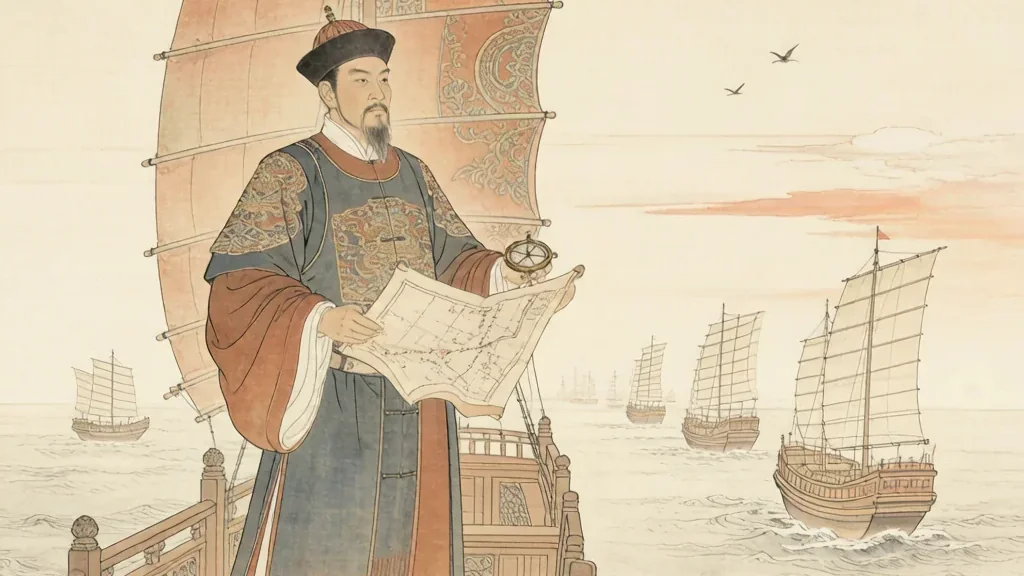
In the early fifteenth century, when European ships were still hugging the coastlines of the Mediterranean and the Atlantic, a massive Chinese fleet was sailing across the Indian Ocean, establishing diplomatic relations, mapping unknown waters, and projecting the power of the Ming Dynasty across half the globe. At its head stood a man whose life story is as remarkable as the voyages he commanded: Zheng He, the eunuch admiral who rose from captivity and servitude to become the greatest seafarer of his age.
Between 1405 and 1433, Zheng He led seven epic voyages that took him from the shores of China to Southeast Asia, India, the Arabian Peninsula, and the east coast of Africa. His treasure ships—the largest wooden vessels ever built—carried thousands of sailors, soldiers, diplomats, and scholars. His fleets included hundreds of vessels, from enormous nine-masted flagships to swift patrol boats, water tankers, and horse transports. It was the greatest maritime enterprise the world had ever seen, and it would not be matched in scale until the twentieth century.
From Captive to Commander
Zheng He was born around 1371 in Yunnan Province, in the far southwest of China, to a Muslim family of Mongol or Central Asian origin. His birth name was Ma He—Ma being a common Chinese Muslim surname derived from Muhammad. His father and grandfather had both made the pilgrimage to Mecca, and the young Ma He grew up hearing stories of distant lands, foreign peoples, and the vastness of the world beyond China's borders.
His life changed abruptly in 1381, when Ming Dynasty forces invaded Yunnan to suppress the remnants of Mongol rule. The ten-year-old Ma He was captured, castrated—a common fate for boys taken in warfare—and sent to serve in the household of Zhu Di, the Prince of Yan. It was a brutal beginning, but it placed Ma He at the center of Ming power. He grew up alongside the prince, receiving an education in military arts, strategy, and statecraft that would have been unimaginable in his home province.
Ma He distinguished himself in the civil war that erupted when Zhu Di rebelled against his nephew, the reigning Jianwen Emperor. He served with distinction in key battles, and when Zhu Di seized the throne to become the Yongle Emperor in 1402, Ma He was rewarded with a new name: Zheng He. The surname "Zheng" commemorated his service in a crucial cavalry battle at a place called Zhenglunba. The eunuch servant had become a trusted commander of the new emperor.
The Treasure Fleet
The Yongle Emperor had grand ambitions. He had moved the capital from Nanjing to Beijing, commissioned the construction of the Forbidden City, and launched military campaigns against the Mongols. Now he turned his attention to the seas. He wanted to demonstrate Ming power to the world, to establish China as the center of a vast tributary system, and perhaps to track down his deposed nephew, who was rumored to have escaped overseas. For this mission, he chose Zheng He.
The fleet Zheng He commanded was unlike anything the world had seen. The largest vessels, known as "treasure ships," were estimated to be up to 400 feet long—nearly four times the length of Columbus's flagship, the Santa María. They had nine masts, multiple decks, and watertight compartment hulls, a Chinese innovation that made ships far more resistant to sinking. The fleet included specialized support vessels: horse ships carrying cavalry, supply ships loaded with food and fresh water, and warships bristling with cannons and troops.
Modern scholars debate the exact dimensions of Zheng He's ships—some argue that the largest estimates are exaggerations—but there is no doubt that the fleet was enormous by any standard. The first voyage alone involved over 300 vessels and nearly 28,000 men. The armada must have been an awe-inspiring sight: hundreds of ships stretching across the horizon, their red sails billowing in the monsoon winds, carrying the power and prestige of the Ming Empire to distant shores.
The Seven Voyages
Zheng He's first voyage departed in 1405, sailing south through the South China Sea to Java, Sumatra, and the Strait of Malacca, then across the Indian Ocean to Calicut on India's southwest coast—a major hub of the spice trade. At each port, Zheng He presented gifts of silk, porcelain, and gold to local rulers, who in turn offered tribute and acknowledged the suzerainty of the Ming emperor. It was diplomacy on a grand scale, backed by the implicit threat of overwhelming force.
The second and third voyages followed similar routes, consolidating relationships established on the first expedition and extending Chinese influence deeper into the Indian Ocean. Zheng He installed a friendly ruler on the throne of Malacca, creating a crucial ally that controlled the strategic strait. He mediated disputes between local kingdoms, suppressed pirate activity, and established a network of Chinese trading communities that would persist for centuries.
The fourth voyage (1413–1415) marked a dramatic expansion of the fleet's range. Sailing beyond India, Zheng He reached the Maldives, Hormuz at the entrance to the Persian Gulf, and the coast of Arabia. His ships carried envoys from more than a dozen kingdoms back to China, where they were received at the Ming court with elaborate ceremony. The Yongle Emperor's vision of a China-centered world order seemed to be becoming reality.
The fifth, sixth, and seventh voyages pushed even further. Zheng He's fleets reached the east coast of Africa, visiting Mogadishu, Malindi, and other trading cities. They brought back exotic tribute that delighted the Chinese court: giraffes (mistaken for the mythical qilin, a creature of good omen), zebras, ostriches, and other African animals never before seen in China. They also brought back detailed navigational charts, geographical knowledge, and diplomatic relationships that extended China's reach across the known world.
Encounters and Diplomacy
Zheng He's voyages were not primarily military expeditions, but they were prepared for conflict. When diplomacy failed, the admiral did not hesitate to use force. In Sumatra, he intervened in a succession dispute, capturing a usurper and bringing him back to China for execution. In Sri Lanka, he defeated a hostile king who had attacked his fleet, taking the royal family prisoner and installing a more cooperative ruler. In Palembang, he crushed a Chinese pirate lord who had been terrorizing the straits for years.
But force was the exception, not the rule. The vast majority of Zheng He's encounters were peaceful. His fleets carried not only soldiers but also scholars, doctors, interpreters, and chroniclers who documented everything they saw: the customs of foreign peoples, the products of distant lands, the patterns of winds and currents, the locations of reefs and harbors. The voyage records, compiled by Zheng He's associates Ma Huan, Fei Xin, and Gong Zhen, provide some of the earliest detailed Chinese accounts of the Indian Ocean world.
Zheng He's approach to foreign relations reflected the Chinese worldview of the time. The Ming emperor, in this view, was the Son of Heaven, the rightful ruler of all under heaven. Foreign rulers who acknowledged this supremacy and sent tribute would be rewarded with trade, protection, and gifts far exceeding the value of their tribute. It was a system based on symbolic hierarchy rather than territorial conquest—a way of managing international relations that was quite different from the European model of colonization that would soon reshape the world.
Zheng He himself was notably respectful of the diverse cultures he encountered. His Muslim background allowed him to connect with Islamic communities across the Indian Ocean. He made a point of visiting Buddhist, Hindu, and Muslim holy sites, leaving inscriptions and donations that have been discovered by modern archaeologists. In Sri Lanka, he erected a trilingual stele—in Chinese, Tamil, and Persian—praising the Buddha, Shiva, and Allah alike. This ecumenical spirit reflected both personal conviction and diplomatic pragmatism.
The End of the Voyages
After the Yongle Emperor's death in 1424, official attitudes toward the voyages shifted dramatically. The new emperor, Hongxi, was deeply influenced by Confucian scholar-officials who had always viewed the expeditions as wasteful extravagance. The treasure fleets were expensive to build and maintain, and the tribute system, while prestigious, brought little economic return. The Confucians argued that the state's resources should be devoted to domestic welfare and defense against northern nomads, not to maritime adventures in distant seas.
Zheng He's seventh and final voyage (1431–1433) was authorized by the Xuande Emperor, who had succeeded Hongxi. By this time, Zheng He was around sixty years old, and the voyage would be his last. According to some accounts, he died during the return journey and was buried at sea, though a symbolic tomb was erected for him in Nanjing. The fleet returned to China in 1433, and the great maritime enterprise came to an end.
The retreat from the sea was remarkably thorough. The Ming government banned the construction of large ocean-going ships, and many of Zheng He's navigational records were deliberately destroyed by officials who wanted to prevent future emperors from reviving the costly expeditions. China, which had possessed the world's most powerful navy and had established diplomatic relations across the Indian Ocean, turned inward. Within decades, the arrival of Portuguese ships in Asian waters would mark the beginning of a new era—one in which Europeans, not Chinese, would dominate the maritime world.
The Zheng He Legacy
For centuries, Zheng He's voyages were largely forgotten in China. The dominant Confucian culture celebrated scholars and administrators, not sailors and explorers. The destruction of the voyage records made it difficult to reconstruct exactly where the fleets had gone and what they had accomplished. In Southeast Asia, however, Zheng He's memory was preserved. Temples dedicated to him—known as Sanbao temples, using his honorific title "Sanbao Taijian" (Grand Eunuch of the Three Treasures)—can still be found in Malaysia, Indonesia, and Thailand, where he is venerated as a protective deity.
The twentieth century brought a dramatic revival of interest in Zheng He. Chinese nationalists embraced him as a symbol of China's historical greatness, proof that the country had been a global power long before the rise of the West. The British historian Gavin Menzies advanced the controversial theory that Zheng He's fleets had reached the Americas before Columbus—a claim that most professional historians reject but that captured the popular imagination. More measured scholarship has focused on understanding the voyages in their historical context, recognizing their genuine achievements without exaggerating them.
Perhaps the most intriguing question about Zheng He's voyages is counterfactual: what if China had continued to explore? What if the Ming Dynasty had maintained its naval power, established permanent colonies in Southeast Asia and Africa, and met the Europeans on equal terms when they finally arrived in Asian waters? The question is unanswerable, but it points to one of history's great turning points—the moment when the world's most powerful civilization chose to turn away from the sea, with consequences that continue to shape global politics today.
Zheng He himself emerges from the historical record as a figure of remarkable complexity. A Muslim eunuch commanding a Confucian empire's fleet. A warrior who preferred diplomacy. A captive who rose to the highest ranks of power. A man who sailed further than any of his contemporaries but whose voyages left no permanent colonies, no empires, no conquests—only relationships, memories, and the enduring image of treasure ships sailing into unknown waters, carrying the flag of a civilization that, for a brief moment, reached out to embrace the world.
Navigation and the Mao Kun Chart
Zheng He's fleets crossed open ocean with a precision that owed much to Chinese nautical science. Sailors steered by the stars using 'star plates,' graduated boards that measured the altitude of key constellations above the horizon, and timed long passages by the monsoon winds. The practical result was recorded in the Mao Kun chart, a remarkable surviving map that lays out coastlines, harbors, and compass bearings from China to the Persian Gulf and East Africa. Watertight compartment hulls, an old Chinese innovation, kept the treasure ships afloat even when holed. Together, these tools let hundreds of vessels sail in formation across thousands of miles with enough confidence to return. The charts and techniques reveal that the voyages were not lucky wanders but the product of mature, systematic seamanship.
Zheng He's Chroniclers
Because Zheng He could not write the full story himself, three of his companions left invaluable records of the voyages. Ma Huan, an interpreter, produced the Yingya Shenglan, a vivid account of the customs, clothing, and commodities of the lands visited. Fei Xin wrote the Xingcha Shenglan, blending observed geography with the wonder of distant courts. Gong Zhen added a further narrative of peoples and ports. These chroniclers traveled with scholars, doctors, and mapmakers who documented winds, currents, reefs, and markets at every stop. Their books are among the earliest detailed Chinese descriptions of the Indian Ocean world, and modern archaeologists still use them to locate ruins and trace trade. Without these writers, the treasure fleet's achievements might have faded even more completely from memory.
❓ Frequently Asked Questions
📝 Chinese Vocabulary
- 郑和 (Zhèng Hé) — Zheng He, the great Ming Dynasty admiral
- 宝船 (Bǎochuán) — Treasure ships, the largest vessels in Zheng He's fleet
- 下西洋 (Xià Xīyáng) — "Voyages to the Western Ocean," the Chinese term for Zheng He's expeditions
- 三宝太监 (Sānbǎo Tàijiàn) — "Grand Eunuch of the Three Treasures," Zheng He's honorific title
- 朝贡 (Cháogòng) — The tribute system, the framework for Ming foreign relations
🎉 Fun Facts
- Zheng He's treasure ships were estimated to be over 400 feet long—Columbus's Santa María could have fit inside one of them with room to spare.
- The giraffes Zheng He brought back from Africa were believed to be qilin, mythical creatures whose appearance signaled an era of perfect governance.
- Zheng He is still worshipped as a god in parts of Southeast Asia, where temples dedicated to "Sanbao" continue to attract worshippers more than 600 years after his voyages.
- Zheng He was born Ma He to a Muslim family in Yunnan; both his father and grandfather had made the pilgrimage to Mecca, filling his childhood with tales of distant lands.
- The fleet navigated by 'star plates' and detailed charts, and a surviving map known as the Mao Kun chart preserves routes from the Indian Ocean to Africa.
- Zheng He installed a friendly ruler on the throne of Malacca, securing the strategic strait that controlled trade between the South China Sea and the Indian Ocean.