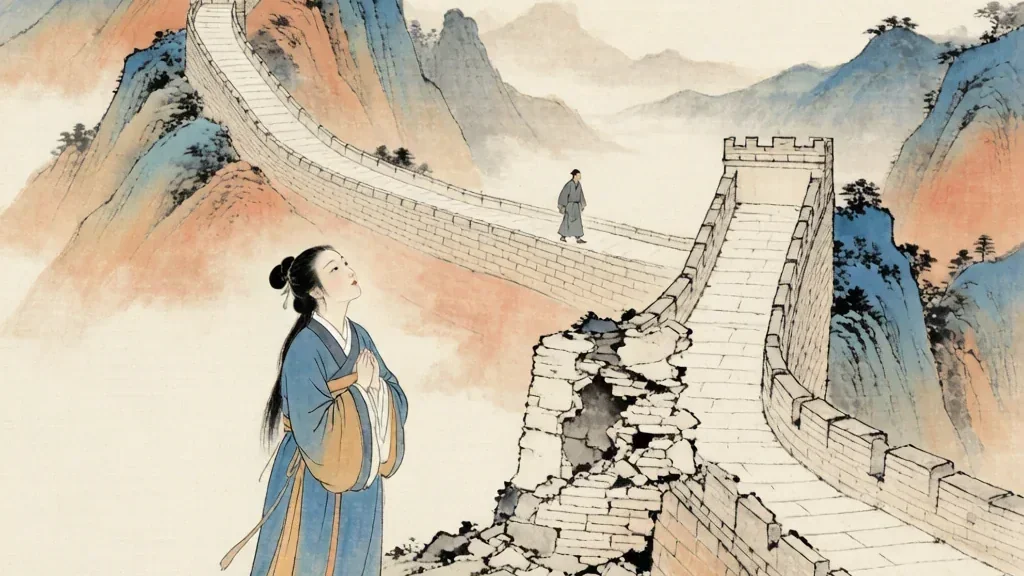
Of all the stories that have been told about the Great Wall of China — and there are many — none is as powerful, as heartbreaking, or as enduring as the legend of Meng Jiangnu. It is a story about love and loss, about the cruelty of empires and the strength of ordinary people. It is a story that says, in no uncertain terms, that the tears of a single woman can bring down the mightiest fortress ever built by human hands.
The tale of Meng Jiangnu (孟姜女) is one of China's Four Great Folktales, alongside the Butterfly Lovers, the Legend of the White Snake, and the Cowherd and the Weaver Girl. It has been told for over two thousand years, evolving and growing with each retelling, but its core has remained unchanged: a woman's grief, so vast and so pure that the heavens themselves could not ignore it.
A Birth from a Gourd
The story begins, as so many Chinese folktales do, with an unusual birth. In the kingdom of Qi during the Qin dynasty, there lived two families, the Meng family and the Jiang family, who were close neighbors and dear friends. One spring, the Meng family planted a gourd vine that grew vigorously, its tendrils reaching over the wall that separated the two properties. When the vine bore a single magnificent gourd, it hung directly over the boundary between the two yards.
Both families claimed the gourd, but being good neighbors, they agreed to split it. When they cut it open, they were astonished to find inside a beautiful baby girl. The two families, who had long desired children, decided to raise her together, naming her Meng Jiangnu — "the daughter of Meng and Jiang."
Meng Jiangnu grew into a beautiful, intelligent, and compassionate young woman. She was skilled in embroidery and poetry, and her kindness was known throughout the region. When she came of age, her parents arranged for her to marry a young man named Fan Qiliang, a scholar of modest means but excellent character. The wedding was planned, and the future seemed bright.
The Emperor's Cruel Decree
But this was the time of Qin Shi Huang, the First Emperor of China, the man who had unified the warring states into a single empire and who ruled with an iron fist. The emperor had ordered the construction of the Great Wall, a vast defensive structure that would stretch for thousands of miles across the northern frontier. To build it, he needed labor — and not voluntary labor. Across the empire, officials were ordered to conscript able-bodied men, dragging them from their homes and families to work on the wall until they dropped.
On the very day of Meng Jiangnu's wedding, before the festivities could even begin, the emperor's soldiers arrived. Fan Qiliang was seized, bound, and carried off to the north. He had been conscripted. There was no appeal, no delay, no mercy. The wedding was over before it had begun, and Meng Jiangnu was left standing in her bridal robes, watching her husband being dragged away to what might well be his death.
Months passed. There was no word from Fan Qiliang. The Great Wall was a place of suffering, where men died of exhaustion, disease, and exposure, their bodies often buried in the wall itself to serve as filler for its construction. Meng Jiangnu waited, hoping against hope, but as winter approached and the cold winds began to blow, she could wait no longer. Her husband was out there, in the freezing north, possibly without adequate clothing. She would go to him.
A Journey of Love
What followed was one of the most extraordinary journeys in Chinese folklore. Meng Jiangnu packed warm clothing — padded jackets, thick trousers, sturdy boots — and set out alone, on foot, to walk to the Great Wall. The distance was immense, over a thousand miles, through mountains and rivers, across plains and deserts. She had no money, no companions, no protection. She had only her love and her determination.
The journey took months. She walked until her shoes wore through, then walked barefoot. She walked until her feet bled, then wrapped them in rags and walked more. She begged for food when she could, ate wild plants when she could not. She faced bandits and wild animals, storms and freezing nights. And through it all, she pressed on, driven by the image of her husband shivering on the wall, waiting for the warmth she was bringing him.
When she finally reached the Great Wall, she found a scene of unimaginable suffering. Thousands of men labored under the whips of overseers, skeletal and broken, building a wall that seemed to stretch to the ends of the earth. She searched among them, asking every face, calling Fan Qiliang's name. But no one had seen him. No one knew where he was.
Finally, a fellow laborer, an old man with hollow eyes, told her the truth. Fan Qiliang was dead. He had died of exhaustion weeks after his arrival, and his body — like so many others — had been thrown into the wall and sealed inside with stone and mortar. There was no grave to visit, no body to recover. He was part of the wall now, just another nameless victim of the emperor's ambition.
The Tears That Crumbled Stone
The news broke Meng Jiangnu. She collapsed at the foot of the wall, and there, beneath the towering stones that had swallowed her husband, she began to weep. She wept for the love she had lost, for the future that had been stolen from her, for the cruelty of a world that could treat human beings as building materials. She wept for Fan Qiliang, who had died cold and alone and nameless, his body entombed in stone.
She wept for three days and three nights. She did not eat, did not drink, did not sleep. She simply wept. Her tears fell upon the stones of the wall, and as they fell, something miraculous — or terrible — began to happen. The stones began to tremble. Cracks appeared in the mortar. The wall, that mighty monument to imperial power, began to shake.
And then, with a sound like thunder, a section of the Great Wall collapsed. Twenty li of wall — nearly seven miles — crumbled to the ground, burying the bodies of the dead conscripts beneath the rubble. And there, among the broken stones, Meng Jiangnu found what she had been seeking: the bones of her husband.
How she recognized his bones among the countless others is a question the legend does not answer directly. Some versions say she bit her finger and let her blood drip upon the bones — and where the blood soaked in, she knew it was Fan Qiliang. Others say she simply knew, the way a wife knows her husband, by a knowledge deeper than sight. Whatever the method, she gathered his remains and held them to her breast, her tears still falling, her grief still unspent.
The Emperor and the Sea
When Qin Shi Huang heard that a woman had collapsed his wall, he was furious. He ordered her brought before him, intending to punish her severely. But when he saw Meng Jiangnu, his anger turned to something else. She was beautiful, even in her grief, and her courage had moved even his hardened heart. He offered her a deal: he would give her husband a proper burial, with honors, if she would agree to become his concubine.
Meng Jiangnu, however, was not to be bought. She had not walked a thousand miles and wept down a wall to become the plaything of the man who had killed her husband. She agreed, but only on three conditions: the emperor must hold a grand funeral for Fan Qiliang, with the entire court in attendance; the emperor himself must mourn, dressed in mourning white; and he must build a bridge over the sea where she could go to mourn her husband in peace.
The emperor, blinded by his desire, agreed to all three conditions. The funeral was held. The emperor wore white. The bridge was built, stretching far out over the Bohai Sea. And on the day the bridge was completed, Meng Jiangnu walked to its end, looked out over the vast gray waters, and, with one last thought of her beloved Fan Qiliang, she threw herself into the sea.
The emperor's guards rushed to save her, but they were too late. The sea had claimed her. And as they stood on the bridge, watching the waves close over the place where she had fallen, they saw something miraculous — the sea suddenly churned and frothed, and from its depths, two fish leaped, dancing together in the spray before vanishing beneath the waves. It was Meng Jiangnu and Fan Qiliang, reunited at last in death, as they had never been allowed to be in life.
The Story That Will Not Die
The legend of Meng Jiangnu has endured for over two thousand years because it speaks to something deeply human. It is, on one level, a protest against tyranny — a reminder that the mightiest empires are built on the suffering of ordinary people, and that this suffering cannot be silenced forever. But it is also, more fundamentally, a love story. Meng Jiangnu's journey, her tears, her final leap into the sea — all are testaments to the power of love to transcend even the most crushing circumstances.
Throughout Chinese history, the story has been used as a veiled criticism of oppressive rulers, of wars that drain the countryside of its young men, of public works that consume human lives.
Today, at the Shanhai Pass where the Great Wall meets the sea, there is a temple dedicated to Meng Jiangnu. Pilgrims come from across China to honor her, to lay flowers at her shrine, to weep for the loved ones they have lost. The temple stands as a monument not to the power of emperors, but to the power of tears — to the truth that the walls we build, no matter how mighty, will one day fall before the force of human grief and human love.
From Qi Liang's Wife to Meng Jiangnu
The figure we know as Meng Jiangnu grew out of a much older lament. In the Zuozhuan, a woman named the wife of Qi Liang wept so bitterly at her husband's death in war that the very wall of the state of Qi collapsed, centuries before any Great Wall existed. Over time storytellers moved the scene northward, attached it to Qin Shi Huang's wall, and gave the mourner the compound name Meng Jiangnu. This slow evolution shows how a local elegy was nationalized into a protest against imperial forced labor. Each dynasty reshaped her to fit its own concerns, yet the core of loyal grief and defiant tears remained, proving how flexible oral tradition can be in preserving feeling while changing setting.
Meng Jiangnu on Stage
The lament has long been a favorite of performers. Regional operas from northern Shaanxi to southern Jiangsu stage her journey and her collapse of the wall, often with stylized weeping songs that let actors show their skill. Shadow plays and ballad-singers carried simpler versions to village audiences, while modern drama and film recast her as a symbol of resistance to tyranny. Because the story needs few props, a single singer with a drum could tell it anywhere, which helped it spread widely. The emotional climax, the three-day weeping that moves heaven, translates naturally to music and gesture, making Meng Jiangnu one of the most frequently staged of the Four Great Folktales. Village troupes still perform her tale during the cold-food season, and television adaptations keep her image before new audiences with each passing generation.
❓ Frequently Asked Questions
📝 Chinese Vocabulary
孟姜女 — : "The daughter of Meng and Jiang" — the heroine of the story, whose tears collapsed the Great Wall.
哭长城 — : "Weep at the Great Wall" — the central event of the legend; part of the title 孟姜女哭长城.
长城 — : "The Great Wall" — the vast defensive structure whose construction caused immense suffering.
秦始皇 — : Qin Shi Huang, the First Emperor of China, who ordered the construction of the Great Wall and is the antagonist of the story.
范杞梁 — : Fan Qiliang, the name of Meng Jiangnu's husband in this telling of the legend, the scholar seized on their wedding day.
葫芦 — : The gourd from which Meng Jiangnu was born, grown jointly by the Meng and Jiang families who raised her.
山海关 — : Shanhai Pass, where the Great Wall meets the sea and where her temple remains a pilgrimage site.
孟姜女庙 — : The Meng Jiangnu Temple at Shanhai Pass, honoring the weeping wife for more than a thousand years.
🎉 Fun Facts
- The legend of Meng Jiangnu is based on a real historical event from the 5th century BCE, though it was greatly embellished over the centuries and eventually associated with Qin Shi Huang's Great Wall.
- At the Shanhai Pass, where the Great Wall meets the sea, there is a temple dedicated to Meng Jiangnu that has been a pilgrimage site for over a thousand years.
- The story has been adapted into every major form of Chinese opera, with regional variations that reflect local customs and musical traditions.
- The image of a single woman's tears bringing down a wall has become a powerful political metaphor in Chinese culture, invoked in folk songs and protests throughout history as a symbol of resistance against tyranny.
- In the earliest versions the weeping wife was named Qi Liang's wife and lamented at the wall of the state of Qi, centuries before Qin Shi Huang's time.
- The story's association with the Cold Food Festival links Meng Jiangnu's grief to older spring rites of mourning observed across northern China.
📅 Explore the Lunar Calendar
Traditional Chinese stories like Meng Jiangnu's are tied to seasonal cycles. Discover the lunar calendar and the festivals that mark the year.
View Lunar Calendar →