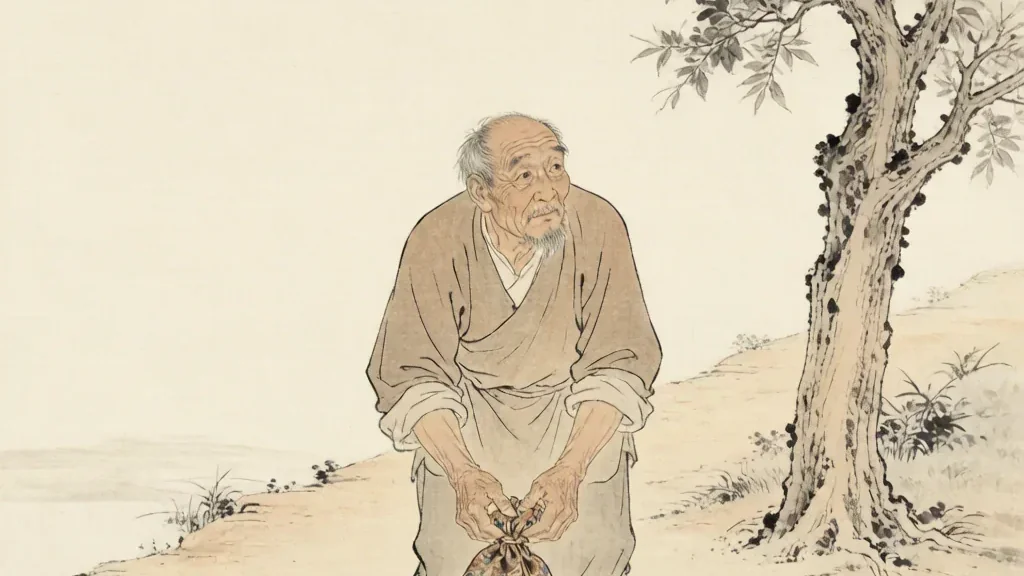
Not every Chinese idiom is about suffering, strategy, or myth. Some simply describe a decent human being doing the right thing. 拾金不昧 (shí jīn bù mèi) — "picking up gold and not concealing it" — celebrates the honesty of returning something lost rather than keeping it. In a world where found money often disappears into the finder's pocket, the idiom holds up a quieter ideal: that what is not yours is not yours, no matter how easily you could keep it. It is one of the most directly moral of the common idioms, and its lesson is as practical as it is virtuous.
The Characters and Their Plain Meaning
The phrase is almost transparent once decoded. 拾 (shí) means "to pick up" or "to find," 金 (jīn) means "gold" but by extension any money or valuables, 不 (bù) is "not," and 昧 (mèi) means "to conceal," "to keep hidden," or "to ignore one's conscience about." Put together, the idiom describes the act of finding wealth and choosing not to hide it away for oneself.
Note that 昧 is the key character. It does not merely mean "not stealing" — the gold was not stolen, it was found. The vice the idiom condemns is concealment, the quiet decision to say nothing and pocket the prize. Honesty here is not the absence of theft but the active refusal to exploit someone else's loss. That nuance is why the phrase feels so pointed.
Because 金 stands in for valuables generally, the idiom applies far beyond gold. A wallet on a bus, a phone left on a cafe table, a dropped envelope of cash — all are modern instances of "found gold," and the right response the idiom commends is the same: return it, or at least try. The four characters encode a whole ethic of finders and losers.
The Classic Tale of He Yue
The best-known story behind the spirit of this idiom concerns 何岳 (Hé Yuè), a poor but upright man of the Ming dynasty recorded in anecdotal collections. One day He Yue found by the roadside a parcel containing several hundred taels of silver. Rather than take it home, he stayed near the spot waiting for the owner to realize the loss and return in distress. When the man came back searching frantically, He Yue returned the silver in full.
The owner, overwhelmed with gratitude, offered He Yue a portion as a reward. He Yue refused, arguing that if he had wanted the money he would never have waited at all — keeping a reward would be little different from keeping the silver. His logic was unassailable: the honest act was complete the moment he returned the find; a bribe afterward would sully it.
A second episode sealed his reputation. Someone entrusted He Yue with a large sum for safekeeping and then forgot about it for years. When the man finally recalled it, He Yue returned every coin without hesitation. The two stories together show consistency: He Yue was honest whether watched or not, whether the owner was present or absent. That is the deeper meaning of 不昧 — not concealing even when concealment would succeed.
The Moral Logic of Returning What Is Lost
Why does Chinese culture prize this so highly? Part of the answer lies in the Confucian emphasis on 义 (yì, righteousness) over 利 (lì, profit). The gentleman, in this view, acts according to what is right, not what is gainful. Finding another's lost wealth is a test precisely because the gain is easy and the wrongdoing invisible. Passing the test proves character.
There is also a practical, social dimension. In a dense, interdependent society, trust is a form of wealth. A community where people return lost things runs more smoothly and more kindly than one where they do not. The idiom reinforces the behavior that makes such trust possible, teaching children that honesty is not just personal virtue but social glue.
Finally, the idiom carries a hint of cosmic justice. The tales usually end with the honest finder being rewarded — not by the grateful owner alone, but by fate. He Yue's name survives in moral literature precisely because he did the unglamorous right thing. The culture remembers him so that others might imitate him, turning individual goodness into collective instruction.
How the Idiom Appears in Daily Life
Today 拾金不昧 is a common phrase in schools, public-service announcements, and news reports about good Samaritans who return lost wallets, phones, or purses. Police stations in China sometimes post "拾金不昧" commendations for citizens who turned in found property, and the phrase appears on certificates of merit.
It is also a natural compliment. If a friend returns money you dropped, you might say they are 拾金不昧. The idiom has a warm, approving tone, never preachy, which makes it easy to use sincerely. Unlike heavier moral idioms, it congratulates rather than exhorts.
In business contexts, the phrase can signal trustworthiness. A shop that returns a customer's forgotten belongings might be praised with it, and the reputation for 不昧 behavior is genuinely valuable in a culture that prizes 信誉 (xìnyù, credibility). The idiom thus bridges private morality and public commerce.
Honesty, Reward, and the Question of the Tip
One subtle debate the idiom invites concerns the reward. He Yue refused a tip, but many modern finders accept a thank-you gift without shame. Is the refusal essential to the virtue, or is the return itself enough? The idiom says only "do not conceal" — it does not forbid gratitude. He Yue's refusal was his own strictness, not a rule for all.
This matters because an overly rigid standard can backfire. If honesty must be perfectly disinterested, people may worry that returning an item "taints" them if they accept thanks, and so do nothing. A healthier reading keeps the core demand — return the lost thing — and leaves the reward as a matter of courtesy. The gold must not be 昧; the handshake may be freely given.
The idiom's durability lies in this clarity. It does not ask you to lie on ice or jab your thigh. It asks one simple thing: when you find what is not yours, do not hide it. Most people can meet that bar most of the time, and a culture where they do is noticeably gentler.
A Reflection on the Easy Test
拾金不昧 is the rare idiom that costs the user almost nothing and gains the world almost everything. It is a test administered daily, invisibly, by chance — a dropped bill, a forgotten umbrella — and passed or failed in a moment no one witnesses but you. He Yue's greatness was simply that he kept passing it.
We tend to reserve admiration for dramatic virtue: the rescuer, the martyr, the sage. But the idiom suggests that character is built in unglamorous instants, on quiet streets, with no audience. The next time you find something that is not yours, the old phrase is a small voice reminding you that the easy right thing is still a real one. Return it, and you have practiced, in miniature, the honesty a whole society depends on.
A Society Where Nothing Is Pocketed
The personal virtue of returning a find finds its public mirror in 路不拾遗, the old ideal of a society so well ordered that no one picks up goods dropped on the road. Where 拾金不昧 asks the individual not to conceal what they found, 路不拾遗 asks the whole community to leave another's loss untouched. Paired with 夜不闭户, the picture of doors left unlatched at night, these phrases describe not just honest people but a trustworthy world. Together they show that Chinese moral thought moves easily from the single act to the social climate it creates. The honest finder is the cell; the honest society is the body.
Honesty Written Into the Law
Beyond personal conscience, returning lost property has long had legal weight in China. Classical codes such as the Tang statutes included rules about found goods, expecting a finder to report or hand over a loss rather than keep it, and treating concealment as an offense in its own right. This means 拾金不昧 was never only a soft moral suggestion; it was backed by the state's authority. The famous tale of He Yue thus sits inside a broader tradition where civic order and private virtue point the same way. For readers today, this helps explain why the idiom feels less like optional niceness and more like a baseline of civilized life, enforced by both shame and statute.
❓ Frequently Asked Questions
📝 Chinese Vocabulary
拾金不昧 — : "Pick up gold and do not conceal it"; honesty in returning lost property.
拾 — : To pick up / find; the act that begins the moral test.
昧 — : To conceal or hide (one's conscience); the vice the idiom condemns.
何岳 — : The Ming-dynasty man famed for returning found silver and entrusted money.
义 — : Righteousness; the Confucian value prized above mere profit (利).
路不拾遗 — : No one pockets goods lost on the road; the ideal of a society so orderly that lost items are left untouched.
信誉 — : Credibility or good reputation, the social asset that honest behavior builds over time.
一诺千金 — : A single promise worth a thousand pieces of gold; a phrase praising unbreakable trustworthiness.
🎉 Fun Facts
- The key character 昧 means "conceal," so the idiom condemns hiding a find more than stealing it.
- He Yue's tale includes a second act of honesty: returning money entrusted to him that the owner had forgotten for years.
- The idiom is still printed on formal certificates commending citizens who turn in lost property in China.
- Unlike study or filial idioms, this one costs the user almost nothing yet builds social trust — which is why it endures.
- The idiom is commonly taught beside 路不拾遗 (no one keeps roadside finds) and 夜不闭户 (doors left unlatched at night), showing individual honesty and a trusting society as two faces of one ideal.
- Some traditional law codes treated keeping a found item without reporting it as an offense, giving the moral lesson the backing of statute as well as conscience.