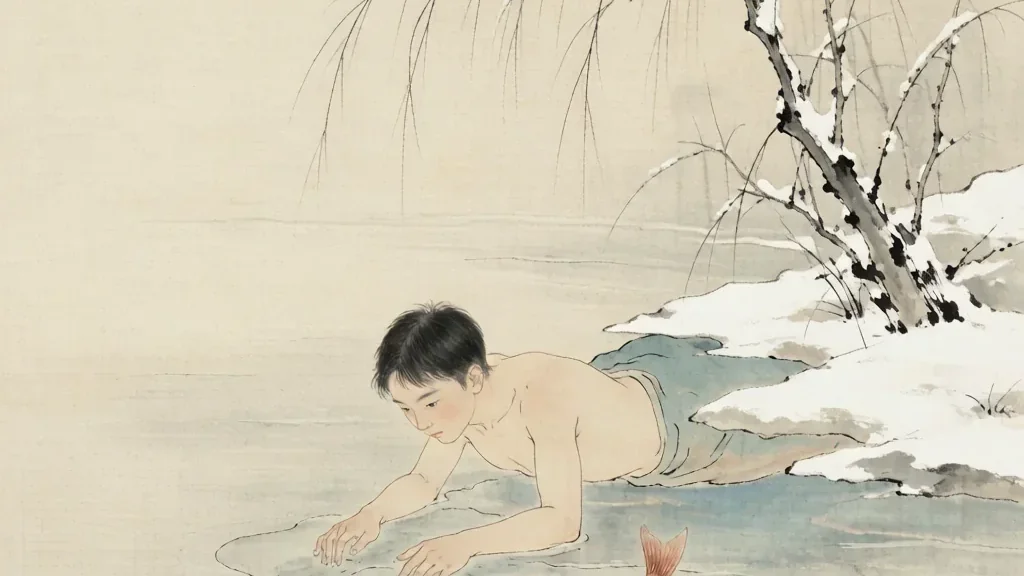
Of all the Chinese idioms about family duty, few are as strange and as moving as 卧冰求鲤 (wò bīng qiú lǐ) — "lying on ice to catch a carp." It tells of a son who, to satisfy his ailing stepmother's craving for fresh fish in the dead of winter, stripped off his clothes and lay down on a frozen river, hoping his body heat would melt the ice and free the fish beneath. The story belongs to the celebrated set of the Twenty-Four Filial Exemplars and captures the Confucian ideal of filial piety (xiao) pushed to its most literal and astonishing extreme. It is a tale that modern readers find both inspiring and unsettling, and that tension is exactly what makes it worth knowing.
The Hero: Wang Xiang and the Twenty-Four Exemplars
The protagonist is 王祥 (Wáng Xiáng), a man of the late Han and early Jin period who lived roughly in the third century CE. He is best known not for politics but for his inclusion among the 二十四孝 (èr shí sì xiào), the "Twenty-Four Filial Exemplars," a later collection of stories compiled to teach children the meaning of devotion to parents. Each exemplar performs some extraordinary act of care, and Wang Xiang's is among the most famous.
What makes Wang Xiang's case poignant is that the mother he served so devotedly was his stepmother, and she did not love him. According to the tradition, she favored her own son and treated Wang Xiang coldly, even slandering him to his father. Yet he responded not with resentment but with ever deeper obedience and care — the Confucian ideal holding that filial duty is owed regardless of the parent's behavior. His patience under unfairness is part of why his story was canonized.
The Twenty-Four Exemplars were used for centuries as moral textbooks, illustrated in cheap prints pinned above peasants' beds and recited by grandmothers to grandchildren. Wang Xiang lying on the ice became one of the most reproduced images in Chinese domestic art, a quiet monument to a virtue the culture prized above almost all others.
The Story of the Winter Carp
The anecdote goes like this: one bitter winter, Wang Xiang's stepmother fell ill and developed a sudden longing for fresh carp, a fish associated with warmth and vitality that was impossible to obtain from a frozen river. Most people would have sighed and given up. Wang Xiang instead went to the ice-covered stream, removed his clothes, and lay directly on the ice, intending that his own warmth should thaw a hole through which he could fish.
Before his body could fail him, the story takes a miraculous turn. The ice cracked open of its own accord, and a pair of carp leapt out onto the ice before him. He gathered them, cooked them for his stepmother, and she recovered. In some versions, the fish appear as a heavenly reward for his sincerity; in others, the warmth of his devotion quite literally opened the river. Either way, the carp are a gift granted to filial love.
The physical image is unforgettable: a near-naked man spread across a sheet of winter ice, shivering yet unmoving, willing his own comfort away for a parent who had never been kind to him. The absurdity of the method is the point — no one lies on ice to catch fish by normal logic, which is precisely why the act proves a love beyond logic.
The Literal Characters and Their Weight
The four characters decode cleanly: 卧 (wò) "to lie down," 冰 (bīng) "ice," 求 (qiú) "to seek," and 鲤 (lǐ) "carp." The phrase is almost a stage direction, a single frozen tableau. As with the best idioms, the grammar is minimal and the scene does the work.
Each character carries cultural freight. The carp (鲤) is itself symbolic in China — a fish associated with perseverance (because it swims upstream) and with success, since "carp" puns on "profit" and features in the legend of the carp that leaps the dragon gate. That Wang Xiang seeks this particular fish adds a layer: he is not just feeding his mother, he is offering her a creature loaded with good fortune.
The ice (冰) is more than weather; it is the obstacle that only love can dissolve. The idiom thus turns a domestic chore — fetch dinner for mother — into a cosmic contest between cold indifference and warm devotion, with devotion winning. The spare language hides this drama, but readers raised on the story hear it instantly.
The Meaning: Filial Piety as the Root of Virtue
Confucius taught that 孝 (xiào, filial piety) is the root from which all other virtues grow. A person who honors parents, the reasoning goes, will honor elders, rulers, and the social order generally. Wang Xiang's story was held up to show that filial love must be absolute — independent of reciprocity, independent of fairness, independent even of comfort and safety.
The stepmother detail is crucial. Had she been loving, the act would be merely dutiful. Because she was cruel, the act becomes sublime. The lesson taught to children was that you serve your parents not because they deserve it but because they are your parents. This is a demanding, even troubling, ethic, and the story does not soften it.
At the same time, the miracle suggests a comforting counterbalance: heaven rewards such love. The carp leap out, implying that sincerity is never wasted. For a peasant family reading the tale by lamplight, that promise — that devotion to parents brings blessings — was a source of real consolation in hard lives.
How the Idiom Is Used and Debated Today
In modern Chinese, 卧冰求鲤 is invoked to praise extraordinary filial devotion, especially around holidays like the Double Ninth Festival or Mother's Day, when piety to elders is celebrated. It also appears in discussions of traditional family values and in school lessons about the classics. The image remains powerful even for secular, modern audiences.
Yet contemporary readers often treat the story with a knowing ambivalence. Few would advise a child to lie naked on ice; parents today worry more that such tales pressured children into self-destructive obedience. Scholars note that the Twenty-Four Exemplars include several stories now considered extreme or even harmful, and Wang Xiang's is frequently cited as the gentlest of the alarming ones.
This debate is itself valuable. The idiom has become a lens for examining how a culture balances respect for elders against the dignity and safety of the young. Used thoughtfully, it can open conversations about what filial piety should mean in a modern, smaller, more equal family — not lying on ice, perhaps, but still showing up.
A Reflection on Love That Costs Something
卧冰求鲤 asks a question modern life lets us dodge: what would you give up for the people who made you? Wang Xiang gave warmth, dignity, and safety for a stepmother who had given him little. We may not imitate his method, but we cannot easily dismiss his meaning. Love, in his story, is measured not by feeling but by willingness to pay.
Perhaps the healthiest inheritance from this idiom is its insistence that care is active, not sentimental. Wang Xiang did not merely feel fondly toward his mother; he went to the river. Whatever form our "river" takes — a phone call, a visit, a hard conversation, a sacrifice of convenience — the idiom reminds us that devotion proves itself in motion. The ice may not crack for us, but the lying-down is the point.
The Collection Behind the Story
Wang Xiang's tale did not travel alone. It belongs to the Twenty-Four Filial Exemplars, a set of stories compiled in later imperial times to teach children devotion to parents through vivid, memorable scenes. Each exemplar performs some extraordinary act of care, from tasting a parent's medicine to burying oneself near a grave, and Wang Xiang's winter on the ice became one of the best known. The collection was printed cheaply and pasted above beds, recited by grandmothers, and painted on walls, making it a true folk textbook of family virtue. Understanding the idiom means seeing it as one card in a full deck of filial legends, a genre designed less to describe real history than to imprint an ideal. The ice story's power comes partly from its place in that repeated, household-level teaching.
Filial Devotion in Modern Life
Few modern parents would ask a child to lie on ice, and many worry that the older exemplars pressured young people into self-harming obedience. Yet the underlying value, respect and care for one's parents and elders, remains strong in Chinese family life. Today it appears as visiting aging relatives, supporting them financially, answering calls, and showing up during illness, the 'river' of ordinary devotion rather than its dramatic extremes. Holidays like the Double Ninth Festival still center elder care, and filial piety is discussed as a balance of duty and dignity for both sides. The idiom thus survives not as a literal instruction but as a marker of a culture that still rates gratitude to parents highly, even as it renegotiates how that gratitude should be shown in smaller, more equal families.
❓ Frequently Asked Questions
📝 Chinese Vocabulary
卧冰求鲤 — : "Lie on ice to seek a carp"; extreme filial devotion.
王祥 — : The filial son who lay on ice for his stepmother's craving.
二十四孝 — : The Twenty-Four Filial Exemplars, a traditional moral story collection.
孝 — : Filial piety; the Confucian root virtue of devotion to parents.
鲤 — : Carp; a fish symbolizing perseverance and good fortune.
孝经 — : The Classic of Filial Piety, the canonical text that made devotion to parents the root of all virtue.
继母 — : A stepmother; the cold parent whose craving Wang Xiang nonetheless served without resentment.
卧 — : To lie down; the opening character of the idiom, the deliberate act of placing himself on the ice.
🎉 Fun Facts
- Wang Xiang's stepmother craved carp in winter, when rivers were frozen solid and fresh fish were nearly unobtainable.
- The story was one of the most reproduced images in traditional Chinese "filial piety" woodblock prints hung in homes.
- In some versions a pair of carp leap out, emphasizing the doubled blessing of the miracle.
- The carp links to the legend of the carp leaping the dragon gate, a symbol of success against the odds.
- The other Twenty-Four Exemplars include equally striking acts, so Wang Xiang's ice story was one face of a whole genre of filial legends taught to children.
- In some regional operas the scene is staged with the carp appearing as a costumed dancer, turning the miracle into festive theater.