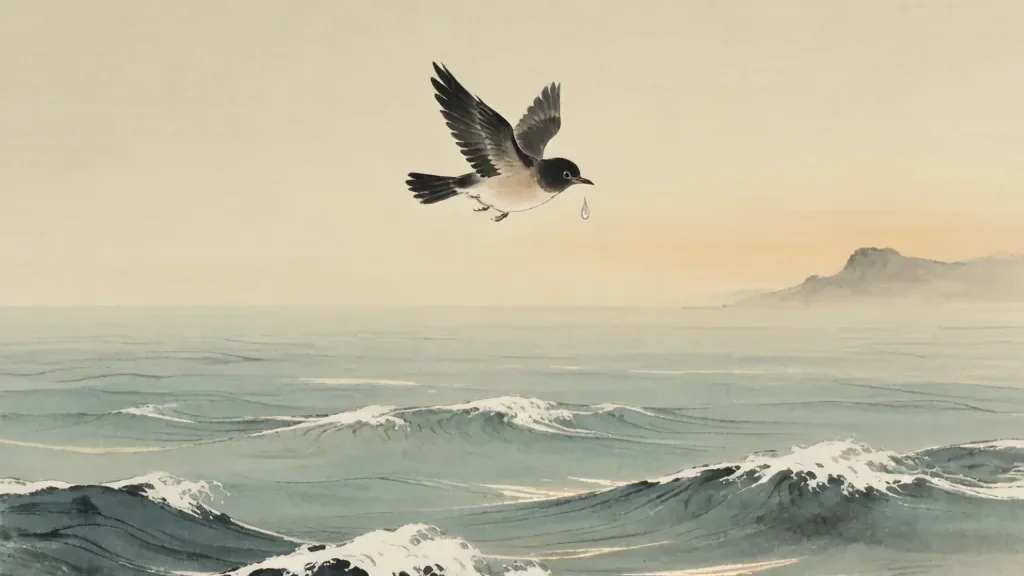
Some stories are remembered not because they end happily, but because they refuse to end at all. The myth of Jingwei is one of the most poignant and haunting tales in Chinese mythology — a story about a young girl whose life was cut tragically short, and who transformed her grief into an eternal mission that continues to this day. It is a tale that asks a profound question: what does it mean to never give up, even when the task is literally impossible?
The story of Jingwei (精卫) comes from the ancient Chinese text "Classic of Mountains and Seas" (山海经), a compendium of mythology and geography compiled over two thousand years ago. Despite its brevity — the original account is only a few sentences long — it has become one of the most frequently referenced myths in Chinese culture, a powerful symbol of perseverance in the face of overwhelming odds.
The Emperor's Beloved Daughter
Jingwei was not always a bird. She was born Nüwa, the youngest and most beloved daughter of Yandi, the Flame Emperor. Yandi was one of the great god-kings of Chinese mythology — not to be confused with the goddess Nüwa who mended the sky, though they share a name. The Flame Emperor was a benevolent ruler who taught humanity agriculture and herbal medicine, and his daughter was the light of his life.
Nüwa was a curious and spirited child, fascinated by the world beyond the palace walls. She had heard stories of the great eastern sea — tales of its vastness, its beauty, its mysterious depths. The sea called to something deep within her adventurous soul, and one day, against all warnings, she slipped away from her attendants and made her way to the shore alone.
What happened next is the cruel pivot on which the entire story turns. Nüwa, inexperienced with the ocean's dangers, waded into the water. Perhaps she wanted to feel the waves around her ankles. Perhaps she saw something glittering in the depths and tried to reach it. Whatever her intention, a sudden wave swept her off her feet and pulled her under. The sea — vast, indifferent, and hungry — swallowed the emperor's daughter without a trace. She was never seen alive again.
Rebirth and Rage
But death was not the end for Nüwa. Her spirit, burning with grief and fury at the injustice of her fate, refused to dissipate. From the very waters that had killed her, a new creature emerged — a small bird with a distinctive appearance. She had a red beak, white feet, and a head covered in patterned feathers that some accounts describe as colorful and beautiful. She was no longer the emperor's daughter. She was Jingwei.
The name "Jingwei" itself is an onomatopoeia — it is the sound of the bird's cry as she flies over the waves. "Jing-wei, jing-wei," she calls, a sound that to Chinese ears carries the weight of tragedy and determination in equal measure. From the moment of her rebirth, Jingwei had a single purpose: she would fill in the sea that had stolen her life, so that no other child would ever drown in its waters.
An Impossible Task
And so Jingwei began her eternal labor. She flies back and forth between the western mountains and the eastern sea, carrying twigs and small stones in her beak. She drops them into the ocean, one by one, day after day, year after year. The sea is vast beyond comprehension, and her contributions are infinitesimally small. A single twig dropped into the Pacific — the gesture seems almost laughable in its futility.
The sea itself is said to have mocked her. In some versions of the myth, the ocean laughs at the little bird and asks, "Do you really think you can fill me with twigs and pebbles? Even if you worked for a million years, you would not make a dent in my vastness."
Jingwei's reply is the heart of the story. "Even if I work for ten million years," she declares, "even if it takes until the end of the universe itself, I will fill you in. I will never stop. I will never rest. I will never give up." And she never has. To this day, according to the myth, Jingwei can be seen flying between the mountains and the sea, carrying her tiny burdens, refusing to admit that her mission is impossible.
The Deeper Meaning
On the surface, Jingwei's story can seem bleak — a tale of futile effort and eternal struggle. But Chinese culture has always read it differently. Jingwei is not a figure of pity; she is a figure of admiration. Her story embodies a value that Chinese philosophy holds in the highest esteem: the courage to persist in the face of certain failure.
There is a famous saying that captures this spirit: "The old man foolishly moves the mountains" (愚公移山) — another Chinese fable about a man who decides to dig away two entire mountains with nothing but a shovel, and succeeds through generations of his family's effort. Jingwei's story belongs to the same tradition. The point is not whether the task can be accomplished; the point is the nobility of refusing to surrender to fate.
In a culture that has weathered countless invasions, famines, and natural disasters over its five-thousand-year history, the story of Jingwei resonates deeply. She represents the refusal to be broken by tragedy, the determination to find meaning in suffering, and the belief that even the smallest being can stand against the greatest forces. She is small, yes — but she is indomitable.
The story also carries an environmental message that feels remarkably modern. The sea, in its arrogance, believes it is too vast to be affected by small actions. But Jingwei's response suggests that persistence, multiplied over time, can change anything. It is a metaphor that speaks powerfully to our current age, where individual actions may seem insignificant against global challenges, but collective persistence can reshape the world.
Legacy of the Little Bird
Jingwei's story has inspired Chinese art and literature for millennia. She appears in countless poems, paintings, and songs. The phrase "Jingwei fills the sea" (精卫填海) has entered the Chinese language as an idiom meaning "to have an indomitable will" or "to persist against all odds." When a student studies through the night for an exam, when an athlete trains despite injury, when a scientist pursues a theory that everyone else has abandoned — they are said to embody the spirit of Jingwei.
Perhaps most touchingly, the myth has given rise to a folk belief: that Jingwei's twigs and stones are slowly but surely having an effect. Some fishermen claim that certain stretches of coastline have indeed grown shallower over the centuries, and they attribute this to the tireless work of the little bird with the red beak. It is a beautiful thought — that even an impossible task, pursued with enough dedication, might one day become possible after all.
The next time you see a small bird carrying a twig in its beak, pause for a moment. You might just be witnessing Jingwei, still at work after all these millennia, still refusing to give up. And in that moment, perhaps you will feel a little braver about your own impossible challenges.
Jingwei in Later Literature
Though the original Classic of Mountains and Seas gives Jingwei only a few lines, later poets adopted her as a symbol of stubborn devotion. Tang dynasty writers compared loyal ministers and wronged women to the little bird, and Ming and Qing poetry used her to praise perseverance against hopeless odds. The image of a small creature pitting itself against the vast sea offered a compact metaphor for integrity under pressure, and she appears in essays, paintings, and even modern revolutionary verse as a figure who refuses compromise. Because the source text is so brief, authors enjoyed freely expanding her story, so her character varies from gentle mourner to fierce avenger. Across these retellings she remained constant as an emblem of unyielding will.
Jingwei and the Foolish Old Man
Jingwei is frequently paired with Yugong, the old man who resolved to dig away two mountains, because both insist that persistence outranks outcome. Where Yugong works openly with his family across generations, Jingwei labors alone and eternally, yet the moral is alike: the worth of an effort lies in its refusal to stop. The two tales became touchstones in Chinese education for teaching endurance, and reformers in the twentieth century cited them to inspire collective effort against foreign domination and poverty. Read together, they show a culture that prizes the attempt as much as the result, and that finds heroism in steady, thankless labor. Jingwei's solitude only sharpens the lesson, since she expects no witness and no reward. Teachers still set the two figures side by side so that children learn how greatness can wear the face of a patient, unnoticed worker who never seeks applause.
A Modern Reading of Jingwei
In recent decades readers have found new meaning in Jingwei's refusal to accept her fate. Environmental writers note that her patient accumulation of stones mirrors the slow, individual actions that together can heal a damaged sea, while feminist critics read her as a wronged daughter who answers victimhood with agency rather than resignation. Psychologists have used the myth to discuss grief that becomes purpose, the way loss can be transformed into lifelong mission. Even in popular media the bird appears as a symbol of quiet resistance, showing up in animation and games aimed at young audiences. The spare ancient account proves remarkably flexible, letting each era project its own struggles onto a small red-beaked bird still flying between mountain and shore. School readers present her alongside Yugong as a model of persistence, and contemporary art often reimagines her as a guardian of the coastline rather than a mere mourner. This constant renewal of meaning is precisely why a few lines from a prehistoric geography book still speak to readers today.
❓ Frequently Asked Questions
📝 Chinese Vocabulary
精卫 — : The bird form of the drowned princess; the name mimics the sound of her cry.
填海 — : "Fill the sea" — Jingwei's eternal mission to fill the ocean with twigs and stones.
炎帝 — : The Flame Emperor, Jingwei's father, one of the legendary god-kings of ancient China who taught humanity agriculture and medicine.
女娃 — : The original name of the princess before her death and transformation; not to be confused with the goddess Nüwa (女娲).
精卫填海 — : A Chinese idiom meaning "dogged determination" or "indomitable will."
山海经 — : The Classic of Mountains and Seas, the ancient compendium of geography and myth where Jingwei's story was first recorded.
发鸠山 — : Mount Fajiu, the western mountain from whose slopes Jingwei gathered the twigs and stones she carried to the sea.
誓鸟 — : The oath bird, an alternate early name for Jingwei that highlights the vow she made to fill the ocean.
🎉 Fun Facts
- The "Classic of Mountains and Seas" (山海经), where Jingwei's story originates, is one of the oldest and strangest books in Chinese literature — a mix of geography, mythology, and bestiary that describes hundreds of fantastical creatures and lands.
- In some regional variations of the myth, Jingwei eventually succeeds in creating a land bridge to the sea's islands, proving that her determination was not in vain.
- The Jingwei myth has been referenced in modern Chinese media, including the popular video game "Genshin Impact" and numerous animated films, showing its enduring appeal to younger generations.
- The Classic of Mountains and Seas describes many other bird-people and hybrids, making Jingwei part of a vast bestiary of early Chinese myth.
- The idiom jingwei tianhai is sometimes used in Chinese to gently tease someone attempting a hopeless task, much like tilting at windmills in the West.
- Because the original Shanhaijing account runs only a few lines, later writers expanded Jingwei's story freely, so details of her character vary widely between sources.