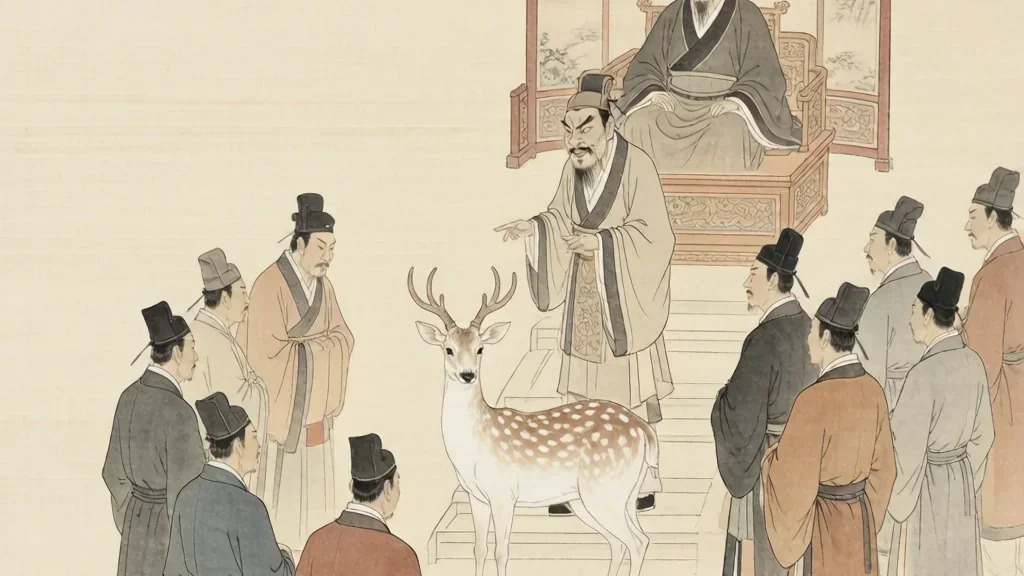
There are lies that are told in secret, whispered in corners where no one can verify them. And then there are lies that are told in broad daylight, in front of everyone, with such brazen confidence that they test not just the truth but the very courage of those who witness them. The Chinese idiom 指鹿为马 (zhǐ lù wéi mǎ), "pointing at a deer and calling it a horse," belongs to this second category. It comes from a moment in Chinese history so audacious in its dishonesty that it has become the standard by which all deliberate distortions of truth are measured.
The story is recorded in the "Records of the Grand Historian" (史记), the monumental work of Sima Qian completed around 94 BCE. It takes place near the end of the Qin Dynasty, during the brief and disastrous reign of Qin Er Shi, the Second Emperor. At the center of the story is Zhao Gao, one of the most notorious villains in Chinese history — a eunuch official whose cunning and ambition played a decisive role in bringing down China's first imperial dynasty.
The Rise of a Dangerous Man
Zhao Gao's origins are shrouded in mystery and controversy. Some sources describe him as a eunuch who rose through the ranks of the Qin palace through a combination of intelligence, ruthlessness, and an uncanny ability to read the desires of those in power. Others suggest he may have been a former prince of the defeated state of Zhao, working from within to destroy the dynasty that had conquered his homeland. Whatever his origins, by the time the First Emperor, Qin Shi Huang, died in 210 BCE, Zhao Gao had positioned himself as one of the most influential figures in the empire.
The First Emperor's death provided Zhao Gao with his opportunity. He forged the emperor's will, ordered the execution of the rightful heir, and placed the weak and malleable Qin Er Shi on the throne instead. With the young emperor as his puppet, Zhao Gao became the true power behind the throne. He eliminated rivals, enriched himself, and tightened his grip on every lever of government. But Zhao Gao was not content with mere power — he needed absolute control, and he needed to know exactly who could be trusted and who could not.
The Test of Loyalty
One day, Zhao Gao devised a test of breathtaking audacity. He brought a deer into the imperial court and presented it to Qin Er Shi, who sat on the throne surrounded by his ministers and officials. "Your Majesty," Zhao Gao announced, "I present you with a fine horse."
The court fell silent. A deer is unmistakably a deer — it has antlers, a slender neck, a different shape, a different way of moving. There could be no honest confusion between a deer and a horse. The emperor, young and perhaps not entirely bright but certainly not blind, laughed. "You are mistaken, Chancellor," he said. "That is clearly a deer. Why do you call it a horse?"
Zhao Gao did not back down. He turned to the assembled officials and asked them, with a smile that did not reach his eyes, "What do you all think? Is this a deer or a horse?" The question was not about zoology. It was about survival. Every person in that room understood that Zhao Gao was testing them — testing whether they would tell the truth and risk his wrath, or lie to protect themselves and prove their obedience.
The Silence of the Court
Some officials stayed silent. They understood that both answers were dangerous — agreeing with Zhao Gao meant participating in an obvious lie, while disagreeing meant defying the most powerful man in the empire. Silence, they hoped, might allow them to escape notice entirely. But Zhao Gao was watching, and he was making notes. Silence was not an answer he would forget.
Some officials, either out of fear or out of a cynical desire to curry favor, agreed with Zhao Gao. "Indeed, it is a horse," they said, nodding vigorously. "A fine horse. A magnificent horse." These were the collaborators, the enablers, the people who had decided that survival was more important than truth and that power was something to be served rather than challenged. Zhao Gao noted their names with satisfaction.
And some officials, braver or perhaps simply more stubborn than the rest, told the truth. "It is a deer," they said, or they said nothing at all, which in this context amounted to the same thing — a refusal to participate in the lie. Zhao Gao noted their names too, but with a very different purpose.
The Reckoning
In the days and weeks that followed, Zhao Gao systematically eliminated every official who had called the deer a deer. Some were executed on fabricated charges of treason. Others were demoted and exiled to distant provinces from which they never returned. The message was unmistakable: in Zhao Gao's court, truth was not a virtue — it was a liability. Obedience required not just silence but active participation in falsehood, and anyone unwilling to call a deer a horse was an enemy of the state.
The emperor himself, Qin Er Shi, was left isolated and confused. He had seen with his own eyes that the animal was a deer, but his entire court now insisted it was a horse. The experience must have been deeply disorienting — a gaslighting of imperial proportions that undermined not just the emperor's trust in his officials but his trust in his own senses. From that moment on, Qin Er Shi was effectively helpless, a prisoner of Zhao Gao's manufactured reality.
The Collapse of an Empire
Zhao Gao's triumph was short-lived. The Qin Dynasty, which had unified China under a single emperor for the first time in history, was already crumbling under the weight of its own tyranny. Rebellions erupted across the empire, and the armies that had once been invincible were now scattered and demoralized. When rebel forces approached the capital, Zhao Gao — realizing that his puppet emperor had become a liability — assassinated Qin Er Shi and attempted to negotiate with the rebels.
The rebels were not interested in negotiations, and Zhao Gao's gambit failed spectacularly. He was killed by the new emperor he had attempted to install, and the Qin Dynasty collapsed entirely shortly afterward, ending in 206 BCE after barely fifteen years of unified rule. The man who had forced an entire court to call a deer a horse had been brought down by the very forces his deception had helped unleash. An empire built on lies, it turned out, could not survive when those lies collided with reality.
Why the Story Endures
The idiom 指鹿为马 has remained in constant use for over two thousand years because the phenomenon it describes is not confined to ancient China. Any time a person in power deliberately misrepresents an obvious truth and demands that others endorse the falsehood, the story of Zhao Gao's deer is invoked.
The story is also a cautionary tale about the relationship between power and truth. Zhao Gao's test was not really about the deer — it was about establishing a new reality in which his word was more important than observable fact. Once he had demonstrated that he could make the entire court call a deer a horse, he had proven that his power was absolute, that he could redefine reality itself. This is the ultimate ambition of tyranny: not just to control what people do but to control what they are allowed to perceive and say.
In modern Chinese, the idiom is often used in political commentary and social criticism, but it has also entered everyday language. A boss who insists that a failed project was a success, a student who copies homework and claims it is original work, a company that markets a dangerous product as healthy — all of these are examples of 指鹿为马. The idiom carries with it the weight of history, the memory of a court that abandoned truth for survival and a dynasty that paid the ultimate price for doing so.
Zhao Gao's Methods of Control
Zhao Gao's career was a master class in seizing power without appearing to hold it. After the First Emperor's death he forged a will, removed the rightful heir, and placed the pliable Qin Er Shi on the throne, then ruled through the puppet while eliminating rivals one by one. The deer was only the most theatrical of his tests, a way to map loyalty by forcing every official to declare himself. His broader method was to make disagreement dangerous and flattery safe, so that the court gradually lost any independent voice. The idiom therefore records not a single lie but a system of manufactured reality, in which survival required joining the falsehood. That is why the story reads as a warning about tyranny's mechanics: control the truth, and you control the people who depend on it.
The Deer and Horse in Later Art
The absurd court scene has inspired painters, dramatists, and filmmakers for two thousand years. Traditional handscrolls show the plump deer in the hall, the smiling Zhao Gao, and the frightened ranks of officials, while operas turn the moment into a study in menace played for uneasy laughter. Modern television dramas about the Qin court reuse the episode as a set piece of villainy, complete with the emperor's bewildered laugh. The image's power is its simplicity: a recognizable animal, a brazen false name, and a silent room deciding its fate. Because the scene is so visual and so legible, it survives easily in art where subtler political tales fade. Each generation repaints the deer and the horse to fit its own anxieties about truth and power.
❓ Frequently Asked Questions
📝 Chinese Vocabulary
指 — : "To point at" — the gesture of deliberate misidentification, the physical act of the lie.
鹿 — : "Deer" — the truth that everyone could see but many chose to deny.
为 — : "To be" or "to regard as" — the transformation of reality through the assertion of power.
马 — : "Horse" — the lie that power demanded everyone accept as truth.
赵高 — : The infamous eunuch official whose name has become synonymous with corruption, manipulation, and the abuse of power.
秦二世 — : Qin Er Shi, the Second Emperor, whom Zhao Gao manipulated from behind the throne.
史记 — : Records of the Grand Historian; the work that records the deer-and-horse episode.
秦朝 — : The Qin Dynasty, China's first empire, which collapsed shortly after the incident.
🎉 Fun Facts
- The story of 指鹿为马 is recorded in Sima Qian's "Records of the Grand Historian" (史记·秦始皇本纪), written only about a century after the events it describes, making it one of the more historically reliable Chinese idiom stories.
- Zhao Gao is almost universally regarded as one of the greatest villains in Chinese history, alongside figures like Dong Zhuo and Qin Hui. His name is rarely used as a given name in China today because of its negative associations.
- The phrase has entered political vocabulary beyond China — it is sometimes used by international commentators to describe situations where governments make claims that contradict observable reality.
- In the popular mobile game "Honor of Kings" (王者荣耀), Zhao Gao appears as a playable character, reflecting the enduring fascination with this historical villain in Chinese popular culture.
- The episode is so well known that calling a deer a horse is a set phrase in Japanese and Korean too, borrowed from the Chinese idiom.
- In Chinese opera and television the figure of Zhao Gao is a stock villain, and actors signal his treachery through smug, exaggerated gestures when he presents the deer.