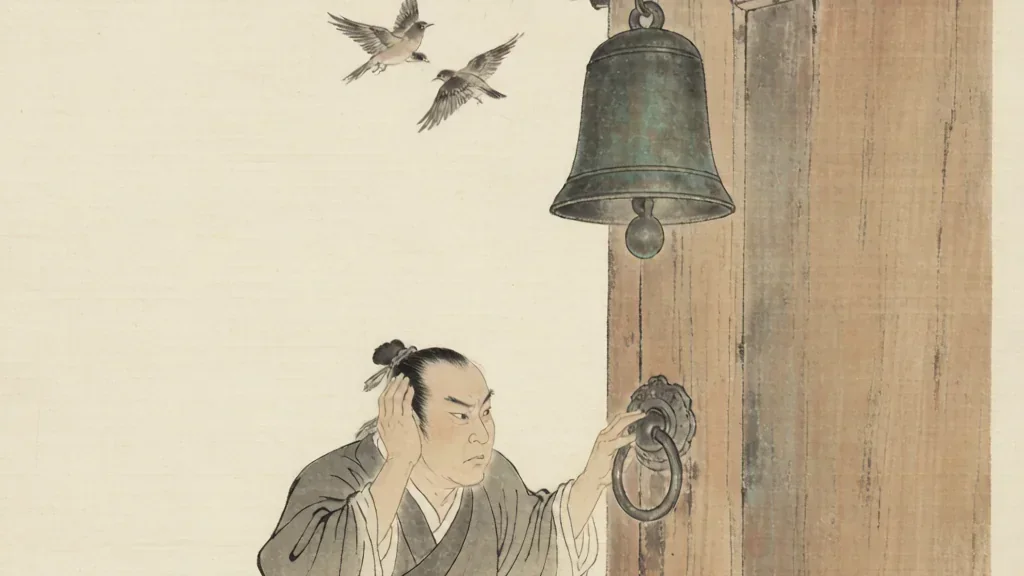
Of all the ways human beings deceive themselves, few are as vivid — or as embarrassing — as the one captured in the Chinese idiom 掩耳盗铃 (yǎn ěr dào líng), "covering one's ears to steal a bell." The image is almost cartoonish: a thief, intent on making off with a large and loudly ringing bell, solves the problem of noise by plugging his own ears. As if the sound existed only inside his head. As if his hearing were the only hearing in the world. It is the kind of story that makes children laugh and adults go very quiet, because every adult has, at some point, been that thief.
The story comes from the "Lüshi Chunqiu" (吕氏春秋), the "Spring and Autumn Annals of Master Lü," a vast encyclopedic text compiled around 239 BCE under the patronage of Lü Buwei, a powerful merchant who became chancellor of the state of Qin. The work gathered the knowledge of a hundred scholars and was meant to be a comprehensive guide to governing, thinking, and living well. Among its many parables, the story of the bell thief stands out for its surgical simplicity. It describes, in just a few lines, the entire architecture of self-deception.
The Bell in the Empty Courtyard
In the story, a thief discovers a magnificent bronze bell standing in the courtyard of a wealthy household. The bell is large — far too large to carry easily — and it is valuable. The thief, knowing the family is away, decides to steal it under cover of darkness. He waits until the household is asleep and the streets are quiet, then slips into the courtyard.
The bell is too heavy to lift whole. After some thought, the thief hits upon a plan: he will break the bell apart with a hammer and carry the pieces away one by one. He raises his hammer and strikes. The bell rings out — a deep, resonant tone that fills the courtyard and rolls out into the night. The thief freezes. The sound is enormous. Anyone within earshot will be woken. He strikes again, and again the bell sings its warning to the neighborhood.
Panic rises in the thief's chest. The sound is the problem. If only he could make the sound stop, he could finish the job and escape. And here comes the turn that gives the idiom its name. The thief, in his desperation, decides that the best way to silence the bell is to cover his own ears. If he cannot hear it, he reasons, then surely no one else can either. He stuffs his ears with his fingers, raises his hammer once more, and strikes the bell with all his might, confident now that the noise has been dealt with.
The Sound That Travels Without Permission
Of course, the bell rings as loudly as ever. Sound, unlike the thief's understanding, does not travel through the ears of the person who makes it. It travels through the air, into the ears of everyone around. The neighbors hear. The household stirs. The thief is discovered, undone not by his crime but by the absurd logic he used to commit it. He believed, for a moment, that his perception was the same as reality — that if he could not hear a thing, the thing itself had gone silent.
The "Lüshi Chunqiu" draws the moral explicitly: "The sound of a bell can be heard by others. If you cover your own ears, you deceive only yourself." The parable was meant as a critique of rulers who believed that problems they refused to acknowledge would simply cease to exist. A king who closes his eyes to corruption does not make the corruption vanish. A general who ignores reports of enemy troops does not make the troops disappear. The kingdom does not become safer because the king has stopped listening. It only becomes safer in the king's mind — and that, the story says, is the most dangerous kind of safety there is.
From Bronze Bells to Modern Ears
The idiom has an interesting quirk of history. The original story in the "Lüshi Chunqiu" actually described the theft of a zhong (钟), a large ritual bell. Over the centuries, the phrase morphed into 掩耳盗铃, using the word líng (铃), which refers to a smaller bell. Why the shift? Linguists suggest that as large bronze bells became rare in daily life, the smaller, more familiar "líng" felt more natural to speakers. The image of a thief hugging a tiny bell while plugging his ears is even more absurd, and the absurdity only sharpened the idiom's bite.
In modern Chinese, 掩耳盗铃 is used to describe any act of obvious self-deception — particularly the kind where the deceiver must know, on some level, that they are fooling no one but themselves. A student who hides a bad report card from their parents and pretends the semester went well. A company that buries an embarrassing audit and tells investors everything is fine. A government that censors bad news and declares the problem solved. A person who deletes the messages on their own phone and believes the conversation never happened. In each case, the bell is still ringing. The neighbors still hear. Only the thief, fingers jammed in his ears, believes the night is silent.
The Quiet Horror of Self-Deception
What makes the story unsettling, beyond its comedy, is how easily the thief's logic reproduces itself in the human mind. The leap from "I do not want to hear this" to "therefore no one hears this" is not a long one. We make it in small ways every day. We avoid checking our bank accounts when we suspect the balance is low. We avoid calling a friend when we fear they are angry. We avoid the doctor when a symptom frightens us. In each case, we are not silencing the problem. We are only silencing ourselves. The bell rings on, the neighbors wake, and the longer we delay, the louder the eventual reckoning.
The idiom's enduring power lies in its refusal to let us off the hook. It does not accuse the thief of greed or cruelty. It accuses him of something more ordinary and more insidious — the willingness to confuse his own perception with reality. That willingness is universal. It is the small, daily dishonesty that grows, if left unchecked, into the great dishonesty of a life lived with fingers in the ears. The thief in the courtyard thought he had solved his problem. He had only solved his awareness of it. And in the gap between the two, the bell kept ringing, the world kept listening, and his escape slipped away with every blow of the hammer.
The Thief as a Comic Archetype
The thief who plugs his ears is part of a long line of bumbling self-deceivers in world folklore. From the wolf who dresses as grandmother to the fox who denies the grapes he cannot reach, storytellers love a character who fools no one but himself. What makes the Chinese thief special is his quiet confidence: he is not confused, he is committed. The comedy comes from watching a grown person act out, in physical form, the thing we all do in our heads. Folklorists note that self-deception tales travel well across cultures because the joke is instantly readable, and the Chinese version has the extra elegance of sound as the thing that cannot be contained. The bell keeps ringing; the neighbors keep listening; only the thief believes the night is silent.
Self-Deception in Classical Thought
In the classical Chinese worldview, perception was never a private matter. The Lüshi Chunqiu presented the bell thief as a lesson for rulers, arguing that a king who blocks his ears to corruption does not make the corruption vanish, only his awareness of it. This fits a broader classical concern with 蔽 (bì), the covering or obscuring of the mind by desire and flattery. Daoist and Legalist writers alike warned that leaders naturally hear what they wish to hear, and that the cure is not more information but the honesty to face unwelcome sound. The idiom thus sits inside a long Chinese conversation about how power distorts perception, and why the most dangerous ignorance is the kind a person chooses. The thief in the courtyard is, in this reading, every ruler who prefers quiet to truth.
Teaching the Idiom to Children
Chinese elementary schools introduce 掩耳盗铃 early, often with a picture book showing the wide-eyed thief stuffing his fingers in his ears while the great bell roars behind him. Teachers use it to teach both a moral and a reading skill: students learn the characters 掩 (cover), 耳 (ear), 盗 (steal), and 铃 (bell), then discuss why the plan could never work. The lesson is usually framed positively as face your problems instead of hiding from them. Because the story is short and funny, children remember it, and the phrase becomes a ready tool for parents who catch a child denying something obvious. In this way the two-thousand-year-old parable still does daily work in family life, turning a philosophical point about perception into a gentle household correction.
Echoes in Modern Psychology
Modern psychology has a name for what the bell thief demonstrates: motivated ignorance, the tendency to avoid information we suspect will be unpleasant. Studies on willful blindness show that people often choose not to look, not because they lack the facts, but because facing them would demand action they wish to avoid. The idiom captures this precisely, centuries before the experiments. Where the ancient text drew a political moral, today's researchers draw a cognitive one, yet both agree on the core: the bell does not stop ringing just because the listener has stopped listening. The thief's mistake is not that he is uninformed but that he mistakes his own silence for the world's. That is a pattern cognitive scientists now document in boardrooms, clinics, and bedrooms alike.
❓ Frequently Asked Questions
📝 Chinese Vocabulary
掩耳盗铃 — : "To cover one's ears and steal a bell" — to deceive oneself into thinking a problem has disappeared simply by refusing to perceive it.
吕氏春秋 — : "The Spring and Autumn Annals of Master Lü," the third-century BCE encyclopedic text that preserves this story.
钟 — : A large ritual bronze bell, the original object stolen in the story before the idiom shifted to "líng."
自欺欺人 — : "To deceive oneself and then deceive others" — a closely related idiom often paired with 掩耳盗铃.
掩耳 — : "To cover the ears" — the central action of the parable, sometimes used alone to mean willful ignorance.
盗 — : To steal; the act of theft at the heart of the idiom.
铃 — : A small bell; the modern form of the object in the phrase, replacing the older large bell.
自欺 — : To deceive oneself; the first half of the paired idiom 自欺欺人.
🎉 Fun Facts
- The "Lüshi Chunqiu" that preserves this story was reportedly displayed at the city gate of the Qin capital with a bounty of gold offered to anyone who could add or remove a single character — a sign of how confident its compilers were in its perfection.
- The idiom's patron, Lü Buwei, was a merchant who rose to become chancellor of Qin but ultimately fell from power and took his own life — a reminder that even the collector of this cautionary tale did not escape the traps it warned against.
- The original phrase in the "Lüshi Chunqiu" was 掩耳盗钟 (yǎn ěr dào zhōng), using "zhong" for the large bell; the shift to the smaller "ling" became dominant during the Tang and Song dynasties.
- The story is sometimes taught alongside "The Emperor's New Clothes" in Chinese schools as a comparison of Eastern and Western parables about self-deception and collective delusion.
- In modern Chinese, 掩耳盗铃 is a frequent caption in editorial cartoons about officials who ignore obvious scandals, making the thief a shorthand for willful political blindness.
- Linguists note the idiom survives across dialects with the same four characters, and it is among the first self-deception idioms taught to children learning chengyu.