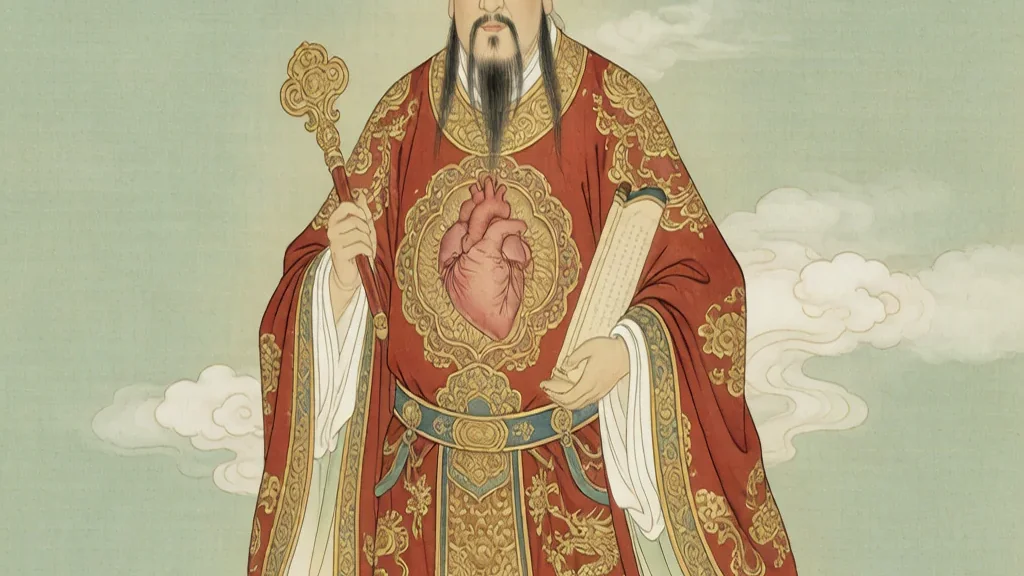
Bi Gan is a historical figure of the late Shang dynasty who, through legend, became honored as one of the Gods of Wealth (Cai Shen) in Chinese folk religion. A loyal uncle and counselor to the infamous last Shang king, Zhou Xin, Bi Gan is said to have remonstrated so boldly against the tyrant's cruelty that the king, in a famous episode, ordered his heart cut out to see whether a "saint's heart" truly had seven openings. Folklore transformed this grisly death into sanctity: because Bi Gan had no heart, he could not be biased, and so he was made the patron of fair commerce and prosperity. His tale links wealth not to greed but to integrity — a striking message in a god of money.
The Historical Bi Gan
Bi Gan was an aristocratic relative of the Shang royal house, traditionally described as the king's uncle, who served as a high minister. The Shang at its end is remembered in later tradition as a time of decadence under Zhou Xin (also called Zhou Wang), whose excesses became a byword for misrule.
According to the received account, Bi Gan repeatedly warned the king against his excesses and cruelty. Such frank counsel enraged the sovereign, and the confrontation ended in Bi Gan's execution — a martyrdom to conscience that later ages admired precisely because it failed to save the tyrant yet honored principle.
The Legend of the Heart
The most famous part of the legend says the king, skeptical of Bi Gan's claim to sagehood, declared he wished to see the "seven-apertured heart" of a sage and had Bi Gan disemboweled. This shocking image fixed Bi Gan in memory as the counselor who gave his very heart to the state.
After his death, myth adds that a goddess — sometimes Queen Mother of the West — gave him a magic gourd or charmed water that let him walk away without a heart, and that he lived on as a disembodied but fair-minded spirit. The detail explains his later role: a man with no heart cannot be partial.
Why a God of Wealth
The leap from martyred minister to God of Wealth rests on a pun and a principle. A "heartless" (impartial) official was exactly what merchants wanted overseeing trade; fairness, not favoritism, builds lasting prosperity. Bi Gan thus became the wealth god who blesses honest business.
Unlike gods of wealth associated with grabbing fortune, Bi Gan represents the wealth that comes from trust and even dealing. Shops and accountants adopted him as patron, hoping their trade would be both profitable and principled — a rare fusion of morality and money.
Bi Gan Among the Wealth Gods
Chinese religion knows several Cai Shen figures. Bi Gan is the "civil" God of Wealth, contrasted with martial wealth gods such as Zhao Gongming or the deified Guan Di. As a civil god he suits scholars, merchants, and clerks rather than soldiers.
He is often shown in official robes, holding a ledger or ruyi scepter, calm and dignified — the picture of the upright administrator. Placed in a shop, his image quietly promises that this business answers to a higher standard than profit alone.
Worship and the New Year
The God of Wealth is welcomed at the New Year, and Bi Gan shares in this veneration. On the fifth day of the first lunar month, households "receive wealth" with incense, firecrackers, and offerings, inviting the god's blessing on the year's trade.
Merchants may keep a small image of Bi Gan at the counter or in the ledger room, and accounting shops historically honored him as their special patron. The rites ask not only for gain but for fair and steady success that harms no one.
Moral Dimension
Bi Gan's story carries a pointed lesson: true wealth is rooted in integrity. A king who tore out a loyal heart lost his kingdom, while the heartless counselor gained eternal honor. The paradox invites reflection on what prosperity really requires.
For believers, praying to Bi Gan is a way to consecrate commerce to conscience. In a society that both prized money and feared its corrupting pull, he offered reassurance that the two need not be enemies — that a just man could also be a rich one's patron.
In Literature and Drama
Bi Gan appears in the novel "Fengshen Yanyi" (Investiture of the Gods), the fantastical account of the Shang-Zhou transition in which many historical figures are deified. There his death and transformation fit a grand scheme by which the fallen become gods of the new order.
Stage and storytelling keep his episode alive as a tale of loyalty unto death. Audiences knew the tyrant would fall and the counselor be rewarded in heaven — a satisfying moral arithmetic that made Bi Gan's suffering meaningful.
Broader Cultural Meaning
Bi Gan stands for the idea that office and wealth are trusts, not prizes. His heart, given to the people, became the symbol of a public servant's duty — a striking image in a culture that valued both loyalty and livelihood.
When merchants bow to his image, they rehearse a compact: prosperity should serve the community, not merely the self. That compact, however imperfectly kept, is part of why a god of money could also be a saint of honesty.
Legacy Today
Bi Gan's cult persists wherever the God of Wealth is honored, especially in business communities of Taiwan, Hong Kong, and Southeast Asia. His temples may stand alone or within larger wealth-god shrines visited at New Year.
Modern devotees still ask him for thriving trade, but the old story reminds them why his blessing matters: not riches at any cost, but the steady fortune that follows a fair hand. In that sense the heartless minister remains the conscience of Chinese commerce.
❓ Frequently Asked Questions
Who was Bi Gan?
He was a loyal minister of the late Shang dynasty who was executed for boldly criticizing the tyrant Zhou Xin.
Why is he a God of Wealth?
Legend says the king cut out his heart; being heartless, he was seen as perfectly impartial, the right patron for fair trade.
What kind of wealth god is he?
He is the "civil" God of Wealth, patron of merchants, scholars, and clerks, unlike martial wealth gods.
How is he shown?
In official robes, often holding a ledger or ruyi, calm and dignified — the image of an upright administrator.
Where is he worshipped?
At New Year wealth rites and in shops or accounting rooms seeking honest, lasting prosperity.
What lesson does he teach?
That true wealth rests on integrity, and that office and riches are trusts to be held fairly.