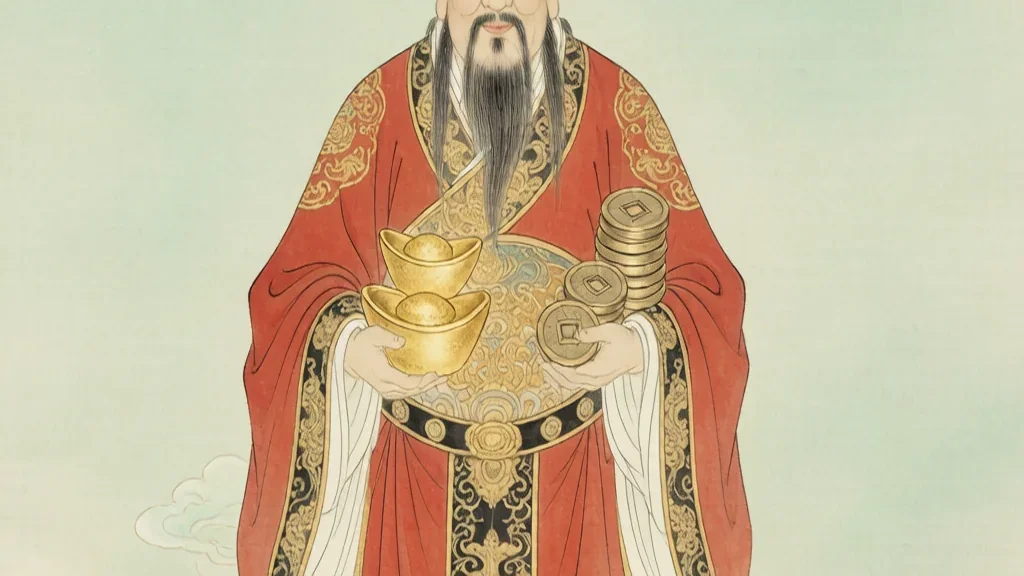
Cai Shen (财神), the God of Wealth, is among the most popular and commercially visible deities in Chinese religion. Invoked by merchants, families, and businesses alike, he embodies the hope for prosperity, fair trade, and enough to share. Unlike the broader Fu Lu Shou trio, Cai Shen focuses squarely on riches — yet his worship carries moral conditions, for the wealth he grants is traditionally meant to reward diligence and righteousness rather than greed.
Many Faces of the Wealth God
Cai Shen is not a single historical person but a title held by several figures. The most common are Bi Gan, a loyal minister of the Shang said to have an "heartless" (fair) heart; Zhao Gongming, a martial wealth god of the thunder tradition; and Guan Yu in his role as a god of commerce and loyalty.
This plurality shows that "wealth" in Chinese thought has many flavors — official salary, trade profit, martial protection of business, and upright stewardship. Different merchants adopted the form that matched their trade and values.
Bi Gan, the Civil Wealth God
Bi Gan was a virtuous uncle and minister of the tyrant King Zhou of Shang, executed for frank criticism. Legend says the goddess Nüwa gave him a "heartless" stomach (无心, a pun on impartiality) so he could not be bribed, making him the ideal, incorruptible god of wealth.
As the civil Cai Shen, he is shown in official robes, gentle and scholarly, the patron of shopkeepers and clerks. His story teaches that true wealth follows integrity, and that honest counsel outlasts a corrupt throne.
Zhao Gongming, the Martial Wealth God
Zhao Gongming is the martial Cai Shen, a dark-faced, bearded rider of a black tiger carrying a silver ingot and an iron whip. Rooted in the thunder-deity tradition, he both grants wealth and punishes fraud, linking money to cosmic justice.
His fearsome look warns cheaters that riches gained by deceit invite the whip. Merchants who valued protection as much as profit favored him, and his cult spread through the Ming novel "Fengshen Yanyi" (Investiture of the Gods).
Worship at New Year
Cai Shen is welcomed with special zeal at the lunar New Year. The "receiving Cai Shen" (接财神) rite on the fifth day is a major event: homes and shops set off firecrackers, burn incense, and lay out offerings of fruit, sweets, and fake gold ingots.
Shops often hang his image above the cash register and open business on the fifth day with ceremony, hoping the god will bring a full year of customers. The timing ties commercial renewal to the calendar's fresh start.
Temples and the Wealth Altar
Wealth temples (财神庙) draw crowds, especially around New Year and before ventures. Devotees present "gold" paper, light candles, and sometimes "buy" a fortune token to be redeemed in the coming year, a playful contract of reciprocity.
In homes, a small wealth altar may hold his image with a wealth bowl or ingot. The practice is cheerful and transactional, built on the understanding that the god rewards effort and upright dealing.
Symbols and Emblems
Cai Shen's icons include gold ingots (元宝), the ruyi scepter, a string of coins, and sometimes boys holding treasures — symbols of accumulated and growing wealth. The color gold and the number eight (发, fā, "to prosper") recur in his décor.
These emblems are not mere greed-signs; they encode a wish for sufficiency and the ability to support family and community. Prosperity in this frame is a means to duty, not an end in itself.
Moral Conditions of Wealth
Importantly, Cai Shen lore stresses that wealth must be earned and used rightly. Tales punish the greedy who hoard or cheat, while blessing the diligent and generous. The god thus polices the ethics of money as well as its supply.
This moral layer distinguishes Chinese wealth worship from simple materialism. To pray to Cai Shen is to ask not only for riches but for the character and fortune to handle them well — a subtle civic lesson wrapped in gold.
Cai Shen in Modern Commerce
Today Cai Shen adorns banks, shops, red envelopes, and advertising across the Chinese world, especially at Spring Festival. His image is a brand of luck, recognizable from Hong Kong malls to overseas Chinatown restaurants.
Even in secular business culture his blessing is invoked at openings and audits alike. The God of Wealth has comfortably entered capitalism, still promising that righteous effort meets reward — the oldest pitch in the Chinese commercial playbook.
Cai Shen in the Diaspora
Chinese communities abroad carried Cai Shen with them, installing his image in clan associations and shop altars from Singapore to San Francisco. In port cities his New Year receipt rite became a highlight of the lunar calendar, complete with lion dances and fireworks.
Overseas, the God of Wealth also softened into a secular mascot of entrepreneurship. Banks and restaurants display him as a luck symbol even when owners no longer pray, a bridge between worship and business identity in a new land.
This double life — devout at the altar, decorative in the window — shows how Cai Shen travels comfortably across cultures. He remains the go-to emblem of the hope that honest effort will, in the end, meet with gold.
Street vendors once sold tiny clay "wealth pots" stamped with his face, a folk toy that doubled as a charm — prosperity made playful and portable for children at New Year.
Through such small objects Cai Shen entered daily play as well as prayer. The God of Wealth was, and remains, a figure who could be both solemnly worshipped and cheerfully toyed with, a rare ease among the gods.
❓ Frequently Asked Questions
Who is Cai Shen?
Cai Shen is the God of Wealth, a title held by several figures including Bi Gan the incorruptible minister and Zhao Gongming the martial tiger-rider. He is among the most popular Chinese deities of prosperity.
Why are there different Wealth Gods?
Wealth has many forms — salary, trade, protection, stewardship — so different figures suit different trades. Merchants chose the version matching their values, from civil clerk to martial guard.
How is Cai Shen welcomed at New Year?
On the fifth day, families and shops "receive Cai Shen" with firecrackers, incense, and offerings of fruit and gold ingots, reopening business with ceremony to invite a prosperous year.
What does Bi Gan's "heartless" mean?
After his execution, Nüwa gave Bi Gan a "heartless" stomach — wú xīn, a pun on impartiality — marking him as unbribable and thus the ideal, fair god of wealth.
Does Cai Shen have moral rules?
Yes. Tales punish greed and fraud while blessing diligence and generosity. The god is seen as policing the ethics of money, not merely supplying it.
Where is Cai Shen seen today?
On red envelopes, shop altars, bank décor, and Spring Festival advertising across the Chinese world, still invoked at openings as a symbol of righteous, rewarded effort.