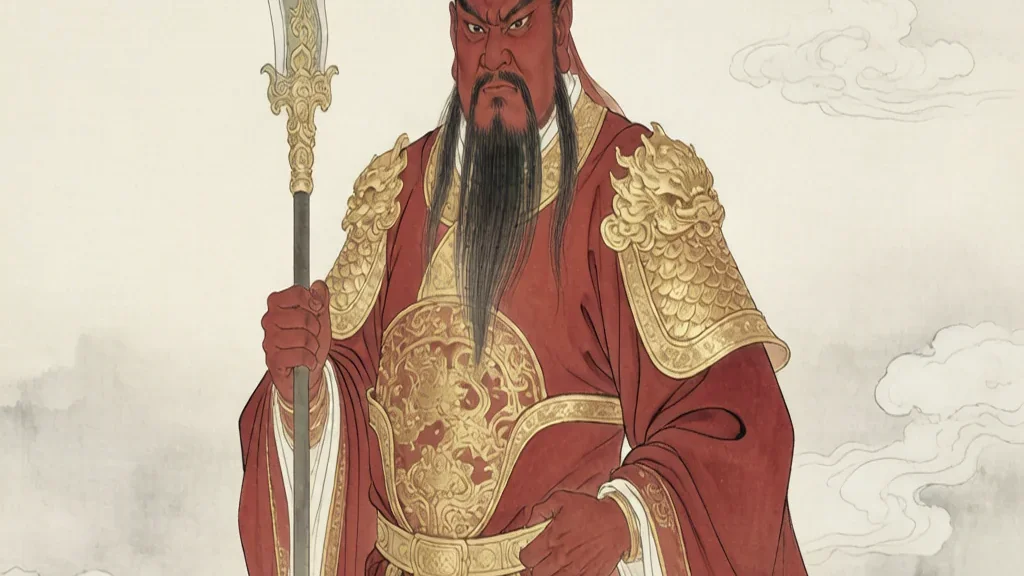
Guan Di, honored as the "Emperor Guan" and more familiarly called Guan Gong or Lord Guan, is one of the most widely worshipped deities in the Chinese pantheon. He began life as Guan Yu, a sworn-brother general of the warlord Liu Bei during the turbulent closing years of the Han dynasty and the ensuing Three Kingdoms era. Over the centuries following his death, this historical warrior was gradually transformed through popular literature, official decrees, and folk devotion into a celestial figure who protects soldiers, merchants, and honest people alike. Today he is venerated simultaneously as a god of war, a patron of loyalty and brotherhood, and a guardian of righteousness, occupying a rare position where emperors, generals, businessmen, and ordinary families have all bowed before his image.
From Historical General to National Deity
The real Guan Yu appears in the official 三国志 (Records of the Three Kingdoms), compiled by the historian Chen Shou, as a formidable and trusted commander. He was renowned for personal courage, steadfast loyalty to Liu Bei, and a dignified, sometimes proud bearing. Historical sources record his decisive role in several campaigns and his eventual death at the hands of rival forces, after which his severed head was sent to the capital region.
What lifted Guan Yu out of the annals of military history was not the dry chronicle but the later novel 三国演义 (Romance of the Three Kingdoms), attributed to the writer Luo Guanzhong. In that beloved epic, Guan Yu becomes the very model of the faithful friend and honorable warrior, willing to endure hardship rather than betray an oath. The novel's enormous popularity spread his reputation far beyond scholars to every level of society.
As storytellers, playwrights, and temple builders magnified his legend, successive dynasties granted him ever-grander posthumous titles. By the late imperial period he was addressed not merely as a loyal lord but as a full divine sovereign, "Guan Sheng Di Jun," the Holy Emperor Lord Guan, a rank that placed him among the highest figures in the popular religious hierarchy.
The Peach Garden Oath and the Ideal of Brotherhood
One of the most cherished episodes associated with Guan Yu is the Oath of the Peach Garden, in which he, Liu Bei, and Zhang Fei pledged to live and die as brothers though they were not born of one mother. This scene, dramatized in the Romance, became the emotional heart of Guan Yu's cult and a powerful cultural template for loyalty and solidarity.
The oath's enduring appeal lies in its promise that chosen bonds of loyalty can transcend blood and self-interest. For this reason, Guan Di became the patron spirit not only of soldiers but of guilds, secret societies, and ordinary people who valued trust between comrades. His image hung in countless shops and brotherhood halls as a silent witness to oaths sworn in his name.
In many folk narratives, Guan Yu's loyalty is portrayed as almost superhuman, yet it is balanced by a strict sense of honor. He is said to have released an adversary he admired rather than strike unfairly, a detail that reinforces his role as a moral exemplar rather than merely a martial one.
Appearance and Iconography
Guan Di is almost always depicted with a long, flowing beard and a face painted a deep, luminous red, a complexion that has become his visual signature across temples and operas. The redness is commonly explained in legend as a sign of his bravery and burning righteousness, and the phrase "red-faced" became a popular shorthand for the man himself.
In his hand he usually holds the 青龙偃月刀 (Green Dragon Crescent Blade), a halberd-like weapon of immense weight said to suit his strength and gravity. Statues often show him seated, calm and majestic, sometimes reading a scroll, which reflects the later tradition that he studied the classics by lamplight between campaigns.
Many images pair him with attendants: Guan Ping, often interpreted as a son or adopted son, and Zhou Cang, a dark, bearded follower who bears the great blade. These companions humanize the forbidding deity and anchor him within a recognizable household of followers.
God of War and Patron of Soldiers
Although often called a war god, Guan Di differs from fierce martial guardians whose role is purely to terrify enemies. His martial authority rests on righteousness rather than mere force, and he is invoked to grant victory to the just and to discipline the unruly. Military units and police academies have long kept his altar as a reminder that strength must serve moral order.
During the Ming and Qing dynasties, official cults to Guan Di were promoted by the state alongside Confucius, creating a paired civic religion of civil and martial virtue. Local magistrates might consult his oracle before campaigns or public works, and soldiers carried small images of him for protection on the march.
His warlike aspect also made him a favorite of martial-arts schools, which credited him with the discipline and inner composure that true skill requires. Pupils were taught that the deity rewarded patience and rectitude more than brute aggression.
Patron of Merchants and the God of Wealth
A striking feature of Guan Di's worship is his embrace by the commercial world. Shopkeepers and traders set up small shrines to him behind the counter, asking not for conquest but for fair dealing, steady customers, and protection from thieves and ruin. His reputation for trustworthiness made him a natural guarantor of honest business.
In the trading halls of southern China and among overseas Chinese communities, Guan Di often shared the merchant's altar with the richer specialized wealth gods, yet he was prized for a different reason: where the wealth gods promised fortune, Guan Gong promised the integrity on which lasting fortune depends. A shop that honored him advertised its own reliability.
This dual identity explains why the same deity could preside over a battlefield altar and a tea house. In both settings his message was continuity of loyalty, whether to a brother-in-arms or to a customer's trust.
Temples and Centers of Pilgrimage
The most important Guan Di sites cluster around his supposed homeland in present-day Shanxi province, especially the county of Xiezhou near Yuncheng, where a large temple complex grew up over the centuries. Pilgrims traveled there to honor the place where the mortal Guan Yu was born and where his local memory first took on a sacred color.
Another major center is Luoyang, associated with the burial of his head after his death; the wooded shrine there, known as Guanlin, became a focus of imperial and popular worship. Additional renowned temples rose in places connected to his campaigns, such as Dangyang, where legend places his famous stand.
Guan Di temples spread well beyond China, following Chinese migrants to Taiwan, Southeast Asia, and elsewhere. In many diaspora neighborhoods the local Guan Di temple doubled as a community hall, a place where disputes were settled and identities affirmed before the watching eyes of the red-faced sage.
Festivals and Ritual Practice
Devotees mark Guan Di's birthday and other anniversaries with temple fairs featuring opera, processions, and the offering of incense, fruit, and paper spirit money. On these days the statue may be washed, robed in fresh imperial garments, and presented with a banquet laid out as for a living lord.
Ordinary households might keep a small image and light a stick of incense at the lunar new year or before a risky venture, whispering a request for protection and fairness. Divination by means of moon blocks or bamboo slips at his altar is common, with the deity understood to answer yes or no through the fall of the blocks.
In the martial-arts and opera worlds, troupes traditionally saluted Guan Di before a first performance of the season, since his stories were staples of the stage and his blessing was thought to steady both sword and voice.
Guan Di in Literature and Opera
The Romance of the Three Kingdoms ensured that Guan Yu's exploits, such as riding alone through enemy lines to see a physician treat his poisoned arm, entered the common stock of Chinese storytelling. These episodes celebrate stoicism and self-mastery as much as fighting skill.
On the stage, the "red-face" role type became closely linked with his character, and actors playing him observed special rituals of respect, sometimes refusing to sit casually in costume. His scenes demanded a dignified stillness that contrasted with the acrobatics of other warriors.
Folk sayings distilled his legend into everyday wisdom. To "pass five passes and slay six generals" is to overcome a series of obstacles through sheer determination, while his name itself became a byword for keeping one's word no matter the cost.
Moral Symbolism and Lasting Legacy
At the core of Guan Di's appeal is a synthesis of qualities that Chinese culture has long prized: courage tempered by courtesy, strength governed by principle, and loyalty that survives defeat. He models a masculinity measured not by domination but by self-command and faithfulness.
Because his virtues spoke to both ruler and ruled, he was claimed by emperors who wanted loyal subjects and by commoners who wanted protection from injustice. This breadth allowed his cult to outlast the dynasties that promoted it and to flourish in modern, secular contexts as a cultural icon.
Today Guan Di appears in films, games, and tourist sites as readily as in temples. Whether honored as a god or remembered as a hero, he continues to embody the ideal that true power begins with keeping one's promises, a message that travels easily across languages and centuries.
❓ Frequently Asked Questions
Was Guan Di a real person?
Yes. He was Guan Yu, a general who served Liu Bei during the late Han and Three Kingdoms period, recorded in early historical texts before being deified in later centuries.
Why is he called a god of war?
He was a celebrated warrior, but his martial authority is understood to rest on righteousness and loyalty rather than on mere violence, which sets him apart from fearsome guardian gods.
Why do businesspeople worship him?
His reputation for trustworthiness made him a patron of honest trade. Shopkeepers honored him to signal reliability and to seek protection from loss and theft.
What weapon is he shown holding?
He is usually depicted with the Green Dragon Crescent Blade, a heavy halberd-like weapon that became his visual trademark alongside his red face and long beard.
Where are the most important Guan Di temples?
Major sites include his homeland near Xiezhou in Shanxi and the Guanlin shrine in Luoyang, with many more temples across China and Chinese communities overseas.
How is he different from other Chinese war deities?
While many martial gods frighten enemies, Guan Di models moral conduct and brotherhood, which is why emperors, merchants, and families all claimed him as their own.