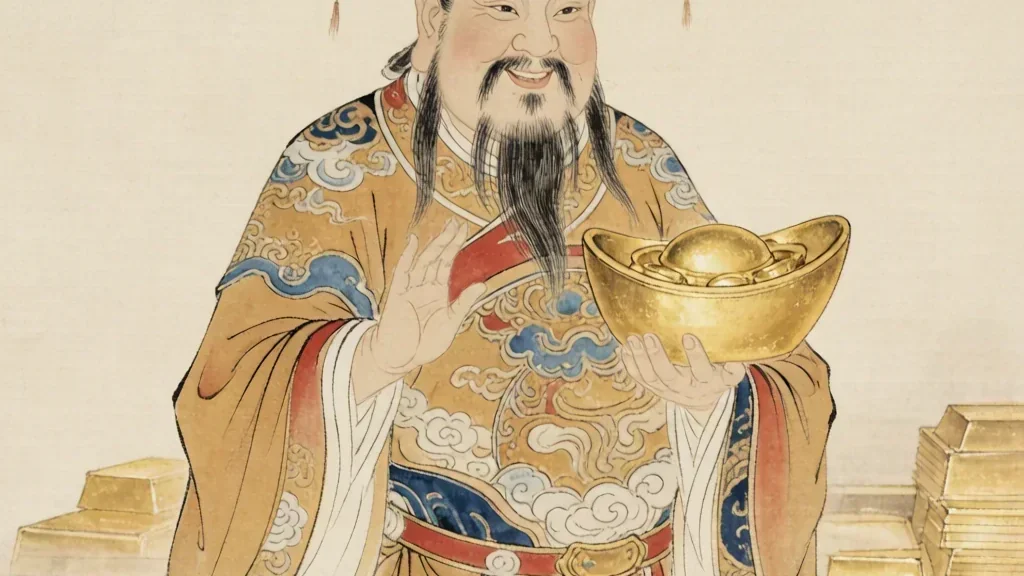
Almost every Chinese household, shop, and bank at some point hangs an image of a plump, smiling figure in court robes cradling a golden ingot. This is Caishen (财神, cái shén), the God of Wealth, the most commercial of China's folk deities and the one whose arrival is celebrated with firecrackers in the small hours of the New Year. Yet Caishen is not one god but many — a shifting council of merchants, ministers, and immortals who, across two thousand years, came to personify the hope that honest effort will be rewarded with abundance.
Origins: Many Gods, One Title
Unlike the great cosmic gods, Caishen grew from the ground up. The earliest Wealth God appears in the Book of Rites as a vague spirit of the stove and granary, but by the Tang and Song dynasties the title had attached to historical and legendary figures. The most beloved is Zhao Gongming (赵公明, Zhào Gōngmíng), a martial deity who first appears in the Taiping Guangji as a plague-spreading demon tamed by a Daoist master. In the Ming novel Fengshen Yanyi (封神演义, "Investiture of the Gods"), he is canonized as the martial God of Wealth, riding a black tiger and wielding a golden whip to reward the faithful and punish the corrupt.
Alongside him stands the "civil" Caishen. The most famous is Bi Gan (比干, Bǐ Gàn), an upright Shang-dynasty minister whose heart was ripped out by a tyrannical king. Legend says that without a heart he could show no favoritism, making him the perfect, impartial distributor of fortune. Other civil forms include Fan Li (范蠡), a statesman who became a wildly successful merchant, and Li Guizu, a Tang official famed for charity. Merchants thus had a patron for both protection and bookkeeping.
In late imperial China the pantheon expanded further into the "Five Roads of Wealth" (五路财神, wǔ lù cái shén), brothers who arrive from the four compass points plus the center, ensuring that money may flow from every direction. This multiplication shows the folk genius for tailoring a single idea — prosperity — to every trade and region.
Iconography: Reading the Wealth God
You can usually tell which Caishen you are looking at. The martial Zhao Gongming is dark-faced, armored, and ferocious, seated on a black tiger with a whip raised; he guards rather than grants. The civil Caishen is the gentle grandfather: round, red-faced, crowned, and dressed in the robes of a high official, holding a ruyi scepter or a string of coins. Both often cradle the yuanbao (元宝, yuánbǎo), a boat-shaped silver or gold ingot that became the universal symbol of riches.
Behind them sits the jubao pen (聚宝盆, jù bǎo pén), the "treasure-gathering basin," a magic bowl that endlessly multiplies whatever is dropped inside — a folk image of compound interest long before the term existed. New Year prints show Caishen descending on a cloud surrounded by boys carrying pomegranates and coins, blessings of both wealth and many sons. The visual language is never subtle: gold, red, roundness, and laughter all signal that fortune should be warm and shared.
Festival Role: Receiving the Wealth God
Caishen's great moment is the lunar New Year. On the eve, households sweep and settle debts so the old year leaves clean. Then, on the fifth day of the first month — called "Po Wu" (破五, pò wǔ, "breaking the fifth") — families throw open doors and windows at dawn, burn firecrackers, and lay out a feast of dumplings shaped like ingots to welcome the Wealth God on his inspection tour. Shops time their reopening to this day, striking fresh account books with his blessing.
The ritual is intensely practical. Merchants paste his image above the counter, bow at opening, and on the fifth day stage a small parade with a paper effigy carried through the street before being burned to send the god home laden with reports. In southern cities like Guangzhou and Hong Kong, the "Caishen market" still draws crowds who buy miniature ingots and fa cai (发菜, fat choy) moss, a homophone for "get rich," turning wordplay into worship.
Cultural Meaning: Virtue and the Moral Economy
To outsiders, Caishen can look like mere greed sanctified. In practice, the folk tradition wraps wealth in ethics. Temple inscriptions pair his name with sayings like 君子爱财,取之有道 ("the gentleman loves wealth, but earns it by the right way"). Almsgiving, fair dealing, and filial care are taught as the real causes of fortune; the god merely certifies the result. This is why he is almost never worshipped alone in greed — he shares the altar with FuluShou (福禄寿), the Stars of Fortune, Emolument, and Longevity, reminding the devotee that money is only one star in a full life.
Caishen also reveals how Chinese religion absorbs history. A plague demon, a disemboweled minister, a retired merchant — all were folded into one benign office because the people needed a face for prosperity they could trust. The God of Wealth is less a theology than a national conversation about work, luck, and fairness, repeated every spring with firecrackers and a bowl of dumplings.
Caishen in Art, Shops, and Daily Commerce
Walk through any traditional market and Caishen is everywhere: on the red envelopes handed to children, on the golden plaques above a shop counter, on the lottery tickets and the business cards of a hopeful trader. His image functions almost as a brand, a reassurance that the enterprise is blessed. Painters of the nianhua (年画, "New Year picture") genre made him a staple subject, printing thousands of cheerful editions each winter so that even the poorest home could afford a god. The commercialization of Caishen is so complete that he has become a mascot of Chinese entrepreneurship itself.
This ubiquity carries a gentle irony worth noting. A deity born of folk need and imperial novel has, in modern cities, merged with advertising. Banks display him at the lunar New Year; stock traders bow to him before a volatile session; restaurants name themselves after him. Yet the old moral frame survives the makeover: the most common inscription beside his figure is still 招财进宝 (zhāo cái jìn bǎo, "attract wealth and bring in treasure") paired with advice to earn it rightly. The God of Wealth thus bridges the ancient and the modern, the sacred and the commercial, reminding a busy society that the wish for enough has always been, at heart, a wish for a life well and fairly lived.