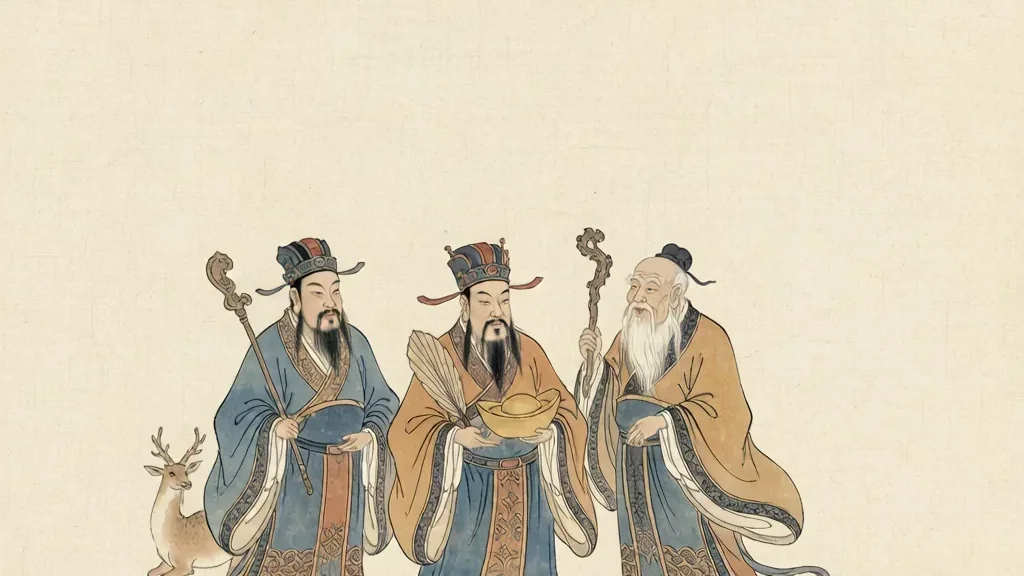
Ask any Chinese person to name the three things a good life requires, and the answer will flow as one word: FuluShou (福禄寿, fú lù shòu) — Fortune, Emolument, and Longevity. These three character-concepts are so deeply woven into the fabric of Chinese culture that they appear together on everything from New Year prints to wedding scrolls, from children's jade pendants to the carved beams of ancestral halls. As folk deities, they are not gods of thunder or judgment but of the quiet, universal human wishes: may you be happy, may you prosper, may you live long. Their smiling faces are the most comforting sight in the Chinese spirit world, and their combined image is a kind of visual shorthand for the whole idea of a life well lived.
Who Are the Three Stars?
The three deities are stellar in origin. Each corresponds to a visible star or asterism in the Chinese sky, and the tradition of personifying these stars as benevolent spirits reaches back at least to the Han dynasty. But it was in popular Ming and Qing culture that the trio crystallized into the familiar figures seen today.
Fu (福, fú) — the Star of Fortune — is usually the central figure in a three-statue group, though in pictorial arrangements he appears on the left. He is depicted as a round-faced, smiling man in the red robes of a high official, often holding a small child or surrounded by boys. The child symbolizes the continuation of the family line, which in traditional China was the greatest fortune of all. He may also carry a ruyi (如意, rú yì) scepter, a curved talisman meaning "as you wish."
Lu (禄, lù) — the Star of Emolument — stands for rank, salary, and career success. He wears the blue or green robes of a civil official and carries a hù bǎn (笏板, the tablet held before the chest at court audiences), or sometimes a ruyi and a child holds a peach. The presence of a deer (鹿, lù, a homophone for 禄) in many images reinforces his identity. Lu's message is that prosperity comes not just from luck but from worldly achievement — the proper reward for education and service.
Shou (寿, shòu) — the Star of Longevity — is the easiest to recognize. He is an old man with a towering, domed forehead, white beard, and a kindly, wrinkled face. He leans on a staff often carved in the shape of a dragon or a crane, and he carries a peach, the fruit of immortality. A bat (蝠, fú, a homophone for 福) sometimes flutters above him or at his feet, weaving fortune into his long years. Shou is not merely the wish to avoid death but the wish for a long, healthy, and dignified old age — to see your grandchildren grow and to die peacefully in old age, surrounded by family.
The Meaning of the Trio
Why three? Chinese folk thought loves triads — Heaven-Earth-Man, past-present-future, the Three Jewels of Buddhism — and FuluShou maps the complete human life. Fortune (Fu) is the foundation, the luck of being born into a good family and the happiness that comes from harmonious relationships. Emolument (Lu) is the middle stage, the career and wealth that you build through your own efforts. Longevity (Shou) is the crowning stage — the time to enjoy what you have earned and to pass it on to the next generation.
The triad is also deeply social. None of the three stars is an individual blessing: Fu blesses the whole household, Lu honors the family name through official service, and Shou means seeing your descendants prosper. FuluShou does not promise a solitary paradise but a full life embedded in family and community. The three faces together say: may your family be happy, may your children succeed, may your old age be long and honored.
This holistic vision explains why FuluShou appears at virtually every life milestone. A newborn receives a Fu-Sho pendant. A scholar passing the imperial exams honors Lu. A wedding scroll displays all three to bless the new couple with everything a family could need. A sixtieth birthday — the completion of one full zodiac cycle — is the great Shou celebration, when the Star of Longevity is thanked for reaching the landmark age. The trio binds the individual life into a rhythm of shared hopes that every Chinese person, regardless of region or dialect, immediately understands.
Iconography: How to Read the Symbols
FuluShou images are rich in visual puns and auspicious symbols. The bat (蝠, fú) is the rebus for Fortune; the deer (鹿, lù) is the rebus for Emolument; the peach and the crane are the emblems of Longevity. A single image might contain all three homophones, turning the picture into a puzzle of blessings. The children surrounding Fu are sons and grandsons — the wealth of descendants. The ruyi scepter, with its cloud-shaped head, means "everything as you wish." The pine tree and the lingzhi (灵芝, a fungus of immortality) appear beside Shou as symbols of endurance and vitality.
The arrangement of the trio follows a strict protocol. In statues, Fu (Fortune) stands on the viewer's left, Lu (Emolument) in the center, and Shou (Longevity) on the right. Lu occupies the center because official rank was, in imperial society, the bridge between personal happiness and a long retirement — the means by which fortune translated into longevity. In paintings and New Year prints, the same order is maintained, and all three figures are shown facing slightly inward toward each other, creating a closed circle of blessings.
FuluShou in Daily Life and Popular Culture
The three stars have transcended religion to become a kind of cultural shorthand. In mainland China, it is common to see a set of three ceramic figurines in the family living room, placed on a shelf or altar facing the door, to welcome blessings into the home. Restaurants display them for good business. Even in modern advertising, FuluShou appears to associate a product — tea, liquor, insurance — with the complete good life. The trio is familiar enough to be used humorously: a meme might replace Fu's child with a smartphone, joking that fortune now means having good reception.
In Chinese diaspora communities — from San Francisco's Chinatown to Singapore's temple streets — FuluShou remains a fixture of the home altar or the shop counter. The figurines are mass-produced in ceramic factories in Fujian and Guangdong, shipped to every continent where Chinese families live. A set of FuluShou is often the first purchase a newly married couple makes for their new home, a quiet declaration that they aspire to the full triad of blessings: may we be happy, may we prosper, may we grow old together. In an age of rapid change, the three smiling stars remain one of the most stable symbols of what it means to wish someone well in Chinese — a single image that says everything worth saying about a good life.