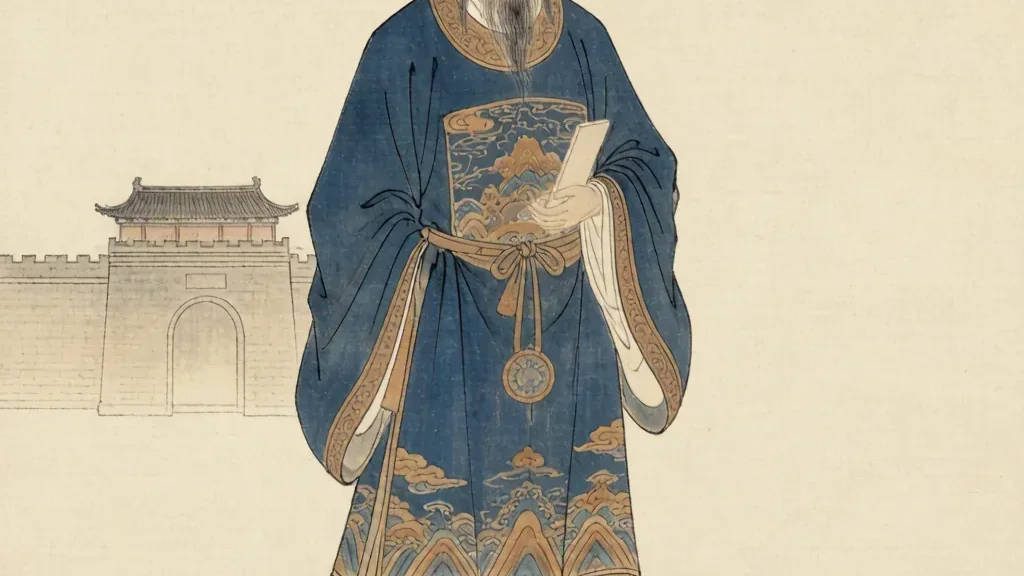
Every walled city in imperial China had a gate, a magistrate, and a god. The last of these was Chenghuang (城隍, chéng huáng), the City God — a divine official who governed the spirit affairs of the city as surely as the human magistrate governed its taxes and trials. His temple was often the largest building after the yamen itself, and his authority stretched from the living who prayed at his altar to the dead who appeared before his judgment seat. Of all the gods in the Chinese folk pantheon, Chenghuang most closely mirrored the earthly bureaucracy, and he offered the most direct proof that the world of spirits was ordered, hierarchical, and just.
Origins: From Moat to Magistrate
The name Chenghuang originally meant something quite literal: "city moat" (城, chéng, "city wall" and 隍, huáng, "dry moat"). In the earliest references, found in the Book of Documents and in Zhou dynasty inscriptions, the term referred to the physical defenses of a settlement — the wall and trench that protected the community. The spirits of these boundaries were vague, impersonal forces, not named gods. People offered sacrifices to the wall and moat as they might to a mountain or river, thanking the protective barrier without imagining a deity with a face.
The transformation from boundary spirit to personal god began during the Six Dynasties period (220–589 CE), when local cults started to attach names and biographies to the city's protective spirit. By the Tang dynasty (唐, Táng, 618–907 CE), Chenghuang was widely worshipped as an independent deity with temples and official sacrifices, and the imperial court began to grant him formal titles. The Song dynasty (宋, Sòng, 960–1279 CE) systematized the cult: every administrative city was required to have a Chenghuang temple, and the deity's rank — from "marquis" to "duke" to "king" — was matched to the city's administrative level. A county town had a count; a prefectural seat had a marquis; the imperial capital had a king.
The final step came in the Ming dynasty (明, Míng, 1368–1644 CE), when the Hongwu Emperor, Zhu Yuanzhang, codified the entire spirit bureaucracy as an explicit parallel to his own administration. He decreed that every city's Chenghuang should mirror its human magistrate, and he standardized the ritual forms. This was statecraft as theology: if Heaven had a bureaucracy, and the empire had a bureaucracy, then the two must match, and the City God was the crucial link at the city level.
Iconography: The Divine Magistrate
Chenghuang is depicted as a stern, dignified figure in the black or blue robes of a Ming dynasty official, complete with a winged wusha mao (乌纱帽, wū shā mào) hat — the headgear of a civil servant. He often holds a tablet or a brush and scroll, the tools of an administrator, and is flanked by two attendants: the "Judge of Records" who holds the book of every inhabitant's deeds, and a demonic-looking "Catch-All Spirit" (范谢将军, fàn xiè jiāng jūn) who drags the guilty to judgment. The total effect is meant to inspire awe rather than affection, the solemn dignity of a courtroom rather than the warmth of a shrine.
The temple itself reinforces this message. The main hall is laid out like a magistrate's court, with the god's statue raised on a dais behind a table bearing a seal and a brush. On either side hang the banners and placards that announce his titles. Beyond the main hall, many Chenghuang temples contain a separate "Horror Courtyard" with depictions of the ten courts of hell — flaying, boiling, sawing — to remind worshippers that the City God's judgment is only the first step in a longer process. The entire temple is a lesson in accountability: every deed is recorded, and every soul will be examined.
Festival Role: The City God's Procession
The most dramatic expression of Chenghuang worship is the annual procession known as the "City God's Inspection Tour" (城隍巡游, chéng huáng xún yóu). On the god's birthday — which varies by city but typically falls in the spring — his statue is carried through the streets in a massive palanquin, accompanied by dancers, musicians, and actors in the costumes of spirit officials and underworld judges. The parade route symbolically traces the boundaries of the city, reasserting the god's authority over his territory.
During the Ghost Festival (中元节, zhōng yuán jié) in the seventh lunar month, Chenghuang plays an even more solemn role. He presides over the temporary release of souls from the underworld, ensuring that the hungry ghosts who roam the earth for the month are kept in order. Offerings are made at his temple to ask for protection from wandering spirits. In many cities, the festival ends with the City God personally "rounding up" the ghosts and returning them to hell — a ritual that consoles the living by proving that even the dead are governed by law.
Cultural Meaning: The City as a Moral Community
Chenghuang was more than a supernatural guardian — he was the city's conscience. Because he kept a record of every inhabitant's deeds and reported to the Jade Emperor annually, he encouraged a kind of supernatural accountability that supplemented the human magistrate's law. A merchant might cheat a customer in the market knowing the human judge would never catch him; but the City God saw everything, and the annual report made every citizen responsible for the moral health of the community.
The City God also bound the living to the dead. The Chenghuang temple was the place where the families of the recently deceased registered the death with the spirit world, ensuring that the soul was properly received. It was also where people prayed for ancestors who might be suffering in the underworld, hoping the City God would intercede. In this way, the god administered the border between life and death — a border that every city dweller would cross, and that the god himself had already crossed.
From a modern perspective, Chenghuang reveals something important about Chinese folk religion: it is not merely a collection of superstitions but a complete system of social ethics backed by supernatural authority. The City God made the imperial bureaucracy cosmic, teaching every subject that order, hierarchy, and moral accountability were not human inventions but the very structure of the universe. His stern, judgmental face — looking out from the main hall of every walled city — was the face of law itself, made visible in wood and paint.
Chenghuang Temples Today: A Living Tradition
Despite the upheavals of the twentieth century — the anti-religion campaigns of , the rapid urbanization that has transformed China's cities — many Chenghuang temples have survived or been restored. The City God Temple of Shanghai (上海城隍庙, shàng hǎi chéng huáng miào), located in the heart of the old city, is one of the most visited sites in China, surrounded by a bustling bazaar that draws tourists and devotees alike. The temple in Xi'an preserves Ming-era architecture and a fierce, majestic statue of the god. Even in Taiwan and Chinese diaspora communities across Southeast Asia, Chenghuang temples remain active centers of worship, their annual processions still drawing crowds.
Today's worshippers offer incense for the same things their ancestors did: protection for a new business, a safe journey, a prayer for a deceased relative. The City God has survived the end of the imperial system because his deepest function — reminding people that their actions have moral weight, and that someone is watching — does not depend on the Ming bureaucracy. As long as cities have walls (or the memory of walls), and as long as people feel the need for a witness to their lives, Chenghuang will continue to sit in judgment, brush in hand, book open, ready to record whatever the year may bring.