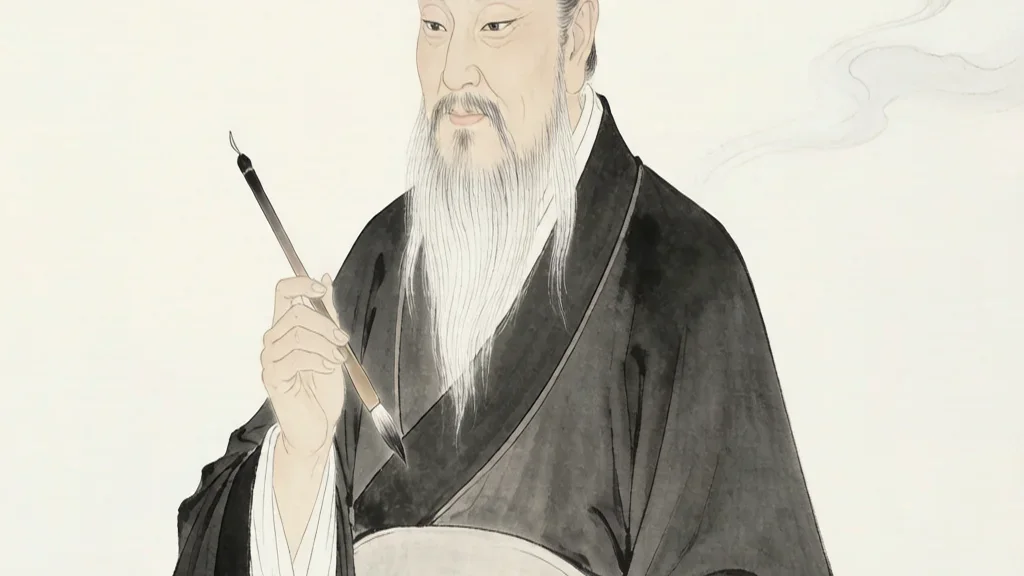
Wen Chang (文昌), the God of Literature, is the patron deity of scholars, writers, and examination candidates in Chinese culture. Revered for centuries by students hoping to succeed in the imperial civil service exams, he presides over literary achievement, wisdom, and official rank earned through study. In a society where the brush was the ladder to power, Wen Chang stood at the top of the scholarly heaven, and his temples were the quiet rivals of the exam halls themselves.
Origins and the Wen Chang Star
The name Wen Chang means "Lord of Letters" and originally referred to a group of six stars in the Big Dipper region, associated with literary eminence and official honor. Ancient astrologers read these stars as governing culture and the fortunes of men of letters.
Over time the constellation was personalized into a god. By the Tang and Song periods, Wen Chang was worshipped as a distinct deity of literature, later fused with a historical loyal official, Zhang Ya, who was deified after death and identified with the star-lord.
Wen Chang and the Examination System
For over a millennium, the imperial examination (科举) was the main road to office, and success demanded years of classical study. Candidates prayed to Wen Chang for clarity, memory, and the favor of examiners — for the "flow" that turns knowledge into a winning essay.
Temples to Wen Chang stood near exam sites and schools. The god's blessing was sought not as a shortcut but as support for disciplined effort; he rewarded the prepared mind. This made him the spiritual anchor of China's meritocratic ideal.
The God's Retinue and Attributes
Wen Chang is often shown in official robes holding a writing brush or a tablet, sometimes riding a white horse or attended by two youths who record names in the book of literary fate. One holds the register of successful candidates, the other the brush that decides rank.
He may also appear with the "Wen Chang pagoda" (文昌塔) symbol, a tower believed to gather literary qi for nearby students. Families placed such towers or miniature steles to boost a child's scholastic luck.
Wen Chang Versus Other Scholar Deities
Wen Chang is the senior literary god, but he shares the field. Confucius is venerated as the sage of learning; the "God of Wealth" Cai Shen governs material fortune; and Kuixing (魁星), a dwarf-like god, rules the top exam grade. Wen Chang presides over the whole literary enterprise.
This division let students address the right patron for the right need: Confucius for wisdom, Kuixing for the highest mark, Wen Chang for the broad career of letters and office. The pantheon mirrored the exam system's layers.
Temples and Ritual Practice
Wen Chang temples (文昌阁, 文昌庙) were common at prefectures and academies. Students offered incense, wrote prayers on red paper, and left brushes or scrolls. Before exams, mothers and grandmothers often led the devotion, betting family hopes on the god.
Rites were modest and studious in tone — no frenzy, just steady respectful appeal. The atmosphere reflected the god's nature: calm, bookish, and oriented to long-term cultivation rather than sudden miracle.
Symbolism of Literary Success
In Chinese value, wen (文, letters/culture) stands opposite wu (武, martial). Wen Chang crowns the civilized arts that legitimize rule. To honor him is to honor the ideal that government should be guided by learning, not merely force.
His cult thus carried a political message: a stable realm is one where the pen outranks the sword in appointing leaders. The god was a gentle advocate for merit and civility.
Modern Echoes
Though the imperial exams ended in the early twentieth century, Wen Chang survives wherever students face big tests. In Taiwan, Hong Kong, and parts of Southeast Asia, pupils still pray to him before university entrance exams, leaving their hopes at his shrines.
His image appears on stationery, school charms, and study apps, and the "Wen Chang pagoda" remains a popular feng-shui item for scholars. The God of Literature has simply changed syllabi, not his job.
Wen Chang in Folk Geomancy
Beyond the temple, Wen Chang entered everyday space through feng-shui. Families placed a Wen Chang pagoda or a small stele on the study desk, or oriented a study toward his directional seat, believing it gathered the literary energy a student needed to succeed.
Some traditions assigned each person a personal "Wen Chang position" based on birth year, much like the Tai Sui direction, and advised studying or placing books there. The practice blended astrology, architecture, and exam anxiety into a single comforting routine repeated each school term.
This geomatic side shows how the God of Literature migrated from state ritual into the bedroom and classroom. He became not only a deity to petition but a spatial arrangement to maintain — proof that scholarship in old China was as much about environment as effort.
Women, though barred from the exams, also venerated Wen Chang for the sons and brothers they tutored at home, weaving his blessing into domestic teaching. His cult thus reached beyond the examination hall into the family school.
In this quiet way the God of Literature sanctioned learning as a household value, not merely an official career. The brush he blessed could belong to any earnest student, girl or boy, within the home's walls.
Even today, a student who places a Wen Chang figurine on the desk joins a chain of petitioners stretching back over a thousand years, each hoping that steady effort, lightly blessed, will find its reward.
❓ Frequently Asked Questions
Who is Wen Chang?
Wen Chang is the God of Literature, patron of scholars, writers, and exam candidates. He originated as a group of stars and later became a personalized deity of literary success and official rank.
Why did students pray to him?
The imperial exams were the main path to office, requiring intense study. Candidates sought his aid for clarity, memory, and examiner favor — support for effort, not a substitute for it.
How is Wen Chang shown?
Usually in official robes with a brush or tablet, sometimes on a white horse, attended by two youths holding the book of literary fate and the brush that decides rank.
Is he the same as Confucius?
No. Confucius is the sage of learning and moral wisdom; Wen Chang is the patron of literary career and exam success. They are venerated separately, sometimes side by side.
What is a Wen Chang pagoda?
A tower or miniature stele believed to gather literary qi for nearby students, placed by families to improve a child's scholastic fortune in feng-shui practice.
Is Wen Chang still relevant?
Yes. Students in Taiwan, Hong Kong, and Southeast Asia still pray to him before major exams, and his image appears on study charms and apps, adapted to modern schooling.