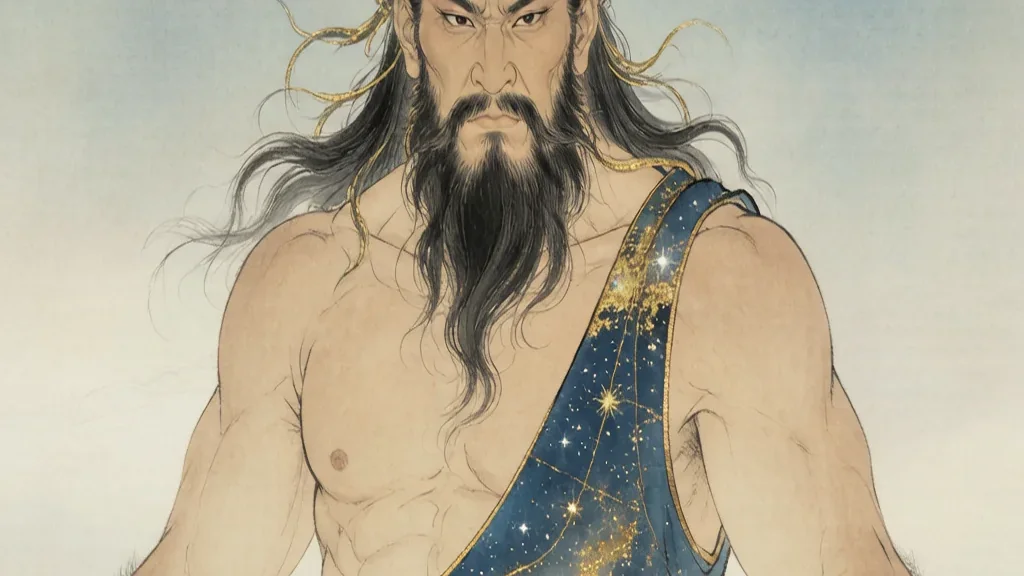
Pangu (盘古) is the central creator figure in Chinese myth, the giant who separated heaven and earth and whose body became the world. Unlike the bureaucratic gods of later religion, Pangu belongs to a cosmogonic tradition in which the universe is born from a cosmic egg and shaped by a single primordial being. Though his legend appears later than some other Chinese myths, it became the standard account of creation, beloved for its image of a self-sacrificing giant whose death gives rise to mountains, rivers, sun, and moon.
The Cosmic Egg
The Pangu myth begins in a time when the universe was a formless chaos, often described as a dark "egg" or a cloudy yolk in which opposites were mixed. Inside this egg, Pangu lay asleep and grew for an immense period.
After countless years he awoke, and with a great effort split the egg: the light, pure part rose to become heaven, while the heavy, turbid part sank to become earth. This act is the original separation of yin and yang.
The egg image is a striking piece of Chinese cosmogony, presenting creation not as the command of a distant god but as the hatching of the world from a single enclosed source.
Separating Heaven and Earth
Once heaven and earth were parted, Pangu feared they might close again, so he stood between them and pushed upward, growing ten feet each day so the two drew further apart. For another vast span he held the space open.
In this way the distance between sky and ground increased daily, and Pangu himself became the living pillar that kept them apart. His posture is the very image of the world's framework.
When at last he felt his task complete and his strength spent, Pangu lay down and died, and from his dying body the familiar features of the earth took shape.
The Giant's Body Becomes the World
The most poetic part of the legend is the transformation of Pangu's corpse into the cosmos. His breath became the wind and clouds, his voice the rolling thunder, and his left eye the sun while his right eye became the moon.
His limbs and torso formed the four directions and the central mountains; his blood flowed into rivers, his veins became roads and waterways, and his flesh turned to soil and the fertile earth. Even his fleas and parasites are said to have become the first humans in some versions.
This total metamorphosis teaches a profound idea: the world is not made by a craftsman outside it, but is the very body of the being who gave it birth—a deeply ecological vision of kinship with nature.
Origins and Dating of the Legend
Interestingly, Pangu is a relatively late arrival in Chinese myth, first clearly recorded in texts of the Three Kingdoms and later periods, possibly with influence from southern or even non-Han creation stories. Earlier traditions favored creator couples like Fuxi and Nüwa.
Once recorded, however, the Pangu story spread quickly and was retrofitted as the opening chapter of Chinese cosmogony, favored because it gave a single, elegant account of how everything began.
Scholars debate its roots, but its popularity shows how readily a compelling creation image could be absorbed into the mainstream pantheon regardless of its precise origin.
Pangu and the Egg in Comparative Myth
The "world egg" is a widespread motif in global mythology, and Pangu's egg places Chinese creation lore in a broad human pattern. The hatching giant also resembles other traditions where a primal being's body forms the world.
What is distinctive is Pangu's ongoing labor—the daily growth that separates heaven and earth—which emphasizes effort and time over a single act of speech. Creation here is patient work, not instant command.
His self-sacrifice at the end further distinguishes the tale, making the world a gift of life rather than a product of conquest or accident.
Symbolism of Yin and Yang
Pangu's splitting of the egg is the mythic first moment of yin-yang division: the clear rising yang and the sinking yin. His whole career enacts the separation and balancing of opposite forces that Chinese philosophy prizes.
By holding the two apart, he prevents their return to undifferentiated chaos, and his body's distribution across the land keeps the balance embodied in physical form. The cosmos, in this view, is his sustained posture.
The story thus serves as a founding narrative for the yin-yang worldview that later infused medicine, statecraft, and daily life throughout Chinese culture.
Pangu in Art and Culture
Pangu is a common subject in painting and sculpture, usually shown as a hairy, muscular giant wielding a hammer and chisel or embracing the swirling chaos. New Year prints and temple murals keep his image familiar.
In modern times he appears in literature, animation, and games as the primal ancestor, and his name is used for places, products, and even scientific projects as a symbol of origins and foundation.
Though not a recipient of the elaborate state cult given to other deities, Pangu occupies a secure place as the mythic answer to the question "How did the world begin?"
Pangu's Hammer and Chisel
In visual tradition Pangu is often shown wielding a hammer and chisel, the tools of a cosmic craftsman shaping the world from the inside out. This image stresses that creation was labor as much as miracle, a slow carving of order from the unformed dark of the original egg.
The chisel also links him to the artisan gods of later folklore and to the stonecarvers who decorated temples and cliff faces, suggesting that human craft participates in Pangu's original act of making. Every shaped stone echoes his first blow.
Some regional tales add that the fleas and lice on his body, scattered by the wind, became the first human beings, a humble and even comic origin that nonetheless underscores the intimacy between humanity and the giant's living flesh. We are, in this imagining, quite literally made of the same stuff as mountains and rivers.
❓ Frequently Asked Questions
Who is Pangu?
Pangu is the primordial giant of Chinese creation myth who hatched from a cosmic egg, separated heaven and earth, and whose body became the world after his death.
How did Pangu separate heaven and earth?
He pushed them apart and grew ten feet each day for ages, holding the space open until they were far enough apart to stay divided.
What became of Pangu's body?
His breath became wind and clouds, his eyes the sun and moon, his blood rivers, his flesh soil, and his limbs the mountains and directions of the earth.
Is Pangu an ancient or a late myth?
His legend is first clearly recorded in texts of the Three Kingdoms period and later, making it younger than some other Chinese myths despite its central role.
What does Pangu have to do with yin and yang?
His splitting of the cosmic egg is the original separation of clear yang (heaven) from heavy yin (earth), enacting the founding division behind Chinese cosmology.
Are there similar creation myths elsewhere?
Yes; the "world egg" and the giant-whose-body-becomes-the-world are widespread motifs, though Pangu's patient labor and self-sacrifice are distinctive touches.