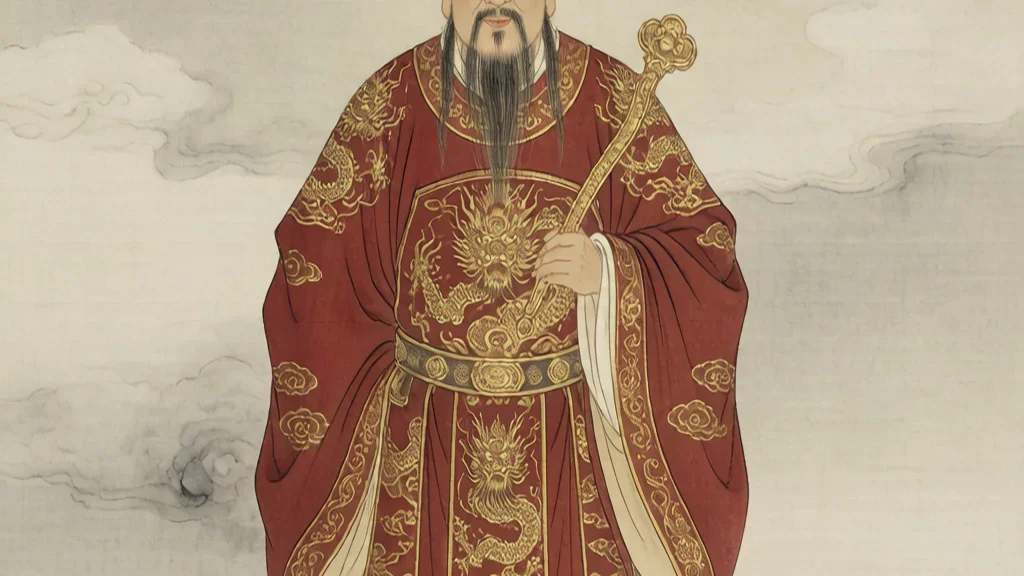
The City God, known as Chenghuang or Cheng Huang, is the tutelary deity of a walled town or city in Chinese folk religion, serving as its supernatural magistrate, protector, and judge of the dead. Where the Earth God guards a single ward, the City God governs the whole urban district and acts as its representative in the heavenly court. Historically rooted in the earthen altars raised at city ramparts, his cult grew into one of the most organized expressions of Chinese local religion, complete with a spirit bureaucracy that mirrored the human yamen. To this day, City God temples remain focal points of community ritual, festival, and the moral imagination of the afterlife.
Name and Literal Meaning
"Cheng" means city wall and "huang" means moat or rampart, so Chenghuang literally refers to the fortifications that protected a town. The deity thus personifies the protective boundary of the settlement — what kept the civilized inside safe from the wild outside.
Over time the word came to name the god who inhabited and governed that boundary. Each walled city had its own City God, often a deified historical official remembered for integrity, so that the divine magistrate was also a local ancestor-hero.
Historical Development
Worship of city walls and moats as spirits is old, but the City God as an organized cult rose notably from the Tang and Song dynasties, expanding with the growth of cities and trade. The Yuan and Ming states formally ranked City Gods and incorporated them into official rite, assigning each prefecture and county its own deity.
The Ming founder Zhu Yuanzhang was especially enthusiastic, standardizing City God titles and temples across the realm. By linking the earthly administration to a heavenly one, the court used the cult to reinforce law and order — the City God was, in effect, the imperial bureaucracy's spiritual branch.
The City God's Spirit Court
Like the Jade Emperor's heaven, the City God's domain is a bureaucracy. He presides over clerks, judges, torturers, and messengers who manage the records of the living and the fate of the dead within his city. Petitions and souls pass through his yamen just as lawsuits passed through a human magistrate's.
This mirroring comforted and warned citizens at once: comforted because order extended beyond the grave, warned because the City God saw hidden deeds a human judge could not. The temple was thus both a courthouse and a confessional.
Judge of the Dead
A central role of the City God is to receive the souls of the newly dead from his subordinate Earth Gods and to begin their assessment. Folk belief held that shortly after death the soul appeared before the City God for a first hearing, after which it moved on to broader judgment.
Temples therefore displayed vivid tableaux of the afterlife — scales, mirrors that reveal truth, and scenes of reward and punishment. These served as popular moral instruction, dramatizing the conviction that justice, delayed on earth, is certain in the next world.
From Historical Officials
Many City Gods were once real people: loyal generals, honest magistrates, or martyrs who died for their city. A notable example is the Tang official who became the City God of a place he served well. Deifying such figures turned local gratitude into lasting worship.
This habit of making gods from worthy dead officials blurred the line between history and mythology, and it meant that a City God's biography was often a civic pride story — the city honored itself by honoring its best servant as its eternal guardian.
Temples and Ritual Life
City God temples stood near the administrative center of a town, sometimes beside the government office. Their layout copied a yamen, with an outer court for the public and an inner hall for the god's "residence." Annual rites included inspecting the city's boundaries and a grand procession of the god's image.
On his birthday and at the Ghost Festival, the temple hosted operas, fairs, and releases of lanterns for the hungry ghosts. The City God's parade, with his sedan carried through the streets, reaffirmed the bond between the deity and the urban community he protected.
Moral and Social Function
Beyond the supernatural, the City God cult taught civic virtue. Proclamations posted in his name urged filial piety, honesty, and peace among neighbors, using the god's authority to back ordinary social norms. The threat of otherworldly audit discouraged secret wrongdoing.
For merchants and travelers, the City God offered protection of person and property within the walls. A stranger entering a city could pay respect at the temple to place himself under its god's care — a spiritual version of registering with the town.
Connection to the Earth God
The City God and the Earth God form a paired hierarchy: the Earth God reports the affairs of his ward up to the City God, who then represents the whole city to heaven. Together they knit every level of local life into the divine order.
This chain reassured people that no place was outside protection and no soul outside account. From the single field to the walled metropolis, the same logic of guardianship applied, scaled like the levels of government itself.
City God Today
Many City God temples survive as active worship sites and as heritage landmarks, especially in Taiwan, Hong Kong, and parts of Southeast Asia, where the cult remains vibrant. On the mainland, restored temples draw both devotees and tourists curious about the afterlife tableaux.
The City God endures because he answers a deep need: the wish that justice and community outlast individual life. Whether approached in faith or studied as culture, he remains one of the clearest windows into how the Chinese imagined the bond between city, morality, and the cosmos.
❓ Frequently Asked Questions
What is the City God?
Chenghuang is the tutelary deity of a walled city, acting as its protector, magistrate, and first judge of the dead.
How does he differ from the Earth God?
The Earth God guards a single ward; the City God governs the whole city and receives reports from Earth Gods.
Where did the cult come from?
It grew from Tang and Song times and was formalized under the Ming, when each city got a ranked City God.
What happens in a City God temple?
Worship, annual processions, and displays of the afterlife that teach moral lessons about reward and punishment.
Are City Gods based on real people?
Often yes; many were honest officials or martyrs deified by the city they served.
Do people still worship him?
Yes; the cult remains active in Taiwan, Hong Kong, Southeast Asia, and restored mainland temples.