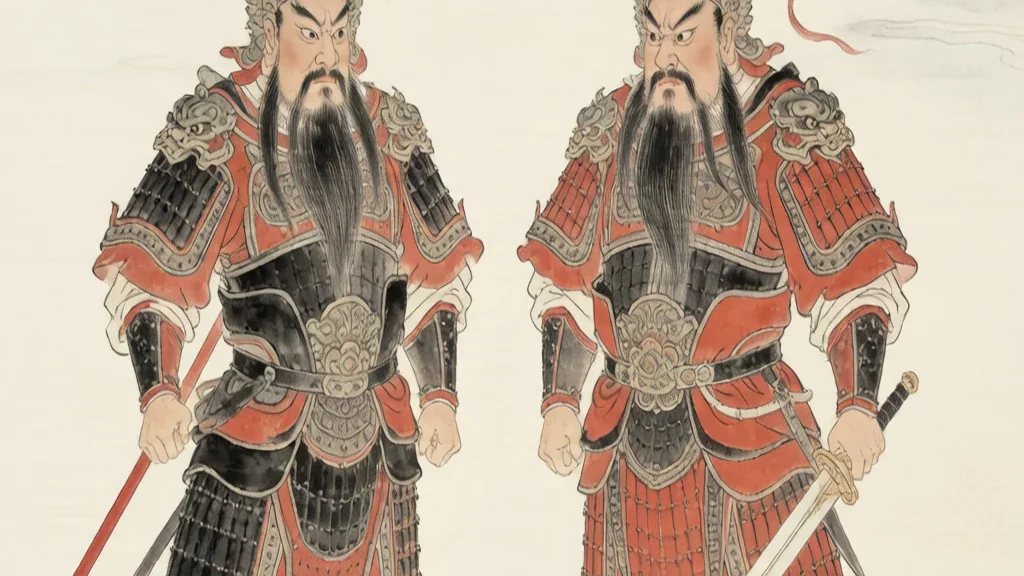
The Door Gods (门神, Mén Shén) are the paired guardians pasted or painted on the two leaves of a Chinese gateway or home entrance. For well over a thousand years, households have honored them at the lunar New Year, believing that the two martial figures block evil spirits, thieves, and disease from crossing the threshold. More than simple decoration, they express a deep cultural anxiety about the boundary between the safe inside and the dangerous outside.
Mythic Origins with Shen Tu and Yu Lei
The earliest Door Gods trace to a legend recorded in the Han dynasty. Two brothers, Shen Tu (神荼) and Yu Lei (郁垒), lived on a mythic mountain where ghosts gathered each night. Armed with reed ropes, they caught mischievous spirits and fed them to tigers. People began drawing their images on doors to keep ghosts away.
This founding myth established the core idea: the door is a contested frontier, and only fierce, watchful beings can hold it. The brothers' tiger-punishing role explains why later door imagery often includes big cats or leaping poses.
The Tang Generals Qin and Yuchi
The most popular Door Gods from the Tang period onward are two historical generals, Qin Shubao (秦叔宝) and Yuchi Jingde (尉迟敬德). The story says Emperor Taizong suffered nightmares of ghosts rattling outside his chamber. The two loyal generals stood guard all night in armor, and the emperor slept peacefully.
In gratitude the emperor had their portraits painted on the palace doors, and the custom spread to common homes. Today the right and left leaves usually show these two, one holding a mace or club, the other a sword, faces framed by helmets and beards.
Forms and Visual Conventions
Door God prints follow strict symmetry. The figure on the right door leaf faces left, the one on the left faces right, so they appear to confront any intruder together. They are bold, colorful, and martial — a deliberate contrast to the soft, prosperous images hung indoors.
Beyond Qin and Yuchi, regional sets include women warriors, boy attendants, or even civil officials for inner doors. The medium is usually woodblock New Year print (年画), mass-produced and pasted fresh each spring as old ones are peeled away.
Placement and Ritual at New Year
Putting up Door Gods is a key part of the lunar New Year cleaning and renewal. After sweeping the house, a family pastes new images just before or on New Year's Eve, often with a reversed "fu" character and spring couplets. The old gods are discarded respectfully, sometimes burned.
The door leaves must be aligned so the guardians "face outward" to meet threats. A common saying warns against pasting them upside down or swapped, lest the protection be reversed. The act is both aesthetic and apotropaic.
Door Gods Versus Zhong Kui
Door Gods and Zhong Kui share a protective purpose but differ in posture. The Door Gods are stationary sentinels who simply stand and stare down evil; Zhong Kui is a roaming hunter who chases and devours demons. Households may use both, placing Zhong Kui inside and the generals at the gate.
This division shows a layered defense model: outer guards at the threshold, inner quellers in the rooms. Chinese home protection is rarely entrusted to a single figure but to a coordinated spiritual team.
Symbolism of the Threshold
In Chinese architecture the door is the "mouth" of the house, through which both guests and fortunes enter. Guarding it is therefore guarding the family's luck itself. Door Gods thus symbolize not only safety but the welcoming of good qi and the rejection of bad.
The pairing also mirrors social ideals: loyalty (the two generals to their emperor), brotherhood, and vigilance. A doorway guarded by such figures announces a household that honors duty and order.
Regional and Dynastic Variety
Different eras favored different Door Gods. Han tales preferred Shen Tu and Yu Lei; Tang and later preferred Qin and Yuchi; some southern communities venerated local loyalists. Folk religion is flexible, adopting new heroes as their stories spread.
In addition, specialized door spirits guarded city gates, shops, and stables, each tailored to the space. The basic pattern — two facing guardians — remained constant even as the names changed with local taste and history.
Modern Survival
Door God prints survive strongly in rural China and in overseas communities, where New Year markets still sell rolls of the familiar faces. In cities, printed paper versions have partly given way to stickers and digital greetings, but the image remains a recognized symbol of the holiday.
Collectively, the Door Gods are a rare case of ancient myth surviving as everyday domestic art. Few households today narrate the full Shen Tu legend, yet almost everyone still knows that the two men on the door are there to keep trouble out.
Door Gods in Overseas Communities
Wherever Chinese migrated, the Door Gods traveled. In Southeast Asia, North America, and Europe, Chinatown shops and clan halls still paste Qin and Yuchi at the entrance, a small claim of protection in a foreign land far from the ancestral village.
The images also became tourist symbols of "Chineseness," printed on calendars and sold as folk art. Even families who no longer perform the full New Year rite often keep a pair for luck and identity, linking the guardians to heritage as much as to safety.
In this diaspora life, the Door Gods show how a domestic apotropaic custom can become a cultural emblem. The two martial figures now guard not only thresholds but the memory of home itself, standing watch over belonging.
❓ Frequently Asked Questions
Who are the Chinese Door Gods?
They are paired guardian figures pasted on entrance doors. The oldest are the brothers Shen Tu and Yu Lei; the most popular are the Tang generals Qin Shubao and Yuchi Jingde.
Why are there always two of them?
The two face each other across the threshold so they jointly confront any intruder. Symmetry signals a balanced, coordinated defense of the home's boundary.
When do people put up Door Gods?
Usually just before or on lunar New Year's Eve, after the house is cleaned, alongside spring couplets and reversed "fu" characters, replacing the previous year's images.
What is the difference between Door Gods and Zhong Kui?
Door Gods are stationary sentinels at the gate, while Zhong Kui is an active hunter of demons. Homes may use both, with the generals outside and Zhong Kui within.
Are Door Gods still used today?
Yes. New Year markets in rural areas and overseas communities still sell Door God prints, and the image remains a widely recognized holiday symbol even in cities.
What did people use before printed images?
Early protection used peach-wood planks (tao fu) inscribed with the guardians' names or symbols, hung on the door as charms against evil.