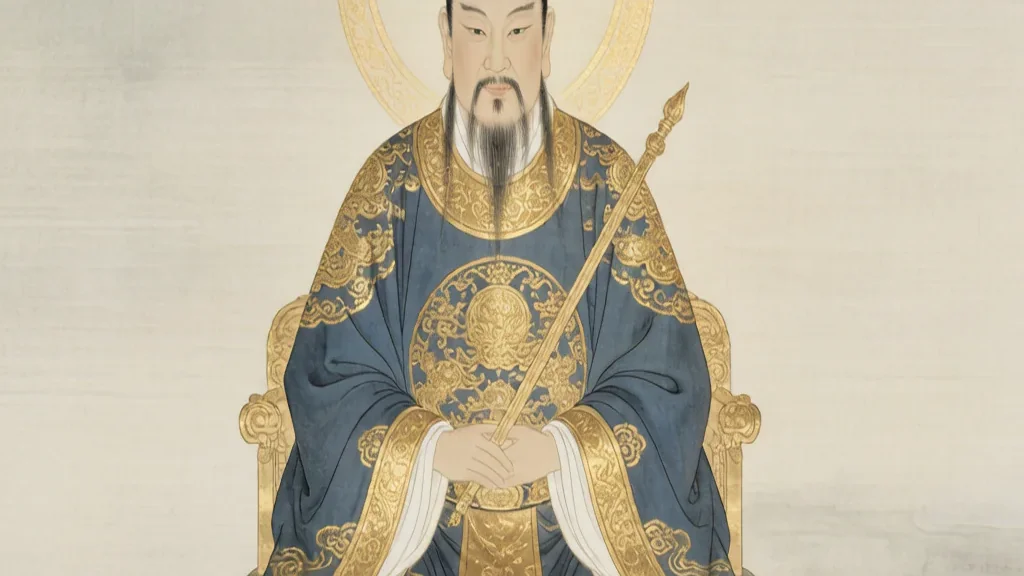
The Jade Emperor, known in Chinese as Yu Di or Tian Gong ("Heavenly Grandfather"), is the supreme ruler of heaven and the head of the vast Taoist celestial bureaucracy in Chinese popular religion. He presides over the gods much as an earthly emperor ruled over officials, dispatching deities to manage weather, wealth, war, and the destiny of mortals. Though Buddhism and local cults supplied many beloved figures, the Jade Emperor stands at the top of the folk pantheon as the ultimate sovereign whose authority binds gods and humans alike. His place in the New Year calendar and in temple worship makes him one of the most recognized faces of Chinese divinity.
Names and Titles
The Jade Emperor is called Yu Huang Shang Di ("Jade August Supreme Deity") in formal liturgy, and among ordinary people simply Tian Gong, the "Heavenly Grandfather." The word "jade" signals purity, nobility, and imperishability — qualities fitting for the lord of heaven. In Taoist theology he is sometimes identified with the highest celestial principle, though in popular practice he is more a kingly administrator than a philosophical absolute.
Different regions and sects use slightly different titles, but the image is consistent: a golden-robed emperor on a dragon throne, attended by civil and military ministers of the spirit world. This bureaucratic framing reflects the Chinese conviction that the cosmos is governed by order and protocol, not chaos.
Rise Within the Taoist Pantheon
The Jade Emperor's stature grew over many centuries. Early Chinese religion centered on sky worship and ancestral rites, with "Heaven" (Tian) as a remote moral force rather than a personal king. As Taoism organized its pantheon, a supreme heavenly sovereign became necessary to head the divine administration, and the figure of the Jade Emperor crystallized.
By the Tang and Song dynasties, imperial courts formally honored him, and a legend of his cultivation over innumerable eons into godhood spread. The Song emperors in particular promoted his worship, linking his heavenly rule to their own earthly mandate and thereby securing his place at the apex of state-sponsored religion.
The Heavenly Bureaucracy
Chinese religion famously imagines the divine world as a mirror of the imperial state. Beneath the Jade Emperor serve ministers, judges, generals, and local clerks — the City Gods, Earth Gods, and Kitchen Gods who report upward through ranks. Petitions from humans ascend through this hierarchy, and the Jade Emperor issues decrees that the lower officials carry out.
This bureaucratic cosmology explains many customs, such as burning "memorials" addressed to heaven or appointing a local Earth God to a village. The Jade Emperor is the final signatory on cosmic affairs, and his court resembles the familiar world of magistrates and petitions that ordinary Chinese knew from daily life.
Myths of His Origin
One popular legend tells that the Jade Emperor was once a mortal prince who, grieved by the suffering of beings, renounced his throne and cultivated the way for many ages until he attained supreme godhood. His long austerities earned him the right to rule heaven and to set the moral order of the world.
Another strand of myth places him as a later organizer of a cosmos already created by primordial gods such as Pangu and Nüwa. In these stories his role is less creation than administration — establishing ranks among the gods, fixing the calendar, and assigning each spirit its duty. Both traditions agree on his function as supreme coordinator.
Relationship With Other Deities
The Jade Emperor is not usually a personal savior like Guanyin; rather, he is the chairman of the board of heaven. Gods such as the Dragon Kings, the God of Wealth, and the City Gods operate under his authority, and even powerful buddhas and immortals are often shown deferring to him in vernacular fiction.
In the novel "Journey to the West," the Jade Emperor appears as the dignified but somewhat confounded ruler of heaven who must call on the Buddha when the Monkey King runs amok. Such tales reveal a folk attitude that, while respectful of his rank, finds him less approachable than the warm, everyday deities who answer direct prayers.
Worship and the New Year
The Jade Emperor's birthday, the ninth day of the first lunar month, is a major occasion. Families celebrate with incense, offerings of vegetarian food, and the lighting of lanterns, often continuing the New Year festivities that began days earlier. The midnight hour of that day is considered especially sacred for prayer.
Households may keep a small shrine to Tian Gong, and in southern China it is common to face the sky and burn joss paper in his honor. Because he represents heaven itself, reverence for him blends naturally with the general New Year wish for peace and prosperity in the year ahead.
The Jade Emperor in Temples
Dedicated Jade Emperor temples exist, though he more often occupies the central hall of large Taoist temples shared with other gods. His image shows a calm, bearded sovereign in imperial yellow, sometimes flanked by attendants who hold a tablet and a scroll of life and death. The decor stresses majesty and order.
Pilgrims approach him for broad blessings — a good harvest, stable weather, protection of the realm, and family harmony. Unlike a specialist deity, he is asked for overall fortune, because as heaven's regent all blessings ultimately flow from his court.
In Folklore and Fiction
Beyond scripture, the Jade Emperor features in countless operas, ballads, and folk tales as the judge of divine disputes and the allocator of ranks. He tests worthy mortals, punishes arrogance, and rewards virtue, functioning as the moral center of the heavenly state.
These stories reinforce the social values of the day: loyalty, filial piety, and respect for rightful authority. By showing even gods obeying procedure, the tales taught that order — not raw power — sustains the world, a comforting message in times of earthly uncertainty.
Modern Cultural Presence
Today the Jade Emperor survives strongly in Taiwan, Hong Kong, parts of Southeast Asia, and among overseas Chinese, where his birthday is still observed with processions and temple fairs. On the mainland, his worship continues in folk and Taoist contexts despite periods of suppression.
For many, he represents not only heaven's rule but Chinese cultural identity itself — a link to ancestors who honored "Heaven above" with the same gestures. Whether understood theologically or simply as tradition, his figure remains a steady emblem of cosmic order at the top of the Chinese spirit world.
❓ Frequently Asked Questions
Who is the Jade Emperor?
He is Yu Di, the supreme ruler of heaven and head of the Taoist celestial bureaucracy in Chinese folk religion.
Is he the same as the Christian God?
No; he is a kingly administrator of the gods rather than a creator or sole monotheistic deity, and he rules within a large pantheon.
How do people worship the Jade Emperor?
They offer incense and vegetarian food, especially on his birthday, and may keep a household shrine to Tian Gong.
What power does he have over other gods?
He assigns duties, grants rank, and issues heavenly decrees that gods like the Dragon Kings and City Gods must carry out.
Why is his court like a government?
Chinese religion pictured the cosmos on the model of the imperial state, with ministers and clerks reporting upward.
When is his festival?
His birthday falls on the ninth day of the first lunar month, a peak of the New Year season.