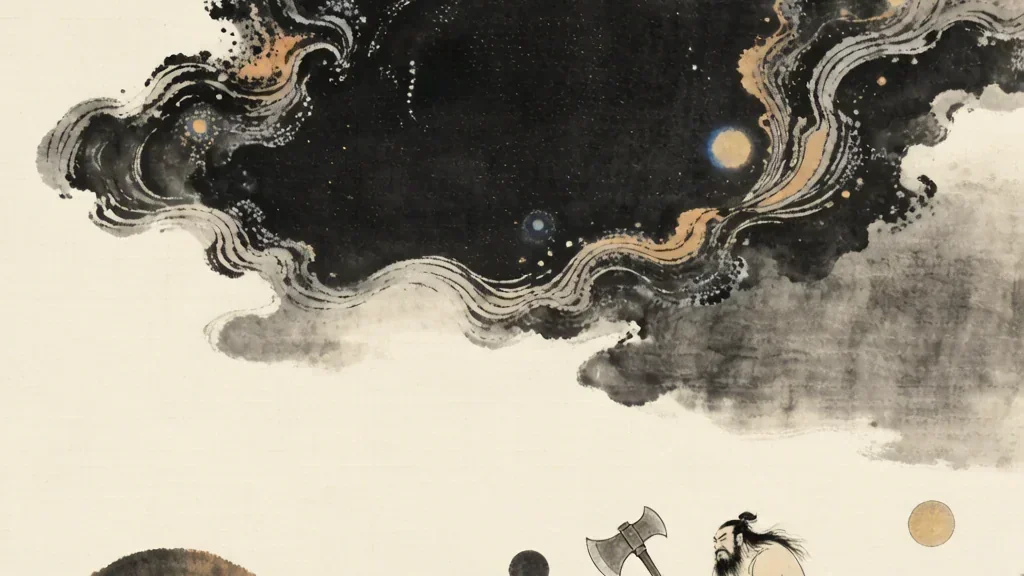
Before there was light, before there was earth, before there was even the concept of "before" — there was only one thing. The Chinese called it the cosmic egg, a vast, dark sphere of chaos that contained everything that would ever exist. Inside this egg, sleeping for eighteen thousand years, was a being named Pangu. His story is the foundational myth of Chinese cosmology, the answer to the most basic question any civilization must ask: how did the world begin?
The tale of Pangu (盘古) is not as ancient as one might expect for a creation myth. It first appeared in written form during the Three Kingdoms period (220–280 CE), recorded by the scholar Xu Zheng in the "Sanwu Liji." Yet the story carries the weight of something far older, drawing from oral traditions that had circulated among the southern peoples of China for countless generations. In time, Pangu would become the central figure in how the Chinese understood the origin of all things.
The Egg of Chaos
In the beginning, the universe was not empty — it was a swirling, undifferentiated mass called Hundun, meaning "chaos" or "muddled confusion." This chaos was not evil or destructive; it was simply unformed, a cosmic batter waiting for a cook. Within this primordial soup, yin and yang — the two fundamental forces of Chinese philosophy — had not yet separated. Heavy and light, dark and light, male and female, all existed as one indistinguishable whole.
Inside this cosmic chaos, the egg formed. And inside the egg, Pangu grew. He slept for eighteen thousand years, gathering strength, becoming aware of himself, becoming ready. When he finally woke, he found himself trapped in darkness, surrounded by the sticky, formless substance of chaos. He could not stretch. He could not breathe freely. He could not see. The confinement was unbearable.
So Pangu did what any self-respecting giant would do. He grabbed his axe — a massive weapon that had formed alongside him from the substance of chaos itself — and he swung.
The Blow That Split the Universe
The crack of that first blow echoed through eternity. The egg shattered, and with it, the fundamental unity of chaos. The light, pure, ethereal elements drifted upward to become the heavens — Yang. The heavy, dense, murky elements sank downward to become the earth — Yin. For the first time, there was up and down, high and low, pure and impure. The universe as we know it had begun.
But Pangu's work was not finished. He knew, with the instinct of a creator, that if he stepped away, the heavens and the earth would simply collapse back into each other, returning to the chaos from which they had come. So he planted his feet firmly on the earth and pressed his hands against the sky, holding the two apart. Each day, the sky rose ten feet higher, the earth sank ten feet lower, and Pangu himself grew ten feet taller. For another eighteen thousand years, he stood there — a living pillar between heaven and earth, straining with every fiber of his being to keep them separate.
When the distance between sky and earth had grown to ninety thousand li (an ancient Chinese measurement roughly equivalent to half a kilometer), Pangu knew his task was complete. The heavens were firmly established. The earth was solid and stable. They would not collapse back into chaos. He could finally rest.
The Death That Gave Life
But Pangu's story does not end with his triumph. It ends with the most profound sacrifice in all of Chinese mythology. After thirty-six thousand years of labor — eighteen thousand in the egg and eighteen thousand holding up the sky — the great giant lay down to die. And in his death, he gave birth to the world as we know it.
As Pangu drew his final breath, his body began to transform. His left eye became the sun, blazing across the sky to light the day. His right eye became the moon, glowing softly to guide the night. The blood that flowed from his veins became the rivers and oceans, the great Yangtze and Yellow, the Pacific and the seas. His breath became the wind and the clouds, carrying rain across the land. His voice, in its final roar, became the thunder that announces the storms.
His flesh and muscles became the soil that would grow crops and sustain life. His bones and teeth became the minerals and precious stones hidden in the earth — the jade, the gold, the iron. His hair and beard became the stars that dot the night sky, scattered like seeds across the dark. The fleas and lice on his body, stirred by the wind of his dying breath, were transformed into the ancestors of humanity, scattered across the new world to multiply and flourish. Even his sweat did not go to waste — it became the dew and rain that nourish the earth each morning.
The First Sacrifice
What makes Pangu's story so powerful is not the spectacle of his feats, but the meaning behind them. In Chinese cosmology, Pangu represents the idea that creation itself requires sacrifice. The world was not spoken into existence by a distant god; it was born from the body of a being who gave everything he was so that others might live. This theme — that life comes from death, that the beautiful emerges from the painful — runs deep through Chinese culture and philosophy.
Pangu also embodies the concept of yin and yang, the dual forces that govern all existence. He was born from their union in the egg, and his act of creation was, at its heart, the act of separating them. Heaven (yang) and earth (yin) were his legacy, and every Chinese philosophical tradition, from Daoism to Confucianism, would build upon this fundamental duality.
In later centuries, Daoist philosophers would expand upon Pangu's story, describing how after his death his spirit became the Three Pure Ones — the highest deities of the Daoist pantheon. His body, having become the world, was honored in temples across China. Even today, in the mountainous regions of southern China, there are shrines dedicated to Pangu, where the faithful come to honor the giant whose sacrifice made their world possible.
A Myth for All Time
The story of Pangu may not be as widely known outside China as the creation myths of other cultures, but within Chinese civilization, it holds a place of honor. It is taught to children in schools, depicted in art and opera, and invoked in poetry and literature. It is, in many ways, the story that explains why the Chinese see themselves as part of the natural world rather than separate from it — because the world itself was made from the body of a living being, and they are the descendants of his very essence.
In an age when we understand the universe through the lens of the Big Bang and cosmic inflation, there is something deeply moving about the image of a lone giant, standing in the darkness, holding up the sky so that life might flourish. Pangu's story reminds us that creation is not a single event but an ongoing process — that the world we inhabit was built through struggle and sacrifice, and that it continues to be sustained by forces far greater than ourselves.
And so, the next time you look up at the sun or the moon, the next time you feel the wind on your face or see the stars scattered across the night sky, remember Pangu. Remember the giant who woke in darkness, swung his axe, held up the heavens, and gave his body so that we might have a world to call home. His story is, in the end, the story of us all.
Pangu and the Measure of the World
The tale gives a striking number for the finished universe: when Pangu finished holding up the sky, the distance between heaven and earth had grown to ninety thousand li, an ancient unit of length roughly equal to a third of a mile. The figure is not meant as a surveyor's measurement but as a way to express a distance beyond ordinary grasp. It also explains why the sky feels so far and the earth so vast. By attaching a number to the impossible, the myth invites listeners to imagine the scale of creation in human terms. The li unit itself, used for roads and rivers across China, here becomes the yardstick of cosmic architecture, linking the familiar landscape of the empire to the body of the first giant.
Pangu and the Gift of Time
After his death, Pangu's eyes became the sun and the moon, and his breath became wind and clouds. This detail does more than populate the sky; it gives humanity a way to measure time. The sun marks the day, the moon the month, and their movements the seasons that guide farming and festival. In this sense Pangu's sacrifice is the origin not only of the world's matter but of its rhythm. The giant who held apart heaven and earth now keeps time for the descendants born from his body. The myth thus answers two questions at once: where the world came from, and why days and years move as they do. His dying gift is a clock made of light, still running above every living thing.
Pangu in Poetry and Painting
Chinese artists have returned to Pangu for centuries as a subject of awe. Temple murals show a hairy, wild giant wrapped in mist, sometimes raising an axe or chisel toward a splitting shell. Folk woodblock prints capture the instant of separation, with his arms spread between a dark earth and a bright sky. Poets, too, have invoked him as the first laborer, the one who made room for everything that followed. In the modern period his name appears on companies, hotels, and a theme-park ride, each borrowing the aura of a beginning. Whether rendered in ink on silk or in cartoon form for children, the image of Pangu straining to hold up the heavens remains a favorite way to picture effort, sacrifice, and the sheer strangeness of existence itself.
❓ Frequently Asked Questions
📝 Chinese Vocabulary
盘古 — : The primordial giant who created the world by separating heaven and earth; the central figure of China's creation myth.
开天 — : "To open heaven" — refers to Pangu's act of splitting the cosmos; part of the idiom 盘古开天 (Pángǔ kāi tiān).
宇宙 — : "Universe" or "cosmos"; originally meant "space (yǔ) and time (zhòu)," reflecting the Chinese understanding of reality.
混沌 — : The primordial chaos before creation; the formless state from which the world emerged.
斧 — : Axe, the weapon Pangu forms from chaos and swings to crack open the cosmic egg.
黎民 — : The common people, in myth born from the parasites on Pangu's body after his death.
开辟 — : To open up or create the world, a term for Pangu's founding act.
神灵 — : Deity or divine spirit, as in the lore that Pangu's spirit became the highest Daoist gods.
🎉 Fun Facts
- Pangu's myth was first recorded in writing during the 3rd century CE, but scholars believe it originated among the non-Han peoples of southern China, possibly the Miao or Yao ethnic groups.
- The phrase "since Pangu created heaven and earth" (盘古开天辟地以来) is a common Chinese expression meaning "since the beginning of time."
- Unlike many creation myths where humans are made from clay or dust, the original Pangu myth suggests humans emerged from the parasites on his body — a humbling origin story indeed!
- Mount Pangu, located in Guangdong province, is named after the creator giant and is a popular pilgrimage site during the Pangu Cultural Festival.
- Daoist lore says that after Pangu died, his spirit became the Three Pure Ones, the highest deities of the Daoist pantheon.
- The tale appears in school textbooks as the standard Chinese answer to how the world began, much like creation stories elsewhere.
☯️ Discover Your Five Elements
Pangu separated yin and yang — the foundation of all Chinese cosmology. Explore how the Five Elements (Wood, Fire, Earth, Metal, Water) shape your personality and destiny.
Check Your Five Elements →