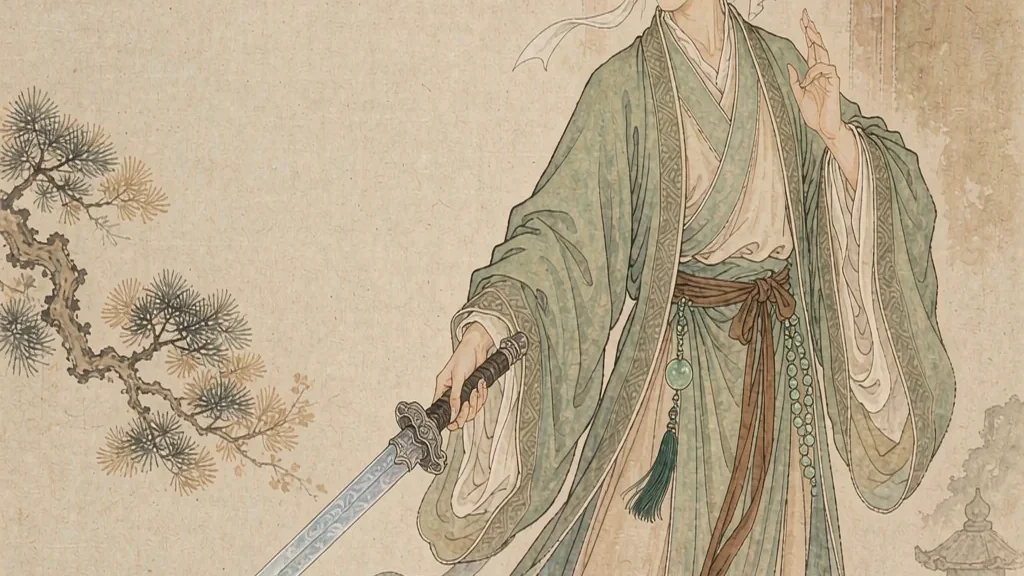
The Shaolin sword, or jian, is the straight double-edged blade most associated in the popular imagination with the scholar-warrior of China. Within the Shaolin martial tradition of Mount Song, the jian is treasured not for brute cutting but for its elegance, its reliance on sensitivity, and its demand for a calm, centered mind. Often called the "gentleman of weapons," the sword trains the practitioner in fluidity, precise footwork, and the quiet control that lies at the heart of Chan Buddhist martial practice. This article surveys the sword's place at Shaolin, its construction, its core methods, and its enduring cultural meaning.
Place of the Sword in Shaolin Arts
Among Shaolin weapons the sword holds a special, almost poetic status. Where the staff and spear project force outward, the jian invites inward refinement, rewarding those who can move without tension.
The monastery preserved sword sets alongside its staff, spear, and broadsword routines, treating the blade as a complement to empty-hand boxing rather than a separate discipline. Monks and later lay disciples practiced it for both protection and cultivation.
In Chinese culture the jian was carried by scholars and immortals alike, so training with it at Shaolin connected the rough physical art to a broader literati ideal of refinement.
Construction of the Shaolin Jian
A traditional jian is a double-edged straight blade, typically of folded or pattern-welded steel, with a central ridge that gives it both strength and flexibility. The blade tapers to a sharp point suited to thrusting.
The hilt carries a guard, a grip wound with cord, and a pommel that balances the weapon; the whole is often paired with a scabbard of wood or lacquered leather. Balance, not length, is the key to a good sword.
Practice swords for students are usually blunt and lighter, allowing safe repetition of forms before any edged blade is used.
Basic Sword Grips and Posture
The sword is held with the "sword finger" of the free hand extended, a gesture that both aids balance and traditionally directed the flow of energy. The grip shifts between a full hold and a sliding hold as techniques change.
Stance work emphasizes upright, mobile postures drawn from Shaolin empty-hand boxing, so the legs can drive the cuts and the body can turn to add power. A sunk, stable stance keeps the blade under control.
The eyes follow the blade, and the breath stays even, so that the sword seems to move of its own accord rather than through muscular strain.
Core Cutting and Thrusting Methods
The jian's main actions are the cut, the thrust, the point, and the circular parry. Cuts fall as diagonal, horizontal, or vertical arcs; the thrust drives the point straight; the point taps with the tip; parries use the blade's flat or edge to deflect.
Because the jian has two edges, the same motion can cut on the return as well as the forward swing, a feature that gives Shaolin sword forms their rippling, continuous look.
Skilled practitioners blend these actions so that defense and attack are one movement, reflecting the Shaolin principle that the best block is already a counter.
Signature Shaolin Sword Forms
Solo forms preserve the sword's techniques in set sequences. One common Shaolin set links stepping, turning, and a series of cuts and thrusts into a pattern meant to be performed with grace and snap.
Longer routines may include leaps and low sweeps, showing the sword's range, while shorter "foundation" sets drill the essentials so the student builds correct habit before adding flourish.
Forms are taught slowly for structure, then with speed and "spirit," the lively expression that judges and teachers look for in a finished performance.
The Sword and the Broadsword
Students often compare the jian with the dao, the single-edged broadsword. The dao is associated with power and chopping, while the jian is linked to precision and thrusting, earning it the "gentleman" label.
Shaolin trains both, and many practitioners learn the dao first because its weight builds strength, before moving to the lighter, trickier jian. The two weapons teach complementary lessons.
In demonstration, the jian reads as flowing and airy, whereas the dao appears forceful and grounded — a useful contrast for understanding Shaolin's range.
Sword Training and Conditioning
Daily practice begins with basic cuts repeated until the wrist is relaxed yet firm, for a tense wrist makes the blade wobble and wastes power. Smooth circles are drilled against the air and then against a partner's wooden sword.
Footwork drills borrow from Shaolin boxing: advancing, retreating, and turning steps that keep the body behind the blade. Conditioning the legs supports the many low and turning postures.
As with other Shaolin weapons, breath and intention are trained together, so the sword becomes an extension of awareness rather than a separate object.
Sword in Wushu and Modern Performance
In contemporary wushu the jian is a standard event, judged on technique, balance, and the liveliness of the performance. Competitive routines are dynamic, with jumps and spins added for spectacle.
Shaolin performers around the world include sword sets in their shows, using the blade's elegance to balance the harder, more percussive staff and fist demonstrations.
While sport has stylized the art, traditional teachers remind students that every flourish should still carry the logic of a real encounter.
Cultural Meaning of the Jian
The jian appears in legend as the weapon of immortals and virtuous heroes, symbolizing clarity, justice, and self-mastery. To wield it well was to display character as much as skill.
In poetry and painting the sword often stands for the free spirit that can act decisively yet remains unhurried, a value close to the Chan outlook cultivated at Shaolin.
Today many learners approach the Shaolin sword as a moving form of mindfulness, a way to train focus and calm through a beautiful, exacting discipline.
Getting Started with the Shaolin Sword
A beginner should obtain a light, blunt practice jian and train in a safe space, starting with posture and the sword-finger hand before attempting cuts. Correct structure prevents injury and builds good habits.
Guidance from a qualified teacher helps correct the subtle wrist and footwork errors that video alone cannot reveal. Regular, patient repetition matters more than early speed.
Over time the student discovers the sword's central lesson: that true control comes not from force but from relaxation, attention, and the steady mind.
❓ Frequently Asked Questions
What is the Shaolin sword?
It is the jian, a straight double-edged blade trained in the Shaolin tradition for precision, fluidity, and mental calm.
How is the jian different from the broadsword?
The jian is double-edged and thrust-oriented, while the dao is single-edged and built for chopping power.
Why is the free hand shaped as a sword finger?
The extended finger aids balance and, in traditional theory, directs the practitioner's focus and energy.
Is the sword hard to learn?
It demands a relaxed wrist and good footwork, so it can be trickier than heavier weapons, but patient basics make it accessible.
Do Shaolin monks still practice the sword?
Yes, sword sets remain part of Shaolin training and are also performed by demonstrators and wushu athletes worldwide.
What does the sword symbolize in Chinese culture?
It stands for clarity, justice, and self-mastery, often carried by immortals and noble heroes in legend.