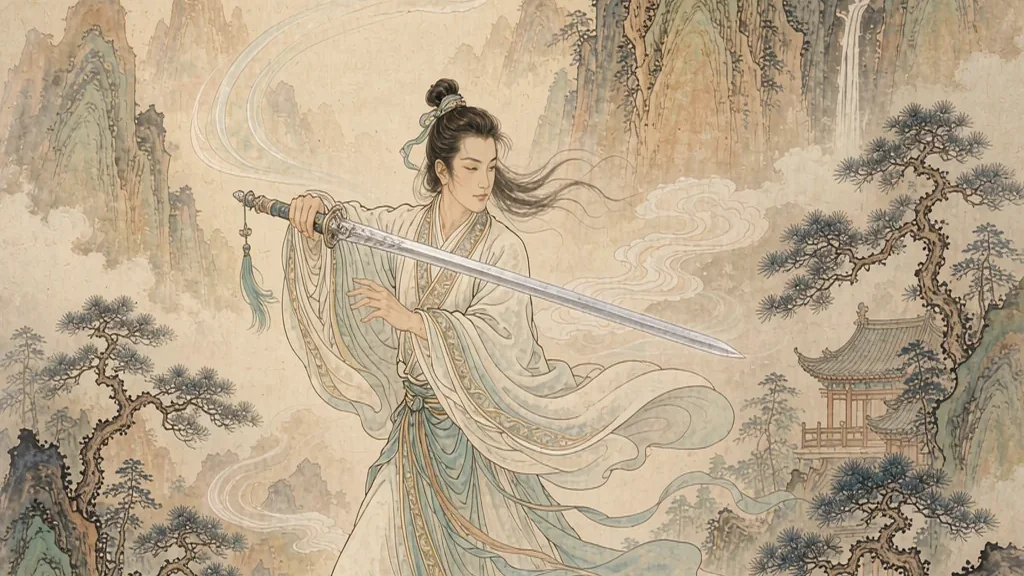
The Wudang sword (武当剑, Wǔdāng jiàn) is the internal sword art of the Wudang school of Chinese martial arts, a tradition rooted in the Daoist temples of the Wudang Mountains in Hubei province. Unlike sword systems built on strength and speed, Wudang sword is practiced as a form of internal cultivation: the straight double-edged blade is moved by relaxation, breath, and intent rather than by muscular force. To watch a skilled practitioner is to see something closer to a slow dance than to combat, yet the art carries a complete and sophisticated martial logic. For centuries it has been prized as both a method of self-defense and a path of Daoist self-cultivation.
Wudang: The Archetypal Internal School
The Wudang school (武当派, Wǔdāng pài) is regarded as the archetypal internal, or neijia (内家, nèi jiā), school of Chinese martial arts, and it is traditionally contrasted with the external, or waijia (外家, wài jiā), tradition associated with the Shaolin temple. Where external arts emphasize muscular power, conditioned striking, and vigorous technique, internal arts cultivate whole-body coordination, relaxed structure, and the circulation of internal energy, or qi. This internal-external distinction was formalized in writing in the seventeenth century by the scholar Huang Zongxi, who traced the internal arts back to the Daoist figure Zhang Sanfeng.
The Wudang Mountains themselves are among the great sacred sites of Chinese Daoism, a landscape of monasteries and peaks that has drawn hermits and pilgrims for more than a thousand years. It is within this Daoist environment that the Wudang martial arts, including the sword, took shape as a synthesis of meditation, breath practice, and combat. The result is an art in which the boundary between spiritual exercise and martial technique is deliberately soft.
What Makes the Sword "Internal"
To call Wudang sword "internal" is to say that its power originates in the body's center rather than in the arm or hand. Practitioners are taught to issue force from the dan tian, the energetic center below the navel, letting it travel through a relaxed and aligned frame into the wrist and finally to the tip of the blade. The Daoist phrase 以意导剑 (yǐ yì dǎo jiàn), "intent guides the blade," captures the ideal: the mind leads, the body follows, and the sword becomes an extension of attention rather than a tool swung by effort.
Because the body stays relaxed, the sword can change direction instantly and appear almost weightless. This is the quality the tradition calls 轻灵 (qīng líng), lightness and agility. A Wudang swordsman is not trying to overpower an opponent's weapon but to remain sensitive and responsive to it, feeling pressure, reading intent, and redirecting energy before it can consolidate into a committed attack.
Lightness, Circles, and Yielding
Wudang sword technique is built on circular, spiraling motion. Rather than meeting a straight thrust with a straight block, the practitioner circles the blade to deflect and absorb, turning the opponent's force aside and using its own momentum against it. Footwork is evasive and rounded, keeping the body off the line of attack while the sword draws continuous arcs in the air. The overall impression is one of flowing continuity, with no abrupt stops between techniques.
Underlying this movement is the Daoist principle of 以柔克刚 (yǐ róu kè gāng), "overcoming hardness with softness." The sword does not try to crush strength; it yields to it and then returns when the strength has spent itself. This is the same logic found throughout Daoist thought, where water is held up as the model because, though soft, it wears away stone. In Wudang sword the blade behaves like water, never resisting directly and always finding the opening.
Strike After the Opponent Moves
A signature idea of Wudang sword is 后发先至 (hòu fā xiān zhì): to strike after the opponent has moved, yet arrive before they do. This is not passivity but precise timing. By waiting for the opponent to commit, the swordsman gathers complete information about the attack and responds along its weakest line, so that a later initiation still lands first. It is the martial expression of wu wei, action that follows the situation rather than forcing it.
In practice this means the Wudang swordsman often appears to give ground, circling and evading until the moment is right. The famous legend of the art's origin tells of Zhang Sanfeng watching a snake evade a crane's beak: the snake never met the strike head-on but flowed around it, and when the crane overreached, the snake struck. Whether or not the story is historical, it describes the art's core habit of mind, patience, sensitivity, and a counterstrike that arrives in the gap the opponent creates.
The Taiji Sword Connection
Wudang sword shares deep roots with Taiji sword (太极剑, Tàijí jiàn), the sword form of Taijiquan. The slow, continuous Taiji sword sequence translates the principles of taiji, relaxation, circularity, and softness overcoming hardness, directly into blade work, and many of its postures echo the Wudang internal method. Taiji sword is today among the most widely practiced sword forms in the world, taught alongside taiji routines in parks and schools across China and abroad.
Historically the Wudang Mountains are regarded as a source of the Taiji tradition, and the Wudang sword curriculum is often taught together with taiji, baguazhang, and xingyiquan as parts of one internal system. The sword thus sits inside a larger family of practices that all train the same qualities: a calm center, a responsive body, and movement guided by intention rather than by tension.
The Jian, the Gentleman of Weapons
The blade at the heart of the art is the jian (剑), the straight, double-edged Chinese sword. It is distinct from the dao (刀), the single-edged saber favored by many external styles; the jian's two cutting edges and slender profile make it a weapon of precision and finesse rather than of crude chopping. In Chinese martial culture the jian has long been called the "gentleman of weapons," associated with scholars, poets, and immortals rather than with brute soldiers.
This genteel reputation fits the Wudang approach. The jian is light, elegant, and demanding to wield well, rewarding refinement over force. A Wudang swordsman treats the weapon as an instrument of the whole person, an object through which composure, timing, and intent are expressed. The sword is thus as much a cultural symbol as a fighting tool, and its practice carries the flavor of scholarship and Daoist refinement.
A Legendary Founder: Zhang Sanfeng
The Wudang martial arts, including the sword, are traditionally attributed to Zhang Sanfeng (张三丰, Zhāng Sānfēng), a Daoist figure said to have lived in the Yuan or early Ming period. Historical details about him are scarce and contested, and he is best understood as a legendary rather than a firmly documented founder. What is clear is his enduring role as the symbolic source of the Wudang internal arts and as a bridge between Daoist spirituality and martial practice.
Legends surround Zhang Sanfeng with the familiar materials of Chinese folklore: miraculous longevity, hermitage on the Wudang peaks, and the insight that gave rise to internal boxing and sword. In Wudang teaching his story is less a biography than a parable about where the art comes from, not from drilling the body into a weapon, but from cultivating a still mind that can move without striving. The legend is part of what gives the sword its contemplative character.
Li Jinglin and the Modern Revival
In the early twentieth century the Wudang sword reached a wider public through the Republican-era general Li Jinglin (李景林, Lǐ Jǐnglín), one of the most famous Wudang sword masters of the modern age. A senior military figure with a deep personal commitment to the art, Li helped organize its teaching and promoted it beyond the closed circle of the Wudang monasteries, at a time when Chinese martial arts were being systematized and presented as a source of national vitality.
Li's efforts belong to a broader movement in which internal arts such as taiji, bagua, and Wudang sword moved from temple and clan into public instruction. That transition carried costs as well as gains, for forms were standardized and some combat depth was lost to performance, but it also ensured the survival and spread of the art. Today Li Jinglin is remembered as a key figure who carried Wudang sword out of the mountains and into the modern world.
Wudang Sword Today
Today Wudang sword is practiced around the world, taught both in dedicated internal-arts schools and as part of the broad taiji and qigong movement. On the Wudang Mountains themselves, the sword remains woven into Daoist temple life, with forms performed at dawn as a kind of moving meditation. For most students the value of the art lies in health, balance, focus, and a living connection to Daoist culture rather than in fighting.
Dedicated lineages still preserve the combat logic of the sword, and serious practitioners study its applications against staff and empty-hand partners. Yet even as a health and performance art, Wudang sword keeps its distinctive identity: relaxed, circular, and internal, an art in which the blade is guided less by the arm than by the whole person. It remains one of the clearest expressions of the Daoist idea that the soft and responsive can master the hard and aggressive.
❓ Frequently Asked Questions
At Wudang the sword is carried as an extension of internal practice. Light, agile, and circular, its play blends the softness of taiji with the alertness of Daoist meditation, so that each parry also settles the mind. The result feels less like combat than like a slow dance with emptiness, where victory comes from not resisting the opponent's strength. In this way the sword shapes character long before it shapes a fighter.
📝 Chinese Vocabulary
武当剑 — : Wudang sword, the internal sword art of the Wudang school.
武当派 — : the Wudang school or sect, associated with the Wudang Mountains.
内家 — : "internal family," the internal-school category of Chinese martial arts.
外家 — : "external family," the external-school category, associated with Shaolin.
张三丰 — : Zhang Sanfeng, the legendary Daoist founder of Wudang arts.
太极剑 — : Taiji sword, the sword form of Taijiquan.
轻灵 — : lightness and agility, a core quality of Wudang movement.
以意导剑 — : "intent guides the blade."
后发先至 — : strike after the opponent moves, yet arrive first.
以柔克刚 — : overcome hardness with softness.
剑心 — : the "sword heart," the calm and focused mind behind the blade.
内丹 — : internal alchemy, the Daoist practice of refining qi within the body.
🎉 Fun Facts
- The Wudang Mountains were inscribed as a UNESCO World Heritage Site in 1994 for their Daoist architecture and cultural landscape.
- The jian is often called the "gentleman of weapons" in Chinese martial culture, linking it with scholars and immortals rather than soldiers.
- The internal-external (neijia-waijia) distinction was set down in writing in the 17th century by the scholar Huang Zongxi, who traced internal arts to Zhang Sanfeng.
- Taiji sword is among the most widely practiced sword forms in the world, taught alongside taiji in parks and schools far beyond China.
- The jian is a straight, double-edged sword, distinct from the single-edged dao saber favored by many external styles.
- Wudang sword is usually taught as part of a broader internal curriculum that also includes taiji and baguazhang.
- On the Wudang Mountains the sword is still practiced at dawn as a form of moving meditation within Daoist temple life.