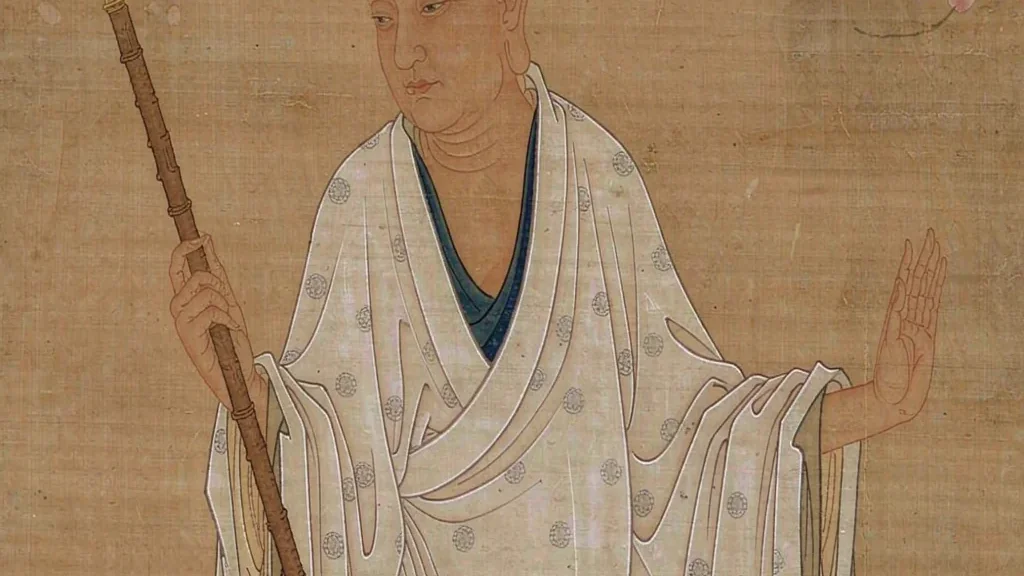
The Shaolin staff (少林棍, Shào lín gùn) is one of the most celebrated weapons in Chinese martial arts and the signature art of the Shaolin Monastery in Henan province. For centuries the monks of Shaolin trained with the staff not as a sport but as a practical means of self-defense, and the long wooden pole became so respected that it is called 百兵之长 — "the chief of all weapons." Unlike a sword or spear, a staff needs no forge and no metal; it can be cut from any sturdy branch, which made it the constant companion of traveling monks and the first weapon a student learns.
The Staff as the "Chief of All Weapons"
In Chinese martial culture the staff (棍, gùn) carries the title 百兵之长, often translated as "the elder" or "the chief of all weapons." The saying reflects both seniority and usefulness: the staff is usually the first long weapon a student meets, and its length, reach, and simplicity make it the foundation from which spears, halberds, and other pole arms are understood. Because it is cheap, legal to carry, and safe to practice, it has remained the entry point of weapons training across many southern and northern styles.
This seniority is also practical. A beginner can learn whole-body mechanics with a stick before handling anything that cuts, and the same footwork, timing, and hip rotation carry over directly to the blade. Masters often say that whoever truly understands the staff understands the principles behind every other weapon, which is why the art is honored rather than dismissed as primitive.
Why a Monastery Chose the Staff
The staff suited Shaolin for reasons that were as moral as they were practical. As Buddhists bound by a vow of non-harm, the monks preferred a blunt weapon that could disable or control an attacker without necessarily taking a life. A staff could break a charge, strike a limb, or simply keep distance — enough to defend the monastery or a traveling brother without the finality of a blade.
It also doubled as an everyday tool. The same pole served as a walking stick on long journeys, a support when resting, and a means to carry loads. Because a monk always had a staff at hand, there was no need to conceal a weapon, and in times of banditry or unrest the staff was ready the moment it was needed. This blend of usefulness and restraint is a large part of why the weapon became synonymous with the monastery.
The Shaolin Staff in History
Shaolin's reputation with the staff is old and well documented. The monastery, founded in the early centuries of the Common Era at the foot of Mount Song in Henan, became a center of Chan (Zen) Buddhism, and martial training grew alongside monastic life. The most famous early episode is the Tang-dynasty account in which thirteen Shaolin monks used their staffs to aid the future Emperor Li Shimin; the grateful emperor later granted the temple land and patronage, cementing the monks' martial fame.
By the Ming dynasty (1368–1644) the Shaolin staff was renowned enough that generals sought out the monks for instruction. Monks from the temple served as frontier and coastal militia, and staff methods were recorded in writing, marking the transition of the art from oral tradition to formal system. The staff had moved from a tool of necessity to a disciplined, teachable curriculum.
Yu Dayou and the Classic of the Staff
A key figure in that codification was the Ming general 俞大猷 (Yú Dà yóu), a distinguished naval commander and staff master who visited Shaolin and trained with its monks. Yu was convinced that staff technique had declined and set about systematizing it, and he wrote the 剑经 (Jiàn jīng), usually rendered as the "Classic of the Staff." Although the title speaks of the saber, the work is a treatise on staff combat built on clear principles of distance, timing, and body method.
The 剑经 is valued today less as a fighting manual than as evidence: it shows that by the sixteenth century the Shaolin staff was being analyzed as a coherent art rather than a collection of tricks. Together with the monks' own teaching lines, Yu's writing helped fix the staff's methods in a form that later generations could study and pass on.
Jinnaluo Wang: Patron of the Staff
Shaolin tradition surrounds the staff with a protective deity. 紧那罗王 (Jǐn nà luó wáng), a figure drawn from Buddhist guardian lore, is honored as the patron spirit of Shaolin staff fighting. Legend tells that a humble monk revealed himself as Jinnaluo Wang and drove off attackers with a staff to defend the monastery, after which the art was taught openly in his name.
Whether read as history or as legend, the story expresses something real about the art's self-image: the staff is not merely a weapon but a guarded inheritance, passed down under a patron's protection. Devotional images and shrine notices at the temple still link the staff to Jinnaluo Wang, keeping the martial and the religious strands of Shaolin together.
The Shaolin Staff Canon and Famous Forms
The staff repertoire at Shaolin is large and was recorded in dedicated manuals. The Ming text 少林棍法禅宗 (Shào lín gùn fǎ chán zōng), the "Shaolin Staff Methods of the Chan Lineage," laid out the monastery's staff system and became a reference point for later teachers. Within that system practitioners learn dozens of named forms, each a set sequence of strikes, sweeps, and footwork patterns meant to be drilled until the body remembers them.
Among the best-known forms are the "Staff of the Arhat" (罗汉棍, Luó hàn gùn) and the "Five Tigers Staff" (五虎棍, Wǔ hǔ gùn), names that signal the imagery and temperament of each routine. A single form may run through more than a hundred linked movements, so mastery is a matter of years, not weeks, and the forms serve both as conditioning and as a ledger of the tradition's techniques.
Core Techniques: Sweep, Chop, Thrust, Block
For all its forms, Shaolin staff work rests on a small set of fundamental actions. The four most often named are 扫 (sǎo, sweep), 劈 (pī, chop), 戳 (chuō, thrust), and 拦 (lán, block). A sweep whips the staff low to clear an opponent's legs or weapons; a chop drives it down with the weight of the body behind it; a thrust punches the tip forward to keep an enemy at a distance; a block turns the shaft to intercept and deflect a blow.
These actions are deliberately few because their power lies in combination. By changing the angle, speed, and rhythm, a practitioner spins the same four techniques into long flowing sequences where the staff seems never to stop moving. Advanced training adds spins, wraps, and strikes at both ends of the pole, so that the weapon becomes an extension of the arms rather than a separate object.
The Eight Methods and Whole-Body Power
Teachers often group staff actions under a list of "eight methods" (八法, bā fǎ), a mnemonic for the principal ways of using the pole — thrust, sweep, block, chop, lift, point, press, and circle, with local listings varying by lineage. What matters more than the exact count is the principle behind them: the staff is powered by the whole body, not the arms alone.
A properly delivered staff strike begins in the feet, rises through the legs, is amplified by a turn of the hips, channeled through the torso, and finally released through the hands. The long lever of the pole magnifies even a small rotation of the waist, which is why staff drill is also whole-body conditioning. The same mechanic drives unarmed strikes, so training the staff builds the coordination used in every other part of the art.
Staff Against Other Weapons
The staff's great advantage is reach. A pole taller than the user's own height keeps an opponent's shorter weapon at a distance, letting the staff fighter strike first and control the gap. Against a sword, a skilled user beats the blade aside with the shaft and steps inside the sword's effective range, or simply keeps the tip in the attacker's face and never lets the blade arrive.
For this reason the staff is treated as the foundation of weapons study. Students are expected to internalize its timing and distancing before moving on to the spear, saber, or sword, on the logic that a shorter or sharper weapon only compounds habits already learned with the pole. The staff is thus both the simplest weapon and, in a sense, the most complete teacher.
The Staff Today
Today the Shaolin staff is known worldwide through the demonstrations of traveling monk troupes, who spin and whirl the pole into a blurred shield around the body. Those performances are spectacular, but behind them lies a living training tradition still taught at the monastery and in schools that trace their lineage to it. Competitions and modern wushu have also standardized staff routines, carrying the old methods onto the stadium floor.
What has not changed is the staff's role as the first and humblest teacher of martial principles. Without a blade to hide behind, it demands timing, footwork, and steady nerve, and it rewards patience above strength. That is why, after more than a thousand years, the wooden pole remains the emblem of Shaolin and the "chief of all weapons."
❓ Frequently Asked Questions
The staff is the humblest and most honest of weapons. With no blade to hide behind, it asks for timing, footwork, and steady nerve rather than raw strength, which is exactly why it anchors the first years of Shaolin training. To learn the staff is to learn patience made visible, and to see why the monastery has prized it for more than a thousand years.
📝 Chinese Vocabulary
棍 — : staff; the long wooden pole weapon.
少林 — : Shaolin, the monastery in Henan province.
百兵之长 — : "the chief of all weapons," the traditional title of the staff.
俞大猷 — : Ming dynasty general and staff master who wrote the Classic of the Staff.
剑经 — : "Classic of the Staff," Yu Dayou's staff treatise.
紧那罗王 — : Jinnaluo Wang, patron deity of Shaolin staff fighting.
少林棍法禅宗 — : "Shaolin Staff Methods of the Chan Lineage," a Ming staff manual.
扫 — : to sweep, a low spinning staff action.
劈 — : to chop, a downward staff strike.
戳 — : to thrust, a stabbing staff strike.
拦 — : to block or bar, a defensive staff action.
🎉 Fun Facts
- The staff is called 百兵之长, "the chief of all weapons," in Chinese martial arts.
- The Ming general Yu Dayou trained with Shaolin monks and wrote the 剑经 (Classic of the Staff).
- The deity Jinnaluo Wang is honored as the patron spirit of Shaolin staff fighting.
- A traditional staff is measured to the user's eyebrows, the 齐眉棍 or "eyebrow-level staff."
- Shaolin staff methods were recorded in the Ming manual 少林棍法禅宗 (Shaolin Staff Methods of the Chan Lineage).
- Monks favored the staff because, as a blunt weapon, it could disable without killing — fitting a vow of non-harm.
- Shaolin staff forms emphasize four core actions: sweep, chop, thrust, and block.
- The staff's long lever amplifies hip and shoulder rotation, building whole-body power.