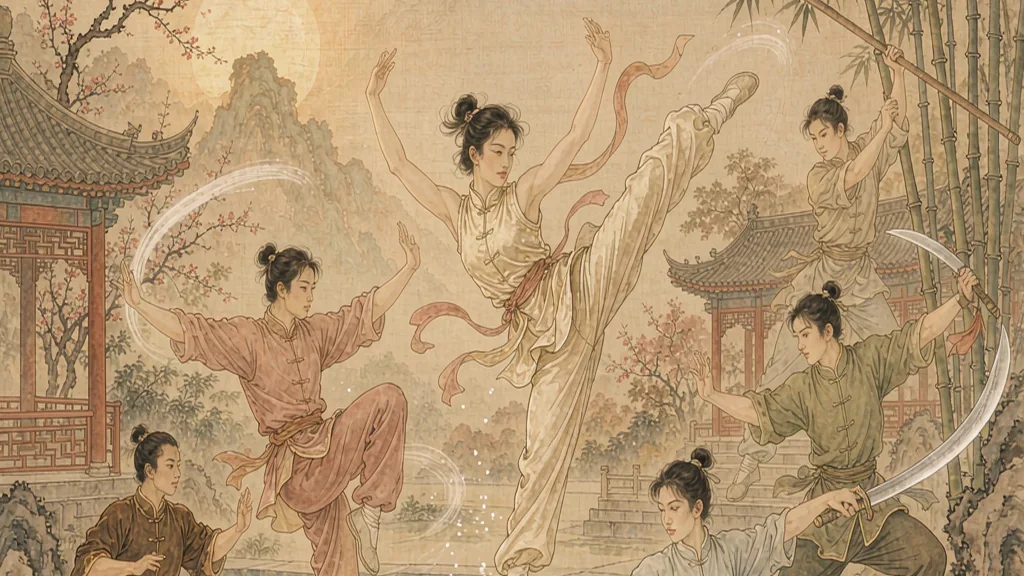
Wushu, in its modern sporting sense, refers to the standardized, athletic form of Chinese martial arts developed from the 1950s onward and governed today by bodies such as the International Wushu Federation. Distinct from traditional combat-oriented kung fu, modern wushu is a performance and competition sport emphasizing spectacular forms (taolu), dynamic kicking, and acrobatic expression, alongside the full-contact event of sanda. It preserves the vocabulary of Chinese martial heritage—stances, weapons, and animal styles—while reshaping it for judges and audiences. This article explains how modern wushu emerged, what its events involve, and how it relates to the traditional arts it grew from.
From Art to Sport
After the mid-twentieth century, Chinese authorities and martial communities sought to organize the country's many regional styles into a coherent, teachable system. Working groups drew techniques from northern and southern traditions to create standardized routines that could be judged uniformly, turning diverse local knowledge into a national sport.
The aim was partly practical—unifying instruction—and partly cultural, presenting Chinese martial arts as a source of national pride. The resulting "modern wushu" prioritized athletic display over battlefield application, a shift that some traditionalists critiqued but that also made the art accessible to millions.
Taolu: The Forms Event
The best-known wushu event is taolu, the performance of choreographed forms judged on difficulty, technique, and presentation. Athletes execute sequences of strikes, kicks, jumps, and weapon work with precise timing, and routines include mandatory "difficulty" movements such as aerial kicks and tornado throws scored separately for risk.
Taolu divides into barehand categories—changquan (long fist), nanquan (southern fist), taijiquan—and weapon categories such as dao (broadsword), jian (straight sword), gun (staff), and qiang (spear). Each has standardized requirements so competitors worldwide perform comparable material.
Sanda: The Combat Event
Balancing the performance side, sanda (also called sanshou) is the full-contact fighting component, combining punches, kicks, and wrestling-style takedowns under rules that prohibit certain strikes. It gives wushu a live-combat dimension and is closely related to the kickboxing and shuai jiao traditions of China.
Sanda athletes train sparring, conditioning, and technique suited to a ring with padded gloves, and competitions are judged on clean hits, knockdowns, and throws. It is the clearest link between modern sport wushu and the fighting roots of the older arts.
Standardization and Judgment
Modern wushu relies on detailed judging criteria: points for posture, power, and rhythm, deductions for errors, and bonus points for declared difficulty moves. This codification lets international events run fairly, but it also pushes athletes toward gymnastic-level flexibility and explosive athleticism.
Critics note that heavy standardization can flatten the character of individual traditional styles, while supporters argue it preserves core techniques and spreads them globally. The tension between uniformity and diversity remains central to wushu's identity.
Training Demands
Competitive wushu is physically intense. Athletes typically train daily from a young age, combining forms repetition, strength and flexibility work, acrobatics, and (for sanda) sparring. The injury risk from high-impact landings and over-flexibility is real, prompting modern programs to add sports-science support.
Because routines are short and explosive—often under two minutes—conditioning emphasizes power and anaerobic capacity more than endurance. Mental focus and performance composure under judges' eyes are also trained, blending sport psychology with traditional concentration methods.
Weapons and Heritage
Wushu keeps China's weapon heritage visible: the four major weapons (dao, jian, gun, qiang) are compulsory events, and broader exhibitions include softer or rarer arms. Performing them builds coordination and connects athletes to centuries of martial craft, even when the competitive context differs from old usage.
The aesthetic of weapon forms—swift, balanced, and rhythmic—carries the visual language of traditional kung fu to new audiences. For many spectators, a wushu sword or staff routine is their first encounter with Chinese martial culture.
Global Spread
Wushu is now practiced in many countries, with world championships and continental games, and it has pursued recognition in multi-sport events such as the Asian Games. Diaspora communities and film culture fueled early interest, while structured curricula let newcomers learn without a traditional master-disciple bond.
Its Olympic ambitions have shaped how routines are designed and judged, pushing clarity and spectacle. Whether or not it reaches the Olympic program, wushu's international federation has already made it a genuinely global sport.
Relation to Traditional Kung Fu
Modern wushu and traditional kung fu are often contrasted: the former sport and performance, the latter lineage, self-defense, and internal cultivation. Yet the boundary is porous—many traditional schools teach wushu forms, and wushu athletes study traditional basics. Each informs the other.
For learners, the choice is not either-or. Wushu offers fitness, discipline, and a spectacular entry point, while traditional training offers depth, philosophy, and fighting context. Together they keep Chinese martial arts alive in both gym and dojo.
Wushu in Schools and Youth Sport
In China and across overseas Chinese communities, wushu has become a regular part of physical education and after-school clubs, valued for building discipline, posture, and coordination in children from an early age. Many primary and middle schools run team training and local competitions, so youngsters meet the sport long before they ever watch it on television or at a major games.
Youth curricula usually emphasize fundamentals—basic stances, flexibility, and simple taolu—rather than the high-difficulty acrobatics of elite competition, which keeps early training safe and enjoyable. The structured grading of wushu also gives young learners clear, attainable milestones, much like the belt systems seen in other martial sports, helping them stay motivated.
Some programs deliberately link wushu to cultural education, teaching the meaning of forms, weapons, and their regional origins alongside the physical movement. This blend of fitness and heritage helps explain why the sport has retained broad popularity even as entertainment options multiply, and it gives children a bodily connection to a long tradition.
Spectacle, Stage, and Screen
Beyond the competitive floor, wushu thrives as performance: mass demonstrations, television galas, and theater pieces stage choreographed group forms that read almost like martial dance. The same athletic vocabulary—leaping entries, weapon spins, and unison timing—translates naturally from sport to spectacle, and large formations can be visually stunning.
Film and streaming media have long borrowed wushu's visual grammar, and many athletes move between competitive sport and stunt or action careers. This crossover spreads the art globally and inspires new students, even when screen choreography exaggerates what competition rules would actually allow in a judged routine.
Cultural showcases also use wushu to represent Chinese tradition abroad, so a single routine can function as sport, art, and informal diplomacy at once. That versatility—athletic, theatrical, and cultural—is something few other martial disciplines match, and it helps keep wushu visible well beyond the tournament hall.
❓ Frequently Asked Questions
What is modern wushu?
A standardized, athletic sport form of Chinese martial arts with judged forms (taolu) and full-contact fighting (sanda), developed from the mid-20th century.
How does it differ from kung fu?
Kung fu often means traditional, lineage-based fighting and cultivation; wushu is a performance sport with uniform rules and difficulty scoring.
What is sanda?
Sanda is wushu's full-contact event using punches, kicks, and takedowns under rules, linking the sport to China's combat traditions.
Is wushu in the Olympics?
It is established at the Asian Games and world level and has pursued Olympic recognition, shaping its rules toward clarity and spectacle.
Is it good exercise?
Yes; it builds flexibility, strength, coordination, and discipline, though the high-impact training requires attention to injury prevention.
Can wushu be used for self-defense?
Its techniques derive from fighting arts, but sport wushu emphasizes performance; practical defense needs additional live-training focus.