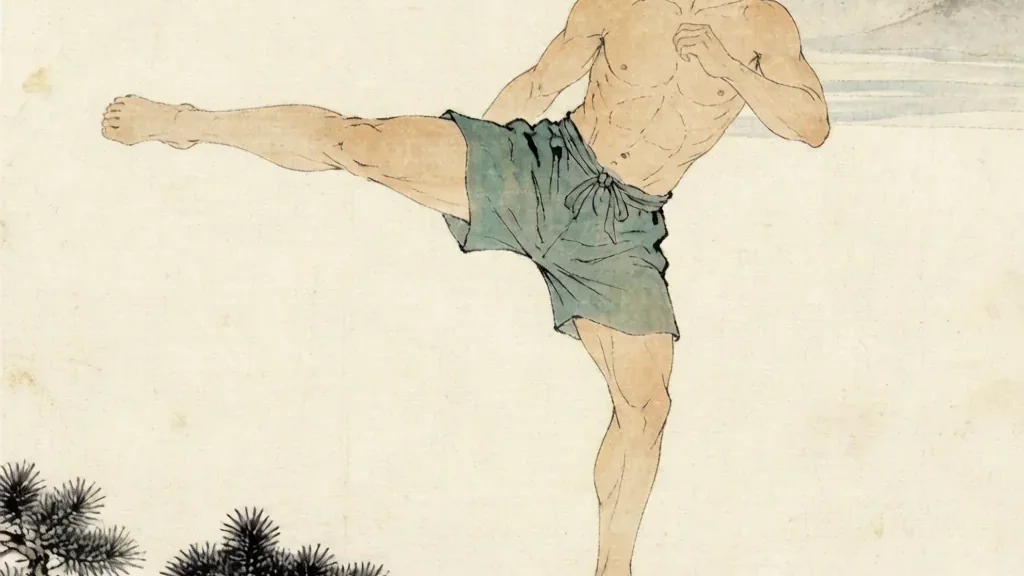
Not every Chinese martial art is ancient. Sanda (散打, ), literally "free fighting," is the modern Chinese answer to full-contact combat sport—a blend of traditional techniques and international kickboxing, wrestling, and boxing. Developed systematically from the late 1970s, it matters because it proves Chinese martial arts did not freeze in the Qing dynasty; they evolved into a rigorous, tested competitive system. For readers who want to know how kung fu performs under rules and referees, Sanda is the live laboratory where tradition meets the ring.
Birth of a Modern Sport
Sanda's origins lie in a deliberate state project. While "taolu" (forms) preserved the choreographed heritage, "sanda" was created as the full-contact counterpart, drawing on the kicking of northern styles, the boxing of southern styles, and the throws of Shuai Jiao (Chinese wrestling). The first national rules and tournaments appeared in the early 1980s.
The aim was pragmatic: produce a Chinese martial sport that could be safely competed and internationally recognized. Techniques were selected for effectiveness under controlled conditions, and dangerous targets (throat, groin, eyes) were banned. Sanda thus became a bridge between the traditional arsenal and the global combat-sports world, sharing the ring with Muay Thai, kickboxing, and MMA. Its rapid rise turned it into a fixture of Chinese university physical education and a source of national pride in international bouts.
Rules, Gear, and the Competition Ring
A Sanda match is fought in a raised platform called a leitai (擂台)—a modern echo of the historical raised fighting stage used for challenge matches in imperial times. Competitors wear protective gear: headguard, gloves, mouthguard, chest protector, and shin guards. Bouts run in rounds, typically two minutes each, and victory comes by points, knockout, or throw-out of the ring.
The rule set shapes the technique. Punching, kicking, and wrestling are all legal, but certain strikes are forbidden for safety. A kick to a downed opponent is not allowed, and clinch fighting is broken up to keep the action flowing. This balance keeps Sanda dynamic and spectator-friendly while still demanding real skill. The leitai's edge also rewards throws that push an opponent off the platform, adding a distinctively Chinese flavor absent from a standard boxing ring.
Techniques: Kick, Punch, Throw, and Knee
Sanda's striking is built on the Chinese kicking tradition—fast, varied low and middle kicks, including the signature whipping and side kicks—combined with boxing-style punches adapted for gloves. What sets it apart from pure kickboxing is the heavy use of wrestling: catches, sweeps, and hip throws that dump the opponent onto the mat or off the leitai. A skilled sanda fighter flows from a kick to a catch to a throw in one sequence.
Knees and elbow strikes are restricted or banned depending on the rule variant, keeping the sport distinct from Muay Thai. The result is a "kick-box-wrestle" hybrid that rewards all-round ability. Conditioning is intense: athletes train cardiovascular endurance, explosive power, and the reflexes to switch between striking and clinch work. Because nearly everything is tested against resisting opponents, Sanda has earned respect as one of the more honest modern martial arts.
Sanda Versus Traditional Wushu
A common question is how Sanda relates to the wushu forms people see in demonstrations. The two are siblings under the "wushu" umbrella but serve different purposes. Taolu (forms) preserve the aesthetic, cultural, and technical vocabulary of traditional styles; Sanda tests a subset of those techniques in live, full-pressure conditions. Many athletes train both, using forms to develop attributes and Sanda to develop fighting sense.
Critics once dismissed traditional kung fu as impractical; Sanda was part of the response, showing that Chinese methods could hold up under rules and against other systems. Yet purists note Sanda intentionally discards many traditional elements—weapon work, internal cultivation, the vast animal forms—in favor of what wins under the rules. The honest view is complementary: Sanda is the competitive engine, traditional wushu the cultural archive. Together they show a living art in two registers.
Training and the Athlete's Path
Modern Sanda training is scientific and demanding. A typical day mixes roadwork and interval conditioning, technical drilling of kicks and punches on pads, partner sparring with protective gear, and strength work. Athletes also study video, weight cut, and periodize their training around competitions. Sports medicine, nutrition, and recovery are now standard, reflecting Sanda's place in China's state sports system.
The pathway often begins in a wushu school or sports academy as a child, progresses through provincial and national junior competitions, and can lead to the national team and international titles. Universities with wushu programs also field Sanda teams, making the sport accessible to students. This structured pipeline is a world away from the old master-disciple model, yet it has produced generations of supremely conditioned fighters who carry Chinese martial sport onto the global stage.
Sanda on the Global Stage
Today Sanda is contested in world championships, at the World Combat Games, and in regular China-versus-the-world events that pit its athletes against Muay Thai, Kyokushin, and MMA representatives. These cross-style clashes are popular precisely because they answer the question "which art works?" with action rather than argument. Chinese athletes have compiled strong records, especially in the kicking-and-throwing dimensions where their tradition is deep.
For the cultural learner, Sanda is the face of contemporary Chinese martial arts—disciplined, athletic, and unafraid to adapt. It demonstrates that "kung fu" is not only a relic of temples and legends but a living practice shaped by coaches, scientists, and athletes. Whether one trains for competition or simply watches, Sanda offers the clearest window into how China kept its fighting heritage relevant in the modern world.
The Role Of The Leitai
Sanda is fought on a raised, padded platform called the leitai, a name inherited from traditional Chinese challenge matches where fighters met on a raised stage. In modern Sanda the platform edge becomes a tactical element: a strong push kick or throw that sends an opponent off the side can win the round outright, adding a spatial drama absent from boxed-in rings. The surface is padded for safety, and corners are cushioned so falls are less dangerous than the old stone stages. Rules keep fighters from being trampled by stopping action the moment someone goes off. This heritage link gives Sanda a recognizable Chinese identity even though its scoring and equipment are thoroughly modern. For spectators the leitai makes the contest visually clear: everything happens in one open space where pushing someone off is as decisive as knocking them down.
Striking Meets Wrestling
What sets Sanda apart from most striking sports is that wrestling is not an afterthought but a built-in equal partner to punching and kicking. A fighter who catches a roundhouse kick can convert it directly into a takedown, and the side thrust kick is used as much to unbalance and dump an opponent as to score points. This integration comes from combining Chinese kicking-boxing with Shuai Jiao style throwing, producing a hybrid that rewards athletes who are comfortable both standing and clinching. Training therefore splits time between pad work, sparring, and wrestling drills, and competitors must be conditioned for the unusual fatigue of mixing the two. The result is a sport where no single skill is enough: a pure striker can be thrown, and a pure wrestler can be kicked at range. That balance is Sanda's defining character.
❓ Frequently Asked Questions
📝 Chinese Vocabulary
散打 — : free fighting, the sport's name.
擂台 — : the raised fighting platform/ring.
武术 — : wushu, the umbrella term for Chinese martial arts.
套路 — : taolu, the forms/competition routines.
摔跤 — : Chinese wrestling, a Sanda throwing source.
侧踹 — : side thrust kick, a long pushing kick used to keep distance
摔法 — : throwing method, the wrestling side of Sanda
擂台 — : the raised platform or ring used for striking and throwing contests
🎉 Fun Facts
- The Sanda platform, the leitai, revives an ancient Chinese tradition of settling challenges by throwing opponents off a raised stage.
- Sanda deliberately fuses the kicks of northern styles, the punches of southern styles, and the throws of Chinese wrestling.
- China-versus-the-world Sanda events regularly pit its athletes against Muay Thai and kickboxing champions.
- Unlike many traditional styles, Sanda is a standard part of Chinese university physical education and the state sports system.
- Sanda's throwing rules let a fighter scoop a kick and slam the attacker down, a blend rarely seen in kickboxing.
- The sport grew out of efforts in the 20th century to make Chinese martial arts testable in competition.