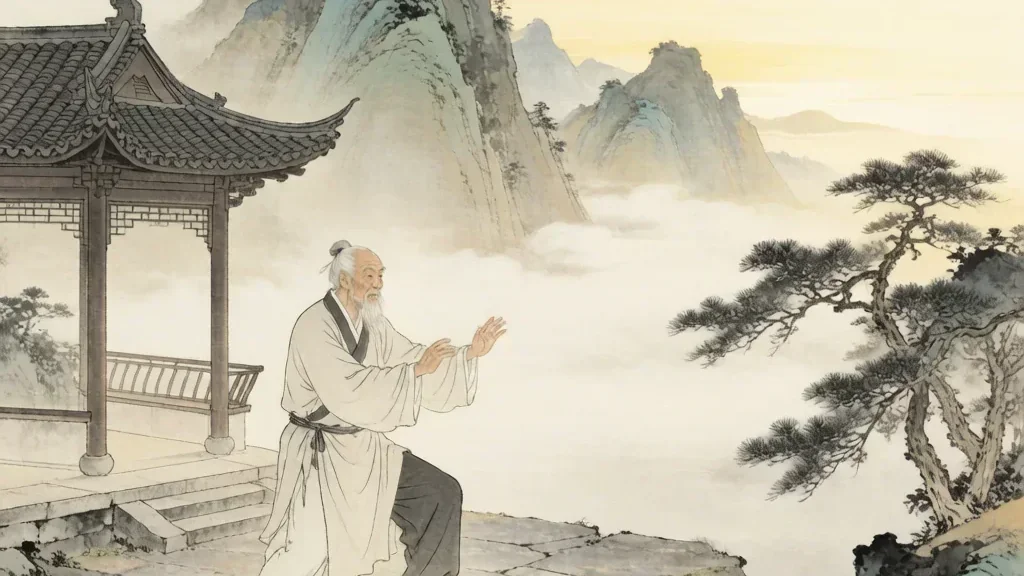
Walk through any park in China at dawn, and you will see them — groups of people moving through slow, graceful postures, arms tracing arcs through the morning air. To most observers, Tai Chi (Taijiquan, 太极拳) appears to be a gentle exercise for the elderly, a moving meditation for health and relaxation. But beneath the serene surface lies a sophisticated and devastating martial art, one that for centuries was a closely guarded fighting system taught only within family lineages. This is the Tai Chi that most people never see.
The Chen Village: Where Tai Chi Was Born
To understand Tai Chi's martial heart, you must travel to Chenjiagou (陈家沟, Chen Family Village) in Henan Province. Here, in the 17th century, a Ming Dynasty military officer named Chen Wangting (陈王廷) retired from service and devoted himself to synthesizing his battlefield experience with the internal cultivation methods of Taoist tradition. The result was Chen-style Tai Chi — the original, and most overtly martial, of all Tai Chi styles.
Chen Wangting was no park meditator. He was a warrior who had commanded troops and fought in life-or-death combat. His Tai Chi preserved the brutal pragmatism of the battlefield: explosive releases of power (fajin, 发劲), sudden changes of direction, stomping footwork, and techniques designed to disable an opponent instantly. The slow, flowing movements that characterize modern Tai Chi practice were originally training methods — a way to ingrain proper body mechanics before executing techniques at combat speed.
For generations, Chen-style Tai Chi was jealously guarded within the village. Outsiders were not permitted to learn the complete system, and the most advanced martial applications were taught only to direct descendants. It was not until the 19th century that Yang Luchan (杨露禅), an outsider who learned Chen-style Tai Chi through determined persistence, adapted the art into the softer Yang style that would eventually spread worldwide. But the martial essence lived on in Chenjiagou.
Push Hands: The Bridge to Combat
If the solo form is Tai Chi's textbook, push hands (tui shou, 推手) is its laboratory. Push hands is a two-person training exercise in which partners maintain light arm contact while attempting to uproot each other's balance. It looks deceptively simple — two people gently circling their arms, occasionally causing one to stumble backward. But within this exercise lies the entire martial strategy of Tai Chi.
Push hands teaches the practitioner to listen (ting, 听) — not with the ears, but with the entire body. Through sustained contact, a skilled Tai Chi player learns to sense an opponent's center of gravity, their tension patterns, and the direction of their intention. When an opponent commits to a push, the Tai Chi practitioner yields (hua, 化), neutralizes the force, and redirects it back to its source. The harder the opponent pushes, the harder they fall.
This principle — using four ounces to deflect a thousand pounds (四两拨千斤) — is not mystical. It is biomechanics. By maintaining a relaxed, rooted structure and moving from the center, a Tai Chi practitioner can redirect incoming force into the ground while simultaneously issuing their own force into the opponent. Advanced push hands training includes free-style sparring, in which practitioners attempt throws, joint locks, and strikes while maintaining the principles of yielding and redirection.
The Four Energies and Eight Methods
Tai Chi's martial vocabulary is organized around the concept of the "Eight Gates" (ba men, 八门), which correspond to eight types of energy (jin, 劲) and the eight trigrams of the I Ching. The four primary energies — peng (掤, ward-off), lü (捋, roll-back), ji (挤, press), and an (按, push) — form the foundation of all Tai Chi technique.
Peng is the fundamental energy: an expansive, buoyant force that fills the body like air in a balloon. It is not stiff resistance but a springy, structural integrity that allows the practitioner to receive incoming force without collapsing. Lü is the energy of yielding and leading, drawing the opponent into emptiness. Ji is a concentrated forward pressure, often applied with both hands supporting each other. An is a wave-like pushing energy that originates in the legs and travels through a relaxed torso into the hands.
The four corner energies — cai (采, pluck), lie (挒, split), zhou (肘, elbow), and kao (靠, shoulder/body strike) — add grappling and close-range striking dimensions. Together with the five directions of footwork (advance, retreat, look left, gaze right, and central equilibrium), these eight energies form the "Thirteen Postures" — the complete martial framework of Tai Chi.
Chen Style: The Original Fighting Art
While Yang, Wu, and Sun styles have become more popular for health practice, Chen-style Tai Chi preserves the art's martial character most clearly. A Chen-style form alternates between slow, silk-reeling (chan si jin, 缠丝劲) movements and explosive fajin releases — sudden bursts of power accompanied by audible exhalations and stamping footwork.
Silk-reeling energy is the defining characteristic of Chen-style practice. The practitioner moves as if drawing silk from a cocoon — continuous, even, and spiraling. This spiraling movement, trained through thousands of repetitions, gives Chen-style Tai Chi its unique power. When a strike is delivered, it arrives not as a linear shove but as a drilling, penetrating force that can bypass surface resistance and disrupt an opponent's internal structure.
Chen-style training also preserves combat techniques that have been softened or eliminated in other styles. The form contains explicit throws, elbow strikes, shoulder charges, and low kicks to the knees and groin. Practitioners train cannon fist (pao chui, 炮捶) — a fast, explosive form that demonstrates the art's capacity for sudden violence. Chen Village masters continue to compete in full-contact push hands tournaments, testing their skills against practitioners of other styles.
The Martial Legacy Lives On
In recent decades, a growing number of Tai Chi practitioners have sought to recover the art's martial roots. Teachers like Chen Xiaowang, a 19th-generation descendant of the Chen family, and Feng Zhiqiang, a master of Chen-style Hunyuan Tai Chi, have worked to preserve and transmit the complete system — health, philosophy, and combat together.
The martial dimension of Tai Chi offers lessons that transcend fighting. It teaches that true power comes not from muscular tension but from relaxation and structure. It demonstrates that yielding can be stronger than resisting, that patience can overcome aggression, and that the softest thing in the world can overcome the hardest. These are Taoist principles made manifest in the human body — and they are as relevant in the conference room as they are in the training hall.
So the next time you see people practicing Tai Chi in the park, look closer. Those slow, graceful movements contain centuries of martial wisdom. Behind every gentle wave of the hand is a potential strike. Beneath every yielding step is the principle that water, soft as it is, can wear away mountains.
The Principle Of Softness Overcoming Force
Tai Chi's martial reputation rests on a deceptively simple idea: do not meet force with force, but yield and redirect it. When an opponent pushes, the Tai Chi practitioner relaxes and follows the pressure, so the attacker's own momentum becomes the lever that unbalances them. This is captured in the tactic of 'lead in and drop to emptiness,' where you invite the force forward and then remove support so it falls into nothing. The method demands exceptional timing and a relaxed body, because any stiffness creates a fixed point the opponent can exploit. Training builds this through push hands, where partners maintain contact and learn to feel intention before it becomes movement. The beauty of the principle is that it lets a smaller person handle a larger one, not by matching strength but by refusing to resist it. That is the practical meaning behind the famous saying that the soft overcomes the hard.
Structure, Root, And issuing Power
Beneath Tai Chi's softness is a strict mechanics of structure. The stance must be rooted, with weight sunk into the legs so the body acts as a stable column, while the spine stays aligned so force can travel cleanly. From this root the waist turns and the limbs issue power, a release called fa jin that can be explosive despite the art's gentle appearance. Crucially, the power is supposed to come from whole-body coordination rather than from the arm alone, which is why endless stance and form training matters. A well-rooted practitioner is hard to move, while an unrooted one can be toppled with a light touch. Push hands teaches students to keep their own root while disturbing the opponent's, turning balance into the central battlefield. Understanding root and issue is what separates Tai Chi as a martial art from mere slow-motion exercise.
Push Hands As Living Training
Push hands, or tui shou, is the bridge between solo form and free application, and it is where Tai Chi's theories become felt rather than theoretical. Two partners maintain forearm contact and try to unbalance each other without striking, using yield, stick, and follow to stay connected. Because they are in constant touch, a skilled player can 'listen' to changes in pressure and intention and respond before a clear attack forms. This develops reflexes that solo forms cannot, training the body to relax under pressure and to act without a separate planning step. There are many push-hands formats, from fixed-step drills to moving and free versions, each adding complexity. Competitions judge who controls the center and who gets rooted off balance. For the learner, push hands is the moment Tai Chi stops being a dance and becomes a dialogue of forces, the clearest proof that the art was always more than meditation in motion.
❓ Frequently Asked Questions
📝 Chinese Vocabulary
- 推手 (Tuī Shǒu) — Push Hands, the two-person training exercise that develops sensitivity, balance, and martial application
- 发劲 (Fā Jìn) — Explosive energy release, the sudden burst of power characteristic of Chen-style Tai Chi
- 掤 (Péng) — Ward-off energy, the fundamental expansive, springy structural integrity of Tai Chi
- 缠丝劲 (Chán Sī Jìn) — Silk-reeling energy, the spiraling movement quality that generates Tai Chi's penetrating power
- 四两拨千斤 (Sì Liǎng Bō Qiān Jīn) — "Four ounces deflects a thousand pounds," the classic Tai Chi principle of using minimal force to redirect maximum power
🎉 Fun Facts
- Yang Luchan, the founder of Yang-style Tai Chi, was known as "Yang the Invincible" (杨无敌) in 19th-century Beijing. He reportedly never lost a challenge match and taught Tai Chi to the Imperial Guards of the Qing court.
- Chen-style Tai Chi's cannon fist form (pao chui) contains over 70 movements and is performed at a much faster tempo than standard Tai Chi forms, demonstrating the art's explosive martial capability.
- Modern sports science has confirmed that Tai Chi's fajin power generation follows the kinetic chain principle — force travels from the ground through the legs, hips, spine, and arms in a coordinated wave, similar to a professional baseball pitcher's throwing motion.
- Push hands is often called the 'chess of martial arts' because it is a game of sensing and redirecting rather than hitting.
- Tai Chi fighters train to issue power from the feet through the waist in a fraction of a second, called fa jin.
- Many internal-art competitions score push hands by who controls the center and unbalances the other.