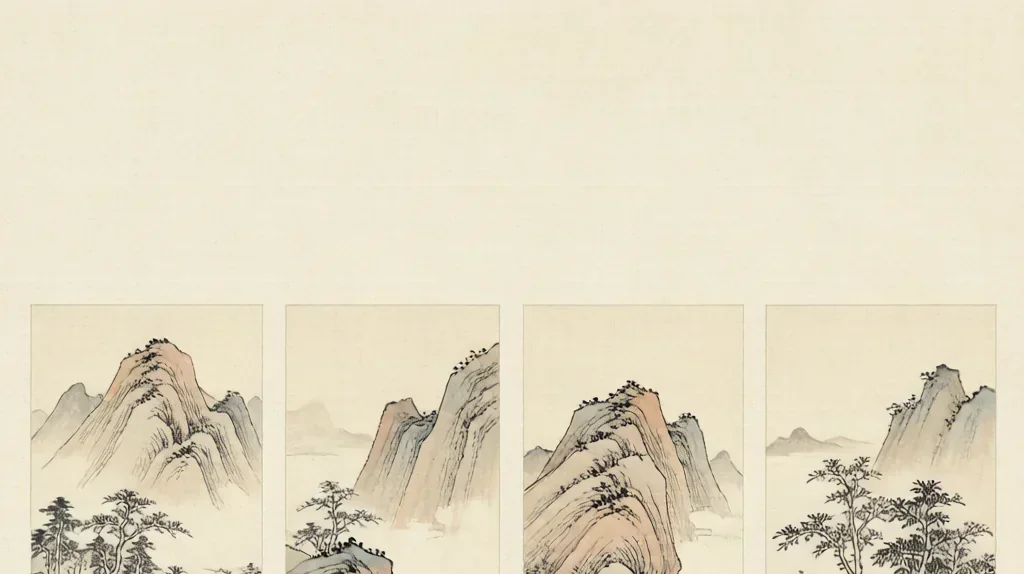
When a Chinese painter dips a brush into ink and touches it to silk or paper, the result is not simply a picture — it is a record of the artist's mind, character, and spiritual state at the moment of creation. Unlike Western oil painting, which can be endlessly reworked, Chinese brush painting is a performance in which every stroke is final, every gesture irrecoverable. This quality — the fusion of technical mastery, philosophical depth, and spontaneous expression — has made Chinese painting (中国画, Zhōngguó huà) one of the world's great artistic traditions, with a continuous history spanning over two thousand years. Its various schools, each with its own aesthetic principles and techniques, together form a landscape of extraordinary diversity within a shared cultural framework.
Gongbi and Xieyi: The Two Poles of Chinese Painting
Chinese painting can be broadly divided into two fundamental approaches that represent opposite aesthetic poles: Gongbi (工笔) and Xieyi (写意). Gongbi, meaning "meticulous brush" or "detailed work," is characterized by fine, precise brushwork, careful attention to detail, and the use of rich, layered colors. Gongbi painters use extremely thin brushes to outline forms with hairline precision before applying color in multiple washes, building up depth and luminosity through patience and technique. The result is works of jewel-like perfection, particularly suited to subjects like palace ladies, birds among flowers, and court life. This style reached its zenith during the Tang and Song dynasties, when court painters produced works of breathtaking refinement for imperial patrons.
Xieyi, meaning "sketching ideas" or "freehand style," stands in deliberate contrast. Where Gongbi seeks to capture the outer appearance of things, Xieyi aims to capture their inner spirit — their essential nature or qi (气). Xieyi painters use bold, expressive brushstrokes, simplified forms, and dramatic contrasts of ink and empty space to convey the essence of their subject with seemingly effortless spontaneity. A bamboo stalk in Xieyi might be rendered in three swift strokes; a mountain in a single wash of pale ink. This apparent simplicity is deceptive — true mastery of Xieyi requires decades of practice to achieve the state where the brush moves without conscious thought, guided by the artist's cultivated intuition. The 8th-century poet-painter Wang Wei is traditionally credited with originating the Xieyi aesthetic, and it became the dominant mode among the literati painters who shaped Chinese art from the Song Dynasty onward.
The Landscape Tradition: Northern Monumentality and Southern Lyricism
Landscape painting (山水画, shānshuǐ huà), literally "mountain-water painting," has been the preeminent genre of Chinese art since the 10th century — a status that landscape never achieved in the Western tradition until the modern era. The reason lies in the Daoist-inflected worldview of the Chinese literati: mountains and rivers were not merely scenery but manifestations of the cosmic Dao, and painting them was a form of spiritual practice, a way of aligning oneself with the fundamental principles of the universe.
The Northern School, associated with painters like Jing Hao and Guan Tong in the 10th century, and later Li Cheng and Fan Kuan in the early Song, favored monumental compositions depicting towering, craggy peaks, deep ravines, and ancient pines clinging to precipices. These paintings convey a sense of awe before nature's grandeur — human figures, when present, are tiny, dwarfed by the sublime scale of the landscape. The technique emphasized strong, angular brushstrokes and dense texturing methods that gave rocks a hard, sculptural quality. In contrast, the Southern School, championed by the scholar-official and calligrapher Dong Qichang in the late Ming Dynasty (though he traced its lineage back to Wang Wei), favored softer, more atmospheric landscapes of rolling hills, misty rivers, and gentle valleys. The brushwork was looser, the ink washes more subtle, and the overall mood more lyrical and introspective. This stylistic distinction, while partly geographic, was fundamentally philosophical — a debate about whether painting should prioritize technical skill (Northern) or spiritual expression (Southern).
The Great Schools: Zhe, Wu, and the Literati Tradition
By the Ming Dynasty (1368–1644), distinct regional and stylistic schools had crystallized. The Zhe School (浙派), centered in the prosperous coastal province of Zhejiang, revived the monumental, professional style of the Southern Song court painters. Led by Dai Jin (戴进), the Zhe School painters produced bold, dramatic works characterized by strong contrasts of ink, vigorous brushwork, and dynamic compositions. They worked primarily as professionals, selling their paintings to wealthy patrons and the imperial court.
The Wu School (吴派), based in the Suzhou region, represented a very different ideal. Its masters — Shen Zhou (沈周), Wen Zhengming (文徵明), Tang Yin (唐寅), and Qiu Ying (仇英), known collectively as the Four Masters of the Ming — were scholar-amateurs who painted not for money but for self-cultivation and as gifts among friends. Their landscapes were intimate rather than monumental, their brushwork learned and allusive rather than bold, their subjects often infused with literary and historical references accessible only to the highly educated. A Wu School painting might include a poem inscribed in the artist's own calligraphy, integrating text and image into a single aesthetic experience — something inconceivable in the Western tradition until the 20th century. This integration of poetry, calligraphy, and painting — the "Three Perfections" (三绝, sān jué) — was the highest aspiration of the literati (文人画, wénrén huà) tradition, which held that a painting's value lay not in its visual accuracy but in the moral and intellectual character of the person who made it.
Bird-and-Flower and Figure Painting
While landscape dominated elite painting, other genres flourished as well. Bird-and-flower painting (花鸟画, huāniǎo huà) became a major genre during the Tang Dynasty and reached extraordinary heights in the Song. Emperor Huizong (宋徽宗), himself a painter of rare talent, established an imperial painting academy that set exacting standards for naturalistic observation. His famous dictum that peacocks always step first with the left foot when ascending a perch — and that a painter who got this detail wrong had failed — exemplifies the almost scientific precision that court bird-and-flower painting demanded. Yet even within this naturalistic framework, the genre was never merely descriptive. Flowers and birds carried rich symbolic meanings: the peony for wealth and honor, the plum blossom for resilience in adversity, the crane for longevity, the mandarin duck for marital fidelity.
Figure painting (人物画, rénwù huà) was the earliest genre to develop, flourishing in the Han and Tang dynasties with works depicting emperors, court ladies, historical narratives, and religious subjects. The Tang master Yan Liben's "Thirteen Emperors" scroll captures the personalities of rulers from Han to Sui with penetrating psychological insight, while Zhou Fang's "Court Ladies Adorning Their Hair with Flowers" offers an intimate glimpse of aristocratic women's lives. After the Song Dynasty, figure painting declined in prestige relative to landscape, though it continued in popular and religious art, and experienced a revival in the 20th century as Chinese artists sought to engage with contemporary social realities.
The Modern Transformation
The 20th century brought unprecedented challenges and opportunities to Chinese painting. As China encountered Western art — oil painting, perspective, anatomy, abstraction — artists faced a fundamental question: how to respond to foreign influences while maintaining a connection to China's artistic heritage. Xu Beihong (徐悲鸿) advocated for a synthesis of Chinese brush techniques with Western academic realism, producing iconic works like his galloping horses that combined Xieyi brushwork with anatomical precision. Zhang Daqian (张大千) explored a different path, studying the Dunhuang murals and developing his "splashed color" technique that merged traditional ink painting with abstract expressionism.
Today, Chinese painting exists in multiple modes simultaneously. Traditional ink painters continue the literati tradition, studying the old masters and working within classical conventions. Contemporary artists experiment with installation, performance, and digital media while referencing traditional aesthetics. And a vibrant commercial art world produces everything from meticulous Gongbi reproductions to ink-wash animations. The schools of Chinese painting, once rigidly defined, have dissolved into a fluid, global conversation — yet the core values that animated the tradition for two millennia — the emphasis on the artist's character, the integration of art and nature, the belief that painting is a form of spiritual cultivation — remain powerfully alive.
📝 Chinese Vocabulary
国画 — — National painting; the general term for traditional Chinese painting
工笔 — — The meticulous, detailed style of Chinese painting
写意 — — The freehand, expressive style; literally "sketching the idea"
山水画 — — Landscape painting; literally "mountain-water painting"
文人画 — — Literati painting; the scholarly amateur tradition
Color, Ink, and the Power of Empty Space
Chinese painting treats ink and color as partners rather than rivals. Gongbi works build luminous surfaces through layered mineral and vegetable pigments, while Xieyi painters often trust a single wash of ink to suggest an entire misty mountain. Across both, the most distinctive feature is the use of negative space: the unpainted areas are not empty but active, evoking sky, water, fog, or pure distance. A lone boat on blank paper reads as floating on a vast river precisely because nothing is drawn. This restraint reflects a Daoist sensibility that values what is suggested over what is stated. Mastery lies in knowing when to stop, the greatest painters leave the viewer room to complete the scene with the imagination, making emptiness itself a compositional tool.
Patronage: Court, Temple, and Market
The schools of Chinese painting were shaped as much by who paid for them as by who painted them. Imperial courts, especially in the Tang, Song, and Ming, employed professional painters in academies and workshops, rewarding precise, auspicious images that celebrated the ruler's prosperity. Buddhist and Daoist temples commissioned large devotional murals and icons, sustaining a separate current of religious art. From the Yuan dynasty onward, however, many scholar-officials painted for themselves and their friends rather than for sale, giving rise to the amateur literati ideal. The Ming and Qing saw a growing commercial market, with professional workshops in Suzhou, Yangzhou, and Guangzhou producing works for merchants and foreign trade. These different patrons, emperor, monk, gentleman, and customer, account for the striking range of styles within a single tradition.
Chinese Painting Beyond the Mainland
The influence of China's painting schools extends far beyond the borders of the mainland. In Korea and Japan, Chinese brush painting arrived with Buddhism and the writing system, seeding distinct but related traditions such as Japanese sumi-e and Korean ink painting. From the seventeenth century, European traders and missionaries carried Chinese paintings and prints west, where their asymmetrical compositions and expressive line fascinated Rococo and later modern artists. In the twentieth and twenty-first centuries, Chinese painters trained abroad returned with new techniques, while diaspora communities in Taiwan, Southeast Asia, and the Americas kept classical methods alive and blended them with local subjects. Today major museums from London to New York hold masterpieces of the literati and academy schools, ensuring that the brush, ink, and spirit cultivated for two millennia continue to speak to global audiences.
❓ Frequently Asked Questions
🎉 Fun Facts
- The Chinese brush has remained essentially unchanged for over 2,000 years. It consists of animal hair (goat, wolf, rabbit, or weasel) bundled into a bamboo handle — a design so perfect that it has never needed improvement.
- Emperor Huizong of the Song Dynasty was such a devoted painter that he reportedly neglected state affairs to practice his art — a choice that may have contributed to the fall of the Northern Song Dynasty to Jurchen invaders in 1127.
- Chinese paintings were never meant to be permanently displayed on walls. They were stored in wooden boxes and unrolled for special occasions — a practice that contributed to their remarkable preservation over centuries.
- The literati ideal held that a painting's value lay in the moral and intellectual character of its maker, not in visual accuracy.
- Wang Wei, the eighth-century poet-painter, is traditionally credited with originating the freehand, expressive manner of Xieyi.
- Zhang Daqian developed a splashed-color technique that merged traditional ink painting with the look of abstract expressionism.