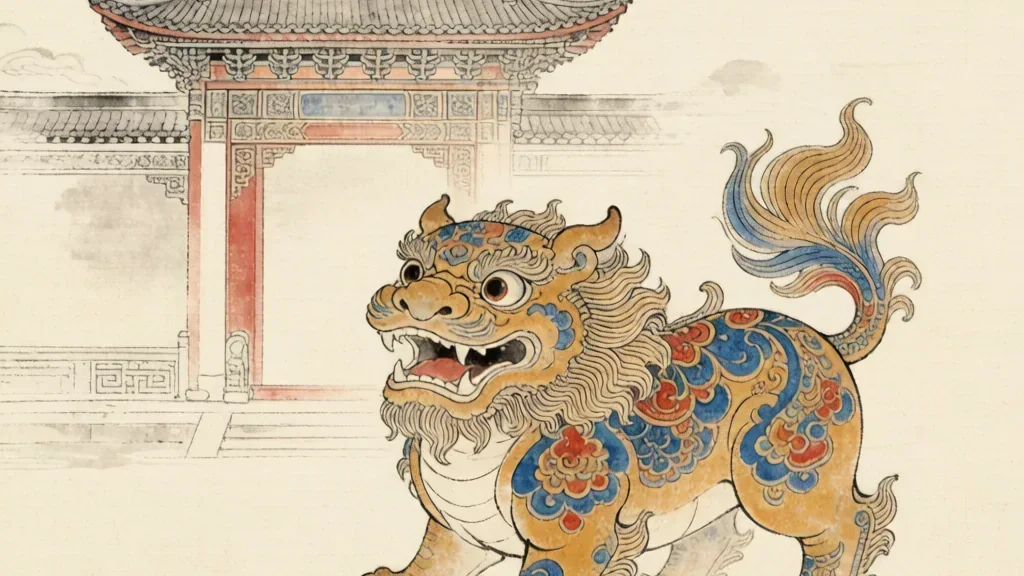
Walk through any Chinese business district, casino, or home, and you are likely to encounter a peculiar creature: a winged lion-like beast with a gaping mouth, often carved from jade or cast in gold, sitting on a desk or guarding a doorway. This is the Pixiu (貔貅), the most popular wealth-attracting charm in Chinese culture. What makes the Pixiu so effective at attracting wealth, according to tradition, is its most distinctive anatomical feature — or rather, the feature it lacks. The Pixiu has no anus. It devours gold, silver, and treasures of every kind, but nothing ever comes out. It is, quite literally, a creature designed to accumulate and retain wealth.
The Pixiu's origins lie deep in Chinese mythology. According to legend, the Pixiu was one of the nine sons of the dragon, and it served as a guardian of the Jade Emperor's (玉皇大帝) heavenly treasury. Its appetite for gold and jewels was so voracious that the Jade Emperor grew concerned for his celestial vaults. To solve the problem, the Jade Emperor sealed the Pixiu's anus, ensuring that whatever it consumed would remain inside forever — thus transforming a potential liability into the ultimate wealth-preservation system. This story is the foundation of the Pixiu's role in Chinese folk belief: it attracts wealth and ensures that it stays.
The Pixiu's Two Forms
The Pixiu actually comes in two distinct varieties, distinguished by the number and shape of their horns. The Tian Lu (天禄), or "Heavenly Emolument," has a single horn and is associated with attracting wealth from a single, concentrated source — such as a salary or a primary business. The Bi Xie (辟邪), or "Evil Averter," has two horns and is associated with broader protection and the warding off of evil influences that might harm one's financial prospects. The name "Bi Xie" literally means "to ward off evil," reflecting the Pixiu's dual role as both wealth attractor and protective guardian.
In practice, the two forms are often conflated, and most commercially available Pixiu figurines are simply labeled "Pixiu" without further distinction. The creature is typically depicted with the head of a dragon (龙头), the body of a horse (马身), the hooves of a qilin (麟脚), and a pair of wings (翅膀). Its mouth is always wide open — the better to gobble up wealth — and it may be shown sitting on a pile of coins, ingots, or treasure, visually reinforcing its association with prosperity.
Feng Shui and Pixiu Placement
The Pixiu is one of the most important objects in Feng Shui (风水), the ancient Chinese practice of arranging spaces to maximize the flow of positive energy, or qi (气). Properly placed, a Pixiu is believed to attract wealth energy into a home or business while preventing it from flowing out. The rules for Pixiu placement are specific and widely observed by practitioners.
The most important rule is that a Pixiu should face outward — toward the door or window — so that it can "see" wealth coming from the outside world and devour it. It should never face inward toward the room, as this would direct its wealth-consuming energy at the occupants themselves. A Pixiu should also never be placed on the floor; it should be elevated on a shelf, desk, or cabinet to give it the best vantage point. Many practitioners believe that the Pixiu should be placed in the wealth corner (财位) of the room — the far left corner when entering through the main door — to maximize its effectiveness.
Additional rules govern the Pixiu's orientation and care. It should not face a mirror, as the reflection is said to startle the creature. It should not be placed in a bathroom or kitchen, as these are considered energetically impure spaces. Some practitioners believe that a Pixiu should be "activated" by touching it daily and speaking to it, treating it as a living presence rather than a mere decoration. The color of the Pixiu also matters: gold Pixiu attract general wealth, black obsidian Pixiu offer protection, and green jade Pixiu promote health and longevity alongside prosperity.
The Pixiu in History and Legend
Beyond its role as a wealth charm, the Pixiu has a rich historical and mythological pedigree. In ancient China, the Pixiu was associated with military power. The phrase "貔貅百万" — "a million Pixiu" — was used to describe a vast and invincible army. The Han Dynasty historian Sima Qian (司马迁) records in the Records of the Grand Historian (史记) that the Yellow Emperor tamed Pixiu and used them in battle against his enemies, their fierce appearance striking terror into opposing forces.
The Pixiu also appears in the Classic of Mountains and Seas (山海经), which describes it as a creature resembling a leopard with a dragon's head and a single horn. This ancient text, compiled over two thousand years ago, is the earliest known reference to the Pixiu, establishing its place in Chinese mythology at least as far back as the Warring States period (475–221 BCE). Over the centuries, the Pixiu evolved from a fierce mythical beast into the beloved wealth charm it is today — a transformation that reflects the enduring Chinese cultural emphasis on prosperity and good fortune.
In modern times, the Pixiu's popularity has only grown. It is one of the most commonly gifted items for business openings, new homes, and Lunar New Year. Pixiu bracelets, made from beads of jade, obsidian, or gold, are worn by millions of people who believe the creature's wealth-attracting properties can work on a personal level. The Pixiu's image appears on everything from keychains to corporate logos, a testament to its status as one of the most commercially significant mythical creatures in the world.
Caring for Your Pixiu
According to tradition, a Pixiu is not merely an object but a living spiritual presence that requires proper care. The creature should be cleaned regularly — dust and dirt are said to block its ability to perceive wealth. Some practitioners recommend "feeding" the Pixiu by placing coins or small pieces of gold near it. The Pixiu should be treated with respect, never turned upside down or handled carelessly. If a Pixiu breaks, it should not simply be thrown away; tradition holds that a broken Pixiu has sacrificed itself to protect its owner from some misfortune, and it should be wrapped in red cloth and respectfully disposed of.
Perhaps the most important rule of Pixiu ownership is that a Pixiu should never be purchased for oneself — it must be received as a gift. This belief stems from the idea that the Pixiu's loyalty is to its original master, and purchasing one for oneself creates a confusing spiritual relationship. A Pixiu given as a gift, by contrast, transfers its loyalty to the recipient. This custom has made the Pixiu one of the most popular gifts in Chinese culture, particularly during the Lunar New Year, when wishes for prosperity are at their peak.
The Pixiu Among the Nine Dragon Sons
The Pixiu is counted among the Nine Dragon Sons, a later Chinese tradition that lists nine offspring of the dragon, each with a single defining trait that decides where its image is placed. One son guards stelae, another bells, another bridges. The Pixiu belongs to this family because it is a dragon child rather than a true lion, and its taste for gold marks its proper role as a wealth guardian. Knowing this placement logic helps explain why the Pixiu appears on desks, safes, and shop counters rather than on roof ridges like the wind-dragon. The Nine Sons system is a decorative rule dressed as myth: put the right dragon in the right spot and the object fulfills its nature. The Pixiu, then, is the dragon son whose nature is accumulation.
Materials and the Art of Carving
Pixiu are carved from a wide range of materials, each carrying its own meaning. Green Hetian jade is the most prized and is associated with health and longevity alongside wealth. Gold and gilt bronze Pixiu are favored for pure money attraction, while black obsidian versions are chosen for protection against harmful influences. Artisans shape the creature with a dragon head, horse body, qilin hooves, and small wings, its mouth always open toward treasure. Fine pieces show crisp scales and a lively expression, and the weight of the stone is often balanced so the figure sits steadily when placed on a shelf. In modern workshops the same forms are also cast in resin and base metal for everyday buyers, spreading the motif far beyond imperial collections.
The Pixiu in Personal Adornment
Beyond statuary, the Pixiu is worn close to the body as jewelry. Bracelets of jade, obsidian, or gold beads, sometimes with a single Pixiu bead, are popular for their promise of personal fortune, and they are often worn on the left wrist, the side traditionally associated with receiving wealth. Rings and pendants follow the same logic, keeping the wealth-attracting creature in constant contact with the wearer. A common belief holds that a Pixiu bracelet should not be placed on the floor and that its eyes should stay uncovered so it can see money coming. Whether as a child's gift at New Year or a self-bought charm, the worn Pixiu carries the same hope as the desk figure: that small, daily contact with the beast quietly builds prosperity.
A Talisman for Business and Commerce
The Pixiu's reputation as a wealth magnet makes it a staple of commerce. Shopkeepers place a figure near the cash register or on the safe, facing the door, so it can swallow money entering the business and never let it leave. At grand openings, a Pixiu is a common gift meant to bless the new venture with steady income. Some companies embed the creature in logos or use it as a mascot, leaning on its instant recognition as a symbol of gain. During the Lunar New Year the Pixiu ranks among the most gifted objects, alongside red envelopes and tangerines, as a wish for a profitable year. In this commercial life the ancient beast has moved from palace treasury to storefront, but its core promise is unchanged: attract, keep, and protect wealth.
❓ Frequently Asked Questions
📝 Chinese Vocabulary
- 貔貅 (Pí Xiū) — The Pixiu, a winged lion-like creature that devours gold and has no anus, making it the ultimate symbol of wealth retention.
- 天禄 (Tiān Lù) — "Heavenly Emolument," the single-horned form of the Pixiu, associated with attracting concentrated wealth.
- 辟邪 (Bì Xié) — "Evil Averter," the two-horned form of the Pixiu, associated with protection and warding off negative influences.
- 风水 (Fēng Shuǐ) — Feng Shui, the ancient Chinese practice of spatial arrangement to maximize positive energy flow, in which the Pixiu plays an important role.
- 貔貅百万 (Pí Xiū Bǎi Wàn) — "A million Pixiu," an ancient phrase used to describe a vast and invincible army.
🎉 Fun Facts
- The Pixiu's most distinctive feature — its sealed anus — is the result of a punishment from the Jade Emperor, who grew tired of the creature depleting heaven's treasury of gold and jewels.
- According to Feng Shui tradition, a Pixiu should never be bought for oneself — it must be received as a gift, or its wealth-attracting powers will not work for the purchaser.
- During the Han Dynasty, the Pixiu was considered a fierce war beast, and the phrase "a million Pixiu" was used to describe an invincible army — a far cry from its modern role as a cute wealth charm.
- The Pixiu is traditionally understood as two sexes: the male (Pi) is said to guard wealth, while the female (Xiu) guards the home and its people, and pairs are sometimes placed together for balance.
- In gambling hubs such as Macau, outsized Pixiu statues are installed at the entrances of casinos to draw in wealth from the crowds passing through the doors.
- A Pixiu is frequently shown clutching or trampling a yuanbao, the boat-shaped silver ingot of imperial China, visually tying the beast to the money it is meant to gather.