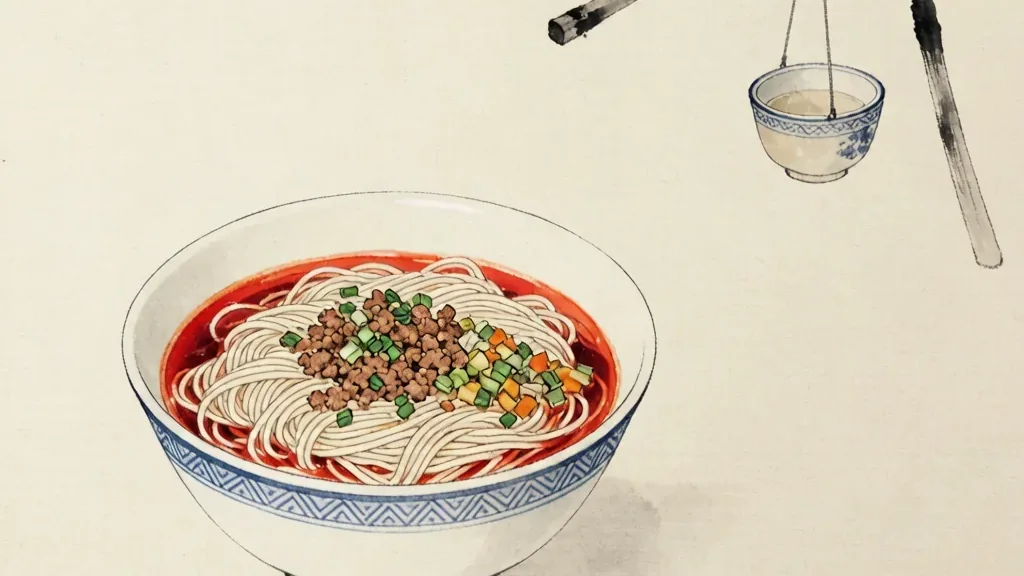
Some dishes travel from the street corner to the royal table and back again, and dàn dàn miàn (担担面) is the perfect example. Born as a cheap, portable meal carried on a shoulder pole through the lanes of Chengdu, this Sichuan noodle bowl is now served in fine restaurants around the world. Its name literally means "carrying-pole noodles," a reference to the bamboo shoulder pole (dànzi) that street vendors used to haul a stove, a pot, and a tray of toppings through the city. What makes it unforgettable is the collision of textures and the famous Sichuan flavor profile: numbing, spicy, fragrant, and savory at once. To understand dandanmian is to understand how Sichuan cooks build layers of taste from a handful of pantry staples.
Origins on a Shoulder Pole
Dandanmian was invented in the late nineteenth century in Chengdu, the capital of Sichuan province. Vendors would balance a pole across one shoulder, with a wok or brazier of boiling water on one end and a wooden box of ingredients on the other: cooked noodles, a rich meat topping, chili oil, Sichuan peppercorn, pickled vegetables, and sesame paste. A customer could summon a bowl anywhere — at a doorway, in an alley, by a bridge — and the vendor would assemble it on the spot. The pole (dànzi) gave the dish its name and its democratic character: food for anyone, delivered by foot.
Because the original servings were small and meant as a snack rather than a full meal, early dandanmian was a few mouthfuls of intense flavor. As it moved into restaurants, portions grew and broth was added, but the soul of the dish — a dry, saucy tangle of noodles coated in chili and sesame — remained. The story of the shoulder pole is more than nostalgia; it explains the dish's compactness and its punchy, concentrated seasoning.
The Anatomy of the Bowl
A proper dandanmian is built in the bowl, not in the pot. At the bottom sit the seasonings: a spoonful of zhīma jiàng (sesame paste), a glossy pool of hóngyóu (chili oil infused with aromatics), a pinch of ground Sichuan peppercorn, soy sauce, and often a little black vinegar for brightness. On top of the cooked noodles goes the zhà cài (pickled mustard greens) for crunch and a savory-sour lift, and then the suïròu — minced pork stir-fried until dry and fragrant with doubanjiang (fermented chili bean paste) and sometimes sweetener.
The noodles themselves are thin wheat noodles, cooked just past al dente so they cling to the sauce. The dish is traditionally served "dry" (gān bàn), meaning minimal broth; the liquid comes from the sauces and a splash of noodle water. The eater mixes vigorously at the table, coating every strand. The result is a bowl that is salty, nutty, hot, and numbing in quick succession — a miniature seminar in Sichuan seasoning.
The Sichuan Flavor System
Dandanmian is a textbook case of Sichuan's famous "má là" (numbing-spicy) philosophy, but it is more than just heat. Sichuan cuisine prizes a spectrum of flavors — sweet, sour, salty, bitter, and umami — balanced so that no single one dominates. The numbing quality comes from huājiāo, the Sichuan peppercorn, whose citrusy buzz is chemically distinct from chili heat. Together, chili and peppercorn create the tingling "má là" sensation that defines the region.
What keeps dandanmian from being merely fiery is the sesame paste and the pickled vegetables, which add roundness and acidity. Good versions taste complex rather than aggressive; the spice should bloom and fade, leaving the nutty and fermented notes behind. This layering is why Sichuan food, often misread in the West as simply "spicy," is in fact one of the most sophisticated regional cuisines in China, built on fermentation, aromatics, and precise balancing.
Dry Versus Soupy Versions
Modern dandanmian splits into two camps. The Chengdu street style is dry and saucy, eaten quickly with the toppings mixed in. The restaurant style, especially outside Sichuan, often comes in a light broth made from the same flavor base, which makes it more approachable and fills a larger bowl. Neither is wrong; they reflect the dish's journey from snack to meal. In Chengdu today you can still find both, sometimes at the same shop, with the dry version prized for intensity.
The soupy version tends to soften the chili and peppercorn, rounding the edges for diners unused to má là. Purists argue the dry version is the authentic one, since a vendor on a pole had no room for a broth pot. Either way, the core identity — sesame, chili, pickled greens, and savory pork — stays intact, and the choice often comes down to whether you want a slurp or a stir.
Making Dandanmian at Home
Home cooks can recreate dandanmian with a short shopping list: thin wheat noodles, ground pork, zhīma jiàng, hóngyóu (or chili flakes bloomed in hot oil), Sichuan peppercorn, zhà cài, and soy sauce. The pork topping is the only cooked component: stir-fry the meat with doubanjiang and a little sweetener until it separates into fragrant crumbs, then set aside. The rest is assembly.
Scale matters. Because the flavor is concentrated, a little sauce goes a long way; taste as you build the bowl and adjust the peppercorn to your tolerance. Toast the Sichuan peppercorn briefly in a dry pan before grinding to wake up its aroma. With fresh noodles and a vigorous mix, a home version can rival a Chengdu stall, and you skip the shoulder pole entirely.
Dandanmian in Chinese Food Culture
Like many Sichuan dishes, dandanmian has become a cultural ambassador, appearing on menus from Manhattan to Melbourne as a symbol of Chinese comfort food with attitude. It sits comfortably beside other Sichuan icons and illustrates how a humble worker's meal can be elevated without losing its character. Food historians cite it as evidence that Chinese street food has always been a laboratory of flavor, not just cheap sustenance.
In Chengdu, dandanmian is part of the city's identity as a laid-back place where good eating is a daily right. It is eaten standing at a counter, slurped at a noodle shop, or ordered late at night. The dish's endurance — from a pole on a dirt lane to a global restaurant staple — is a small story of how Chinese cuisine carries its history in every bowl.
Dandanmian on the Modern Menu
Today dandanmian appears in two main forms that mirror its history. The street style remains dry and intensely saucy, eaten quickly as a snack, while the restaurant style arrives in a light broth that softens the chili and peppercorn for a wider audience. Outside Sichuan the soupy version dominates, sometimes with extra vegetables or a softer heat, yet the core identity of sesame, chili, pickled mustard greens, and savory pork stays intact. In global Chinatowns and even non-Chinese restaurants, dandanmian is now a standard item that signals Sichuan flavor to newcomers. Its move from a pole-borne street food to a menu staple shows how a dish built for portability can scale up without losing the punchy, concentrated seasoning that made it famous.
The Role of Fermented Paste
Behind the heat of dandanmian sits a quieter source of flavor: fermentation. Doubanjiang, the chili bean paste, and the pickled mustard greens both rely on controlled fermentation to build salty, tangy, umami depth that fresh ingredients cannot match. The Sichuan peppercorn adds its citrus-like numbing tingle, but it is the fermented components that give the bowl its rounded, mature taste. This reliance on ferment and aromatics is why Sichuan cuisine is often misread in the West as merely spicy when it is in fact one of China's most layered regional kitchens. A good dandanmian tastes complex rather than aggressive, with the spice blooming and fading to leave the nutty and fermented notes behind, a small lesson in balance that the bowl teaches with every stir.
❓ Frequently Asked Questions
📝 Chinese Vocabulary
担担面 — : dandan noodles / carrying-pole noodles.
花椒 — : Sichuan peppercorn, source of the numbing tingle.
芝麻酱 — : sesame paste.
榨菜 — : pickled mustard greens.
红油 — : chili oil.
担子 — : the bamboo carrying pole that gave the noodle its name
豆瓣酱 — : fermented chili bean paste used to season the pork topping
麻辣 — : the numbing-spicy taste profile of Sichuan cooking
🎉 Fun Facts
- The original dandanmian servings were tiny — meant as a snack, not a meal — because vendors could only carry so much on a shoulder pole.
- Sichuan peppercorn contains hydroxy-alpha-sanshool, a compound that creates the unique buzzing numbness rather than heat.
- Zhacai, the pickled mustard green topping, is so popular it is now exported worldwide as a crunchy snack on its own.
- UNESCO named Chengdu a City of Gastronomy in 2010, with dandanmian among the dishes that earned the city that title.
- The name dandanmian can also suggest the rhythmic clack of the vendor's pole as he walked the lanes of old Chengdu, calling customers to a quick bowl.
- Modern Chengdu noodle shops often let customers choose the dry style for authenticity or a soupy style for a milder bowl, reflecting the dish's two lineages.