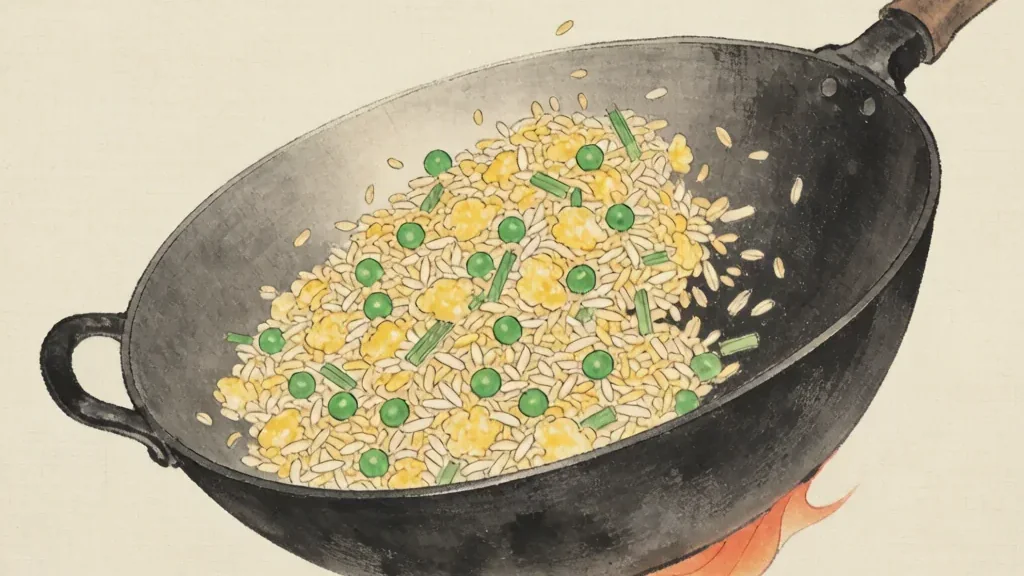
Fried rice (炒饭, chǎofàn) is the great recycler of the Chinese kitchen: cold, leftover rice tossed in a hot wok with egg, scallion, vegetables, and bits of meat or shrimp until every grain is separate, glossy, and faintly toasted. Simple in concept, it is a demanding test of wok skill, since success depends on high heat, a loose "dry" rice, and rapid movement. Across China and the diaspora, fried rice appears as快捷 breakfast, lunch-box staple, and late-night snack, with Yangzhou fried rice as its most celebrated formal version. Few dishes better capture the Chinese virtue of waste-not thrift elevated into something genuinely delicious.
The Logic of Leftover Rice
Fried rice exists because of rice's centrality to the Chinese meal and the inevitability of leftovers. Freshly cooked rice is too moist and sticky to fry well; a day-old batch, chilled and slightly dried, separates into individual grains that can be seared rather than steamed. Cooks therefore plan ahead, cooking extra at dinner so breakfast or the next day's fried rice is better for it.
This thrift is philosophical as much as practical. Turning surplus into a fresh dish embodies the ideal of not wasting grain, a serious matter in a farming civilization. The humble origin also explains fried rice's democracy: anyone with a wok and yesterday's rice can make it, rich or poor.
The Wok and the Heat
The defining tool is the round-bottomed wok (wok) over a fierce burner. The cook heats oil until it smokes lightly, adds aromatics and egg, then the cold rice, tossing and pressing to break clumps. The goal is "golden each grain" (粒粒金黄), with no soggy mass. High heat drives off moisture and imparts wok hei, the faint smoky breath that only a hot wok gives.
Technique matters more than ingredients. A home stove weaker than a restaurant's must compensate with a very dry rice and small batches, since crowding lowers the temperature and steams the rice instead of frying it. The line between great and mediocre fried rice is almost entirely heat and motion.
Yangzhou Fried Rice
The most famous named version is Yángzhōu chǎofàn, associated with the Yangzhou region of Jiangsu. A refined recipe calls for rice studded with shrimp, diced ham, scallop or chicken, peas, carrots, bamboo shoots, and egg, each component cut small and cooked separately before combining. Its elegance made it a banquet and overseas-restaurant standard, though purists insist the authentic Yangzhou form uses only a restrained set of fine ingredients.
Legend links the dish to the Qing-dynasty official Yi Bingshou (伊秉绶), though the claim is disputed. Whatever its provenance, Yangzhou fried rice became the dish Chinese restaurants abroad served to prove they could do something more than "egg fried rice," and it remains the gold standard by which diners judge a kitchen.
Everyday and Regional Variants
Beyond Yangzhou, regions improvise freely. Cantonese "young chow" keeps it light with egg, shrimp, and barbecue pork (charsiu). Sichuan adds chili and pepper for a hot version; Fujian might fold in seafood; northern China uses scallion and egg with a splash of soy. In homes, whatever is in the fridge—leftover vegetable, a sausage, a spoon of pickles—becomes the seasoning.
The dish's openness is its survival strategy. No two households fry rice identically, and the "recipe" is really a method: hot wok, dry rice, fast hands, season, finish. That flexibility let fried rice travel and localize wherever Chinese cooks landed.
Beyond China: Global Fried Rice
Chinese migration spread fried rice worldwide, where it hybridized. Southeast Asia's nasi goreng and Thai khao pad owe clear debts to the technique, seasoned with fish sauce, lime, and chili. Japanese chāhan adds ketchup or mayonnaise in casual forms. In the West, "egg fried rice" and "special fried rice" (with meat and shrimp) became takeout clichés, sometimes laden with soy and grease far from the delicate original.
These adaptations show fried rice's chameleon nature: the method survives translation because it asks so little and rewards so much. A wok, cold rice, and an egg are enough to make something recognizably "fried rice" on any continent.
Fried Rice as Comfort and Snack
In China, fried rice is the food of in-between moments: a quick breakfast before work, a child's after-school bowl, a midnight refuel. Street vendors and night markets sell it folded with egg in a paper cone, and congee shops pair it with morning gruel. Its portability made it a lunch-box favorite for students and workers long before fast food.
Emotionally, fried rice is memory. Many overseas Chinese name it as the taste of home, because it is the dish a parent could always assemble from a near-empty fridge. The simplicity that makes it humble also makes it intimate.
Nutrition and Modern Twists
Plain egg fried rice is modest in fat and filling, but loaded versions with meat, oil, and soy climb in calories. Modern health spins use brown rice, cauliflower rice, or extra vegetables, and "fried rice" bowls topped with protein are now café staples. Yet the classic remains a balanced one-bowl meal of carbohydrate, protein, and vegetable in a single stir.
However updated, the soul of fried rice stays the same: respect for leftover grain and the discipline of the hot wok. It is thrift rendered as craft, and that paradox is exactly why the dish has lasted for centuries and crossed every ocean.
Tips for the Best Result
A few habits separate good from great fried rice. Pre-cook and chill the rice, use a wok over the highest heat available, and have all ingredients prepped before the fire goes on, since the cooking is fast. Add seasonings at the edge of the wok so they sizzle, and finish with scallion off the heat to keep its fresh note. Season lightly and taste as you go.
Avoid the common mistakes: too much oil, crowding the pan, and stirring constantly so the rice never sears. Let it sit and toast between tosses. With practice the home cook approaches the restaurant's grain-by-grain result, and the leftover-rice rule means there is always a chance to try again tomorrow.
❓ Frequently Asked Questions
What is fried rice?
Cold, dried rice tossed in a hot wok with egg and other ingredients until the grains separate and toast.
Why use leftover rice?
Cold, dried rice separates into grains and fries instead of steaming, giving the proper texture.
What is Yangzhou fried rice?
A refined Jiangsu version with shrimp, ham, egg, peas, carrot, and other finely diced ingredients.
How do you keep grains separate?
Use dry rice, a very hot wok, small batches, and constant tossing to avoid steaming.
What is wok hei?
The faint smoky aroma imparted only by cooking over intense wok heat.
Can fried rice be made without meat?
Yes; egg-and-vegetable fried rice is the simplest and most common vegetarian form.