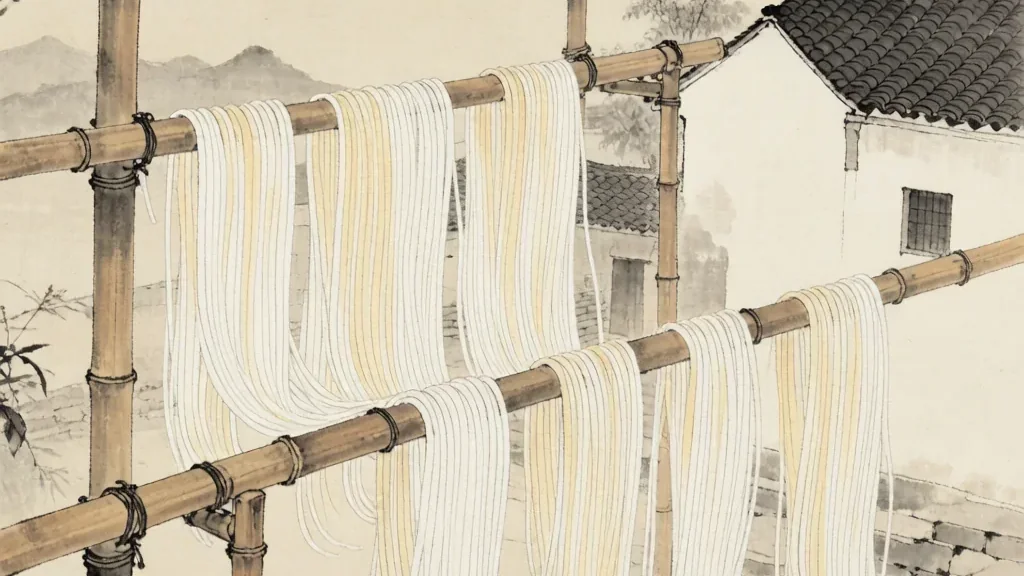
Miantiao (面条, miàntiáo) is the Chinese word for noodles—wheat-based strands that rank among the staple foods of northern China and a beloved meal across the whole country. From hand-pulled lamian to knife-shaved daoxiaomian, from Beijing zhajiangmian to Sichuan's spicy bowls, Chinese noodles are astonishingly diverse in shape, sauce, and occasion. More than sustenance, they carry symbolism: the long, unbroken strand is the traditional birthday noodle (changshou mian, 长寿面) eaten for longevity. This article surveys the forms, techniques, and cultural meaning of Chinese wheat noodles, a tradition as old as Chinese agriculture itself.
What "Miantiao" Means
The character 面 (miàn) means wheat flour and, by extension, noodles or wheat-based foods; 条 (tiáo) means strip or strand. Together miàntiáo simply denotes noodle strands, as opposed to rice noodles (mǐ fěn) of the south.
In daily speech people name noodles by preparation or topping—lamian, zhajiangmian, daoxiaomian—rather than by the generic term. "Miantiao" is the umbrella word a cook or shopkeeper uses for the plain strands.
Understanding the distinction between wheat and rice noodles is fundamental to reading any Chinese menu by region.
A Long History
Wheat reached China from the west millennia ago and took root in the drier north, where rice struggled. Archaeological and textual evidence places noodle-like foods in China at least two thousand years ago; a famous find of preserved noodles in northwestern China dates to around 4,000 years ago.
Early noodles were kneaded, stretched, or cut by hand, then boiled—much as today. Written records from the Han through Tang describe "cake" (bing) that included boiled noodle forms, showing their deep roots.
Over centuries regional styles crystallized along lines of climate, grain, and trade, producing the map of Chinese noodles we know now.
Wheat North, Rice South
China's staple divide runs roughly along the Yangtze: wheat and noodles dominate the north, where cold, dry land suits wheat; rice and rice noodles dominate the humid south. This geography explains why iconic noodle dishes cluster in Shaanxi, Shanxi, Beijing, and the northwest.
Yet migration and appetite long ago broke the boundary—noodles are eaten everywhere, while rice remains southern. The two staples coexist even within one household's meals.
Shanxi in particular prides itself on hundreds of noodle shapes, a regional obsession with the form itself.
Forms and Techniques
Chinese noodles are defined as much by how they are made as by how they are sauced. Lamian (拉面) are hand-pulled by swinging and stretching the dough into threads. Daoxiaomian (刀削面) are sliced straight off a loaf into boiling water with a curved blade, producing ribbons with a chewy edge.
Others are rolled and cut (qie mian), extruded, or pressed. Each technique yields a different bite: pulled noodles are elastic, knife-cut ones broad and robust, rolled-cut ones tender.
The craft is physical and regional; masters of lamian or daoxiaomian perform their making as public theater.
Sauces and Soups
A noodle is only half the dish; the dressing completes it. Two broad families are tang mian (汤面, soupy) and ban mian (拌面, dressed/dry). Soups range from clear pork-bone to fiery chili oil; dressings from fermented bean paste to sesame and vinegar.
Toppings follow local larders: zhajiangmian tops wheat noodles with fried fermented soybean paste and shredded vegetables; Sichuan bowls lean on chili oil, peppercorn, and peanuts; northwestern ones on lamb and cumin.
The same strand thus becomes a different meal in each province, a versatility that explains the noodle's ubiquity.
Longevity Noodles
The long unbroken noodle is a symbol of long life, eaten especially on birthdays as changshou mian (长寿面, "longevity noodles"). Tradition holds one should not bite or cut the strand, lest one "cut" one's years.
This makes the noodle a food of blessing, served at birthdays and sometimes at the Lunar New Year for hopes of a long year. The symbolism travels with Chinese communities worldwide.
The custom shows how a humble staple carries wishes—proof that Chinese food is as much about meaning as flavor.
Regional Diversity
Shaanxi and Shanxi offer vinegar-tart, hearty wheat noodles; Beijing contributes zhajiangmian and clear-soup beef noodles; the northwest (Lanzhou lamian) is famous for hand-pulled beef noodle soup with a bright broth.
Sichuan turns noodles spicy and numbing; Xinjiang brings laghman-style pulled noodles with lamb and peppers; Shanghai and the south prefer finer, soup-light styles. Each region's bowl is a culinary postcard.
Together they form one of the world's great noodle traditions, comparable only to Italy's or Japan's in variety.
Street Food and Daily Life
Noodles are the quintessential fast food of Chinese cities: a bowl at a corner shop, a late-night street stall, a railway-station rush. They are cheap, filling, and endlessly customizable.
The slurp is encouraged—it cools the strand and is a sign of enjoyment. Noodle shops run from dawn to late, feeding students, workers, and night owls alike.
In northern cities a bowl of noodles can stand for the whole meal, especially in winter, when a hot soup noodle warms to the core.
Instant Noodles and Modern Life
China is the world's largest consumer of instant noodles, a twentieth-century convenience that turned the staple into shelf-stable fast food. Invented in Japan and embraced across Asia, instant noodles became a symbol of urban speed.
Yet fresh-noodle culture thrives alongside, with artisanal lamian and regional shops resisting homogenization. Younger cooks revisit heritage shapes as a point of pride.
The coexistence of instant and hand-pulled shows the noodle's dual life: necessity and craft, speed and tradition.
Nutrition and the Modern Bowl
Wheat noodles are mainly carbohydrate, but a balanced bowl—with meat or egg, vegetables, and a broth—becomes a complete meal. Northern wheat-eaters traditionally paired noodles with pickles and greens to round out nutrition in a grain-heavy diet.
Modern concerns about refinement have pushed some shops toward wholegrain or added-vegetable strands, and home cooks blend in spinach or carrot for color and fiber. The broth's sodium is the main caveat, easily controlled in home cooking.
Seen plainly, the Chinese noodle is a flexible vehicle: as healthy or as indulgent as its toppings make it, which is precisely why it has survived four millennia of changing appetites.
Noodles Abroad
Chinese migrants carried noodle traditions worldwide, seeding Chinatown shops from San Francisco to Singapore. Lo mein, chow mein, and beef noodle soup are now global terms with Chinese roots.
Regional styles like Lanzhou lamian have spread internationally as franchised shops, introducing hand-pulled broth noodles to new audiences. The noodle is among China's most successful culinary exports.
Each overseas bowl is both authentic and adapted—another chapter in a four-thousand-year story still being written.
❓ Frequently Asked Questions
What does miantiao mean?
It simply means "noodles"—wheat strands, as opposed to rice noodles (mifen); the term is the generic word for the staple.
How old are Chinese noodles?
Archaeological finds of preserved noodles in China date back about 4,000 years, and written records describe noodle-forms from the Han era onward.
Why are noodles linked to long life?
The long unbroken strand symbolizes a long life; birthday "longevity noodles" are eaten without biting the strand, to avoid "cutting" one's years.
What are the main noodle types?
Hand-pulled (lamian), knife-shaved (daoxiaomian), rolled-cut, and extruded, each with a distinct bite and regional home.
Are noodles northern or southern?
Wheat noodles are the northern staple; rice noodles dominate the south, though noodles are eaten everywhere in China today.
What is the difference between tangmian and banmian?
Tangmian are served in soup; banmian are dressed dry with sauce, oil, or paste—two fundamental ways to serve the same strand.