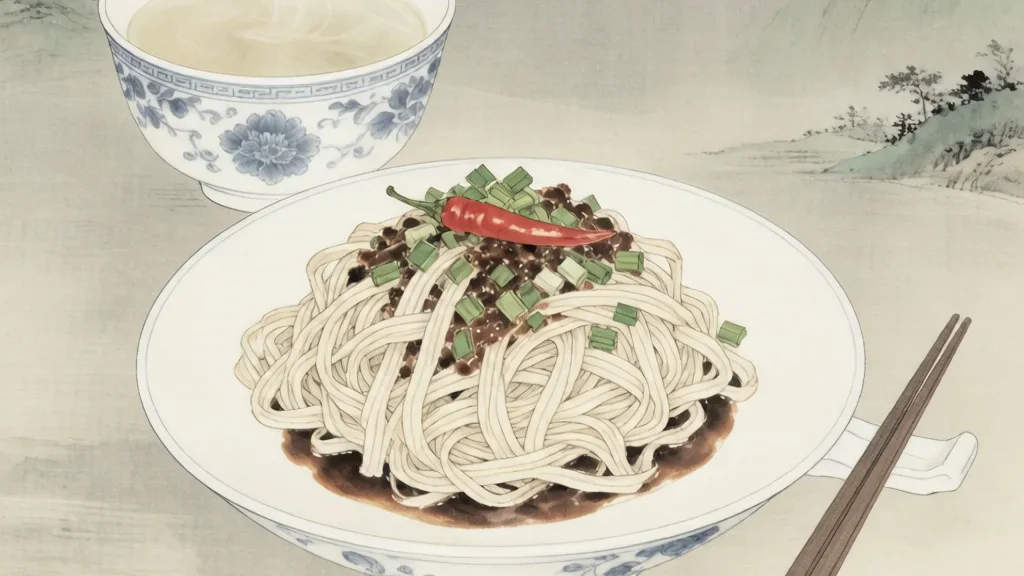
Knife-cut noodles — 刀削面 (dāo xiāo miàn) — are Shanxi's sliced masterpiece: ribbons of wheat dough shaved mid-air from a held loaf straight into a pot of boiling broth. The motion is part cooking, part performance, and the noodles it produces are like no others — ragged-edged, thick in the middle, thin at the lip, with a chewy bite that machines cannot fake. Born in China's wheat heartland, they turned a simple staple into a spectator sport. This is the story of a northern noodle shaped by a single flick of the wrist.
What Are Knife-Cut Noodles?
Daoxiaomian means, quite literally, "knife-shaved noodles": 刀 (dāo) is knife, 削 (xiāo) is to shave or pare, and 面 (miàn) is noodle. Unlike rolled-and-cut noodles or hand-pulled ones, they are never flattened first. A cook holds a solid block of dough and carves ribbons directly off its face, letting them fly into the pot.
The shape is the signature. Because each ribbon is sliced at an angle, it has one thin, almost translucent edge and one thick, doughy back, with a slightly ragged surface that catches sauce. That unevenness is exactly what gives the noodle its springy, satisfying chew — and what no factory extruder has managed to copy.
Shanxi, the Wheat Heartland
The dish comes from Shanxi, a northern province with a cold, dry climate that made wheat — not rice — the staple crop for centuries. Shanxi is often called the cradle of Chinese noodle culture, and locals take fierce pride in the sheer number of ways they form dough into strands, sheets, and pellets.
Against that backdrop, daoxiaomian emerged as a practical innovation. Rather than rolling dough thin and cutting it, a cook could shave noodles straight into the cooking pot, saving both time and the equipment of a full noodle workshop. The method suited busy households and traveling merchants who wanted a hot meal without a rolling pin.
Origins and Legend
Precise dates are murky, but daoxiaomian is generally traced to Shanxi's folk kitchens and is often said to be several hundred years old. A popular legend credits the technique to a cook who, having lost or lacked a rolling pin, simply shaved the dough with a knife straight into the pot — necessity mothering a now-famous method.
Whether or not that story is true, the skill clearly matured in Shanxi, where wheat, water, and a good blade were all a cook needed. From there it traveled with migrants across northern China and, later, to cities worldwide with Shanxi diaspora communities, becoming one of the region's most recognizable culinary exports.
The Dough Foundation
Daoxiaomian dough is firmer than most noodle doughs but softer than bread, with a hydration around 45 to 50 percent — far lower than the 60-plus percent typical of hand-pulled noodles. That low water content is what makes the block hold its shape in the cook's hand and the ribbons stay distinct in the broth.
It is usually nothing more than high-gluten wheat flour, water, and sometimes an egg or two for richness. Resting is essential: after kneading, the dough sits at least half an hour so the gluten relaxes and the block becomes smooth and crack-free. Any imperfection causes the blade to catch and the ribbon to break mid-flight.
Getting the water right is the cook's first test. Too wet and the block slumps and the ribbons tear; too dry and the blade drags, leaving thick, doughy slabs. Experienced makers judge by feel — the block should spring back slowly when pressed and show no cracks — and adjust the next batch by a tablespoon of water at a time.
The Shaving Technique
The performance is the part everyone remembers. The cook balances a three- to four-kilogram block of dough on one forearm or a board, then draws a curved blade across its surface in quick, rhythmic arcs. Each stroke peels off a ribbon roughly twenty centimeters long, which sails in an arc into the boiling water below.
A practiced chef shaves well over two hundred noodles a minute, producing a near-continuous stream. The tempo, the soft hiss as ribbons hit the water, and the visible control make shaving a draw in its own right — which is why restaurants built glass-walled stations so diners could watch the show while they waited.
Posture matters as much as the blade. The cook stands close to the pot, shoulder relaxed, and lets the wrist — not the arm — do the work, so the stroke stays even as the block shrinks. As the loaf gets smaller it is rotated and re-balanced, and the last scraps are scraped off and dropped in so nothing is wasted.
The Knife
The tool is not a kitchen knife but a specialized blade: a curved, single-edged shaver, often with a slight concavity and sometimes a small guard, that rides along the dough and lifts each ribbon. Its shape is tuned so the cut ribbon curls just enough to cook evenly and hold sauce.
Traditionally these were forged by village blacksmiths who customized the curve to a particular cook's grip and stroke. Today mass-produced versions exist, but serious shops still favor a well-balanced blade, because the feel of it against the dough is what separates clean, uniform ribbons from ragged, broken ones.
Broths and Sauces
In Shanxi the classic serving is a lamb-based broth scented with ginger and star anise, then brightened with a slash of Shanxi aged vinegar (老陈醋, lǎo chén cù). The vinegar's deep, mellow sourness cuts the lamb's richness and makes the dense noodles taste lighter than they are.
The neutral wheat flavor also makes daoxiaomian endlessly adaptable. In Beijing it may meet soybean paste; in Sichuan it is tossed with chili oil; a home cook might top it with a quick tomato-and-egg stir-fry. The noodle is a blank, chewy canvas that takes almost any sauce without losing its character.
Toppings finish the bowl. A scatter of cilantro, a spoon of chili oil, or a few crushed peanuts can shift the same noodles from rustic to restaurant-ready, and a braised-meat gravy (卤) turned over the top is a popular hearty option. The shaved noodle's rough surface is built to hold all of it.
Regional and Modern Variations
Within Shanxi alone, daoxiaomian varies by city — some broths richer, some cuts wider — and neighboring provinces have adopted it with local twists. The constant is the shaving; everything around it is fair game for regional taste and available ingredients.
Modern shops play with colored doughs, folding in spinach, tomato, or squid ink for visual drama, and a few experiment with gluten-free flours for diners who cannot eat wheat. Novelty aside, the consensus benchmark remains classic wheat noodles shaved into a clear lamb broth with aged vinegar.
Performance and Revival
Daoxiaomian has enjoyed a revival as part of China's broader interest in regional heritage foods. Cooking competitions now stage shaving contests that judge speed, uniformity, and even how cleanly the ribbons land in the pot, turning a kitchen task into a spectator sport on television and at festivals.
Showmanship has grown with the fame: some chefs shave over the shoulder or behind the back, or aim the ribbons into a pot across the room. However theatrical, the point is unchanged from the folk kitchens of Shanxi — a loaf of dough, a sharp blade, and a steady hand turning flour and water into something memorable.
The renewed fame has also professionalized the craft. Cooking schools in Shanxi now teach shaving as a credential, and heritage efforts frame daoxiaomian as intangible cultural heritage worth protecting. For a dish born of thrift, being treated as a tradition to safeguard is a long way from the folk kitchen.
❓ Frequently Asked Questions
📝 Chinese Vocabulary
刀削面 — : knife-cut noodles; Shanxi specialty.
山西 — : Shanxi, the northern wheat province of origin.
老陈醋 — : aged vinegar; the classic Shanxi condiment.
削面刀 — : noodle-shaving knife.
面块 — : dough block for shaving.
白案 — : dough-based foods section of a Chinese kitchen.
羊肉 — : lamb; the traditional broth base.
案板 — : cutting board the dough rests on.
筋道 — : chewy, springy texture of good noodles.
卤 — : braised sauce or gravy served over noodles.
🎉 Fun Facts
- Shanxi is reputed to boast more than 300 distinct noodle styles, with daoxiaomian the most celebrated.
- A practiced chef can shave well over 200 noodles a minute in a steady stream.
- The tool is a curved single-edged blade, sometimes nicknamed the "flying knife."
- The ragged, one-thick-one-thin shape is intentional — it grabs sauce and stays chewy.
- Shanxi aged vinegar (老陈醋) is the traditional acidic counterpoint to rich lamb broth.
- The shaving is now a spectator draw at festivals, with chefs shaving over the shoulder for show.
- A popular legend credits the method to a cook who, lacking a rolling pin, shaved dough straight into the pot — charming but unverified.
- Competitions judge not just speed but how cleanly the ribbons land in the boiling water.