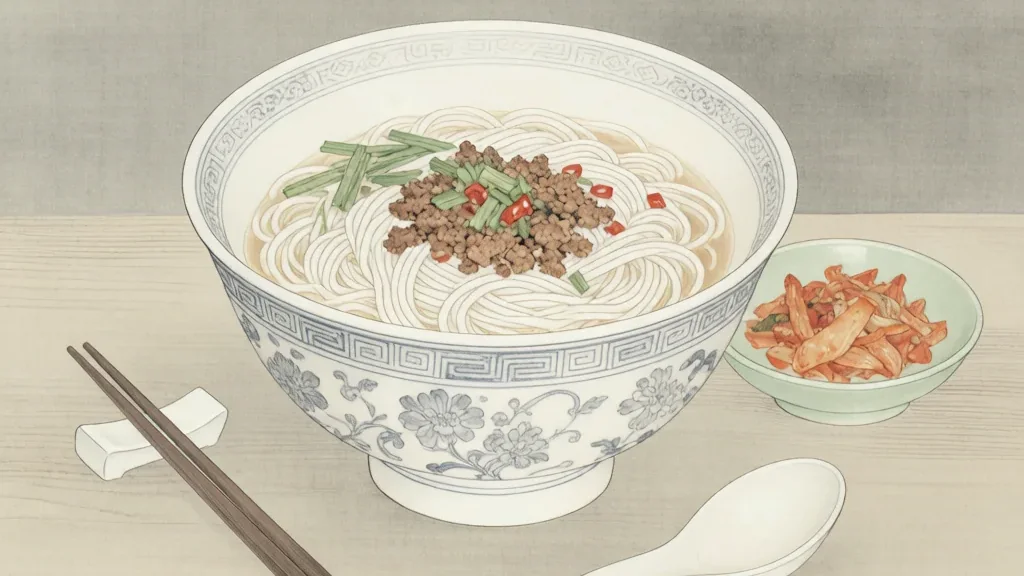
Guilin mifen (桂林米粉, Guìlín mǐfěn) is the signature rice-noodle dish of Guilin, in Guangxi Zhuang Autonomous Region—springy round rice noodles served in a fragrant spiced broth (lǔ shuǐ, 卤水) and topped with sliced pork, beef, or "guo shao" (crispy fried pork), pickled long beans, and peanuts. Eaten for breakfast and at any hour, it is the everyday soul food of the city, as identifying for Guilin as its famous karst mountains. The dish's character comes less from the noodle than from the master brine: a dark, aromatic reduction of spices, soy, and often a little fermented bean that defines each shop's signature. Locals eat it by mixing everything together, then sipping the broth to finish.
What Guilin Mifen Is
At its core the dish is a bowl of fresh rice noodles (mǐ fěn, 米粉) — round, smooth, and chewy — bathed in a small amount of dark, intensely seasoned brine rather than a light soup. Toppings and condiments turn the plain noodles into a meal.
Unlike a brothy noodle soup, the classic Guilin bowl is served "dry" with just enough brine to coat, though a side bowl of clear pork or bone broth is usually provided to drink. The eater mixes, then slurps.
The noodle itself is mild; the brine and toppings do the talking. This inverted emphasis—sauce over soup—sets it apart from most Chinese noodle bowls.
Origins in Guilin
Guilin, a city ringed by dramatic limestone peaks in northern Guangxi, has eaten rice noodles for centuries as a staple of the rice-growing south. The local form evolved around a distinctive spiced brine that became the mark of the place.
Accounts tie the dish to the region's multi-ethnic foodways, blending Han rice-noodle tradition with Guangxi seasonings. By the twentieth century Guilin mifen was a city institution, with rival shops each guarding a brine recipe passed down generations.
Today the dish is protected as part of local culinary heritage and promoted as a symbol of Guilin alongside the scenery.
The Rice Noodle
The noodles are made from rice ground into slurry, steamed into sheets, and cut or extruded into round strands of varying thickness. Freshness is key: they are briefly boiled to heat through and soften, then drained into the bowl.
Texture is the point—springy, smooth, and never mushy. Good Guilin mifen have a slight bite that stands up to mixing with the heavy brine.
Because rice, not wheat, is the base, the noodles are naturally gluten-free, a feature valued by some diners though not the traditional concern.
The Master Brine (Lushui)
The soul of the dish is the lǔ shuǐ, a dark master sauce simmered from soy, rock sugar, and a bouquet of spices—star anise, cassia, clove, fennel, and often a fermented bean or mushroom for umami. Some recipes include a little pork or beef stock.
Shops maintain and replenish their brine like a perpetual stock, deepening with use. The exact spice blend is a trade secret and the basis of local loyalty; "which shop's lushui" is a serious question in Guilin.
A spoonful or two is enough to perfume and darken the whole bowl, which is why the dish reads as "dry-ish" rather than soupy.
Toppings
The classic topping is guō shāo (锅烧) — pork (often belly) simmered, then fried until the skin is crisp and the layer beneath jelly-soft, sliced thin. Braised beef (lǔ niú ròu, 卤牛肉) is another favorite, as is simple sliced pork.
Across the top go pickled long beans (suān dòu jiǎo, 酸豆角), crushed peanuts, scallion, and sometimes fried soybeans. These add crunch, sourness, and aroma to balance the rich brine.
The combination of crisp pork, sour beans, and peanuts against the slippery noodle is the texture story of the bowl.
How to Eat It
A Guilin mifen arrives with noodles, brine, and toppings, plus a side of clear broth. The eater stirs everything together so the brine coats each strand, then adds chili oil or pickled vegetables from the condiment bar to taste.
The noodles are eaten first, and the remaining clear broth is drunk from the side bowl to cleanse and complete. Some locals finish the whole thing in a few minutes, standing at a counter.
Customizing at the condiment table is expected; the "standard" bowl is only a starting point.
History and Daily Life
For Guilin residents the noodle is routine and ritual: a morning bowl before work, a late bowl after travel, the first meal sought by returning natives. Small shops open at dawn and serve steady crowds through the day.
It functions as cheap, fast, complete nourishment—protein, starch, and flavor in one bowl—which is why it thrives as breakfast in a city of early risers and tourists.
The dish also travels: Guilin migrants carried it across China, and "Guilin mifen" shops now appear in many big cities.
Variations Across Guangxi
Neighboring Guangxi cities have their own rice-noodle styles—Liuzhou's luosifen (river-snail noodles) being the famous funky cousin—but Guilin's is defined by its clean, spiced brine rather than fermentation or snail broth.
Some versions lean more soupy, some drier; some add beef offal, others keep to pork. The through-line is the round rice noodle and the aromatic lǔ shuǐ.
This family resemblance ties Guangxi's noodle culture together while letting each city claim its own accent.
Cultural Role and Identity
Guilin mifen is woven into the city's identity alongside its landscape. Visitors are told to eat the noodles beneath the peaks, and the dish features in local promotion as much as the Li River does.
It also represents the everyday excellence of Guangxi eating—unshowy, deeply flavored, and rooted in rice. For the Guangxi diaspora it is a taste of home.
Festivals and food festivals celebrate it, but its true life is the weekday queue and the steaming bowl at dawn.
Modern Life and Beyond
Today the dish ranges from heritage shops with decades-old brine to fast-casual chains that standardize the formula. Instant and ready-to-cook versions let the diaspora recreate it abroad.
Health-minded adaptations lighten the brine's salt and oil, though purists warn this dulls the signature. Delivery keeps the bowl relevant to younger, busier eaters.
Through every change, the test stays the same: a springy rice noodle, a fragrant dark brine, and the ritual of mixing before the first slurp.
❓ Frequently Asked Questions
What makes Guilin mifen special?
Its dark, aromatic spiced brine (lushui) and springy round rice noodles, served with crisp pork, pickled beans, and peanuts, mixed before eating.
Is it a soup or a dry noodle?
Classically it is served "dry" with just enough brine to coat, plus a separate side bowl of clear broth to drink.
What is guo shao?
Pork (often belly) simmered then fried so the skin turns crisp while the layer beneath stays jelly-soft; a signature topping.
Is it gluten-free?
The rice noodles are gluten-free, though the brine may contain soy (wheat); ask if you need strict gluten-free.
Where is it from?
Guilin, in Guangxi Zhuang Autonomous Region, where it is a daily breakfast and city symbol.
How does it differ from luosifen?
Guilin mifen uses a clean spiced brine; luosifen is fermented and snail-based with a funky, pungent broth.