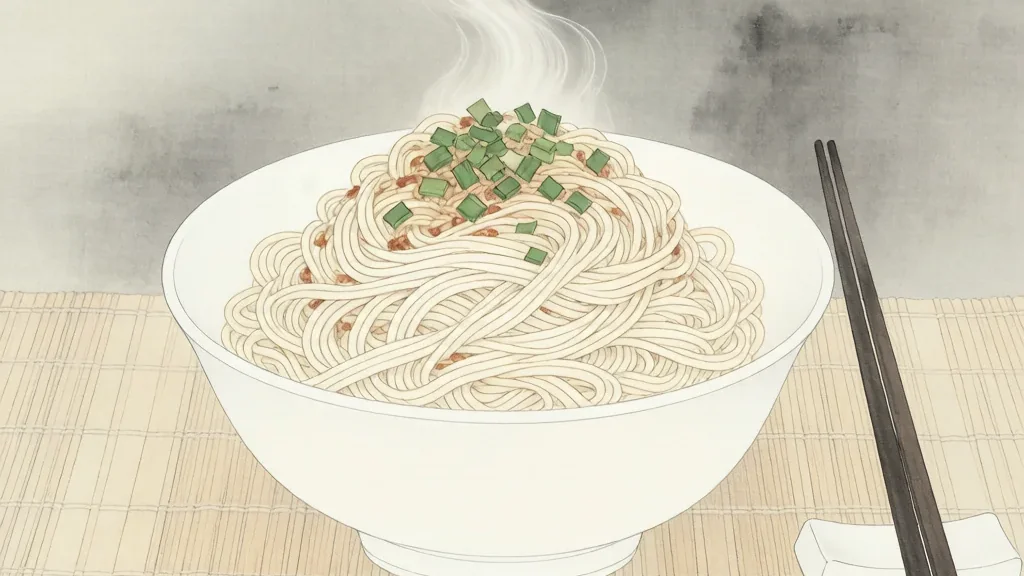
Yibin burning noodles (宜宾燃面, yíbīn ránmiàn) are among the most distinctive dishes of Sichuan province — dry-tossed wheat noodles that arrive glossy with red chili oil, scattered with peanuts, sesame, and preserved vegetables, yet contain not a drop of soup. Unlike the broth-laden noodle bowls most people associate with Chinese cuisine, ranmian is served "dry," the diner's first act being to lift chopsticks and toss everything together until each strand gleams. The finished bowl is fiery, numbing, fragrant, and faintly sweet, a concentrated expression of Sichuan's love affair with chili and huājiāo (花椒, Sichuan peppercorn). For the people of Yibin, a riverside city in southern Sichuan where the Jinsha and Min rivers meet to form the Yangtze, ranmian is far more than a snack: it is a daily ritual, a point of civic pride, and an edible symbol of their city.
Yibin and the Yangtze Riverfront
Yibin sits at the southern edge of the Sichuan Basin, a strategic port where cargo boats once gathered to navigate the Upper Yangtze. The city's noodle culture grew out of this working waterfront. In the late Qing dynasty and Republican-era decades of the nineteenth and early twentieth centuries, dockworkers, boatmen, and porters needed cheap, filling food that could be eaten quickly between loads and that would survive a morning on the move. A dry noodle tossed in oil traveled better than a soup noodle, which would spill and cool. Local cooks responded with a dish that was portable, calorie-dense, and thrillingly spicy — exactly the kind of food that fuels hard labor on a cold riverbank.
Ranmian's rise is closely tied to Yibin's identity as a transport hub. As the city prospered on river trade, small noodle stalls multiplied along its streets, each cook guarding a slightly different ratio of oil, chili, and topping. The dish became so embedded in local life that Yibin residents came to measure their mornings by it. By the late twentieth century ranmian was firmly established as the city's signature food, and in 2011 it was listed as a Yibin municipal intangible cultural heritage item.
Where the Name "Burning" Comes From
The Chinese name 燃面 means literally "burning noodles," and the character rán (燃) is the same one used for lighting a fire. Two explanations are commonly offered. The first is visual: the finished bowl is so saturated with glistening red chili oil that, under lamplight, the noodles appear almost to flicker with flame. The second is sensory: the chili heat delivers a burning tingle that lingers on the lips and tongue. Either way, the name captures the dish's defining drama — a bowl that looks and feels aflame without ever seeing a stove after boiling.
A folk variant of the story plays on a pun. Because the noodles contain almost no liquid and are tossed in oil until completely dry, legend says a well-made bowl could, in theory, be lit with a match — hence "burning." While no one actually sets their breakfast on fire, the tale neatly expresses the dish's hallmark dryness. The name thus signals both a cooking style (dry-tossed) and a flavor promise (intense heat), making 燃面 one of the most evocative names in Chinese noodle cuisine.
The Noodle — Shui Ye Zi Mian
Authentic ranmian depends on a particular noodle called shuǐ yè zi miàn (水叶子面), thin alkaline wheat noodles prized for their pale yellow color and resilient, springy bite. The alkalinity — traditionally from a lye-water solution — gives the noodle a faint yellow tint and a distinctive chew that ordinary wheat noodles lack. Crucially, alkaline noodles can absorb a generous coating of chili oil without turning mushy, which is exactly what ranmian demands.
The noodles are boiled only until just past al dente, then immediately lifted out, drained, and shaken or fanned to drive off steam and surface moisture. This step matters enormously: any residual water would dilute the oil and dull the flavor. Overcooked or waterlogged noodles are considered the cardinal failure of a ranmian cook. Freshness is also key — the best shops make or receive their noodles daily so they retain the taut elasticity that lets them carry the heavy topping.
Building the Chili Oil
The soul of ranmian is its red oil, and constructing it is a craft in itself. Cooks heat rapeseed (or sometimes peanut) oil with aromatics — scallion, ginger, garlic, star anise, and cassia bark — then infuse it with ground chili and, in many recipes, a measure of Sichuan peppercorn. The oil is brought to the right temperature and poured over the chili so the spices bloom without scorching, yielding a fragrant, deep-red liquid rather than a bitter paste.
Good ranmian oil balances heat with aroma. The chili provides brightness and pungency; the Sichuan peppercorn contributes the trademark citrusy numbness known as má (麻); the toasted aromatics lend a savory backbone. Some shops keep their oil recipe secret across generations. The quantity is generous — the noodles should look lacquered rather than lightly dressed — and the goal is always flavor, never mere fire.
The Topping System
Ranmian's texture comes from a layered scatter of dry toppings applied after the noodles and oil are combined. Roasted peanuts, crushed and left chunky, give a salty crunch. Toasted sesame seeds add a second, finer crispness. Finely minced yácài (芽菜), a preserved Sichuan mustard green, supplies salty umami and a chewy bite. Fresh scallion rings cut through the richness with a clean, oniony snap.
Some versions also include a spoon of xiānglàjiàng (香辣酱), a prepared fragrant chili-bean sauce, or a sprinkle of crushed Sichuan peppercorn for extra numbness. The toppings are arranged on top of the oiled noodles and left unmixed; the diner does the tossing at the table. This presentation is deliberate — it keeps each element distinct in aroma and texture until the moment of eating, when the act of mixing becomes part of the experience.
How Ranmian Is Made, Step by Step
The preparation follows a disciplined sequence. First, the noodles are boiled and drained with steam expelled. They are then transferred to a bowl and tossed at once with a little cooked oil to keep them from sticking. Next comes the red chili oil, poured generously over the strands. Only after the oil is in do the dry toppings — peanuts, sesame, yácài, scallion — go on top. The bowl is served immediately while the noodles are still warm and the oil fragrant.
Timing is everything. A ranmian cook works fast: from the moment the noodles leave the pot, the dish must reach the customer within a minute or two, because the pleasure lies in warm, freshly oiled noodles rather than a cooled, congealed mass. In a busy Yibin breakfast shop, a single cook may turn out dozens of bowls an hour, each one a small exercise in coordination between pot, oil, and toppings.
The Eating Experience
A bowl of ranmian arrives looking deceptively simple: pale noodles beneath a dark-red sheen, crowned with peanuts, sesame, and green scallion. The first move is to mix thoroughly with chopsticks until every strand is evenly coated and the colors meld into a glossy red tangle. The opening impression is the roasted, nutty fragrance of peanuts and sesame, quickly followed by the bright heat of chili and the tingling numbness of Sichuan peppercorn.
As you eat, the yácài delivers salty, savory bursts; the scallion refreshes between bites; and the firm, cool-ish noodle provides a textural anchor against the warmth of the oil. There is no broth to sip, so the experience is concentrated and tactile — all flavor lives on the noodle itself. A bowl is typically finished in just a few minutes, leaving tingling lips and a satisfied heat that carries through the morning.
Breakfast, and a City's Daily Ritual
In Yibin, ranmian is above all a breakfast food. Stalls open early and fill with workers, students, and retirees who start the day with a fiery bowl and perhaps a cup of weak tea to balance the heat. The custom reflects a broader Sichuan preference for bold flavors at any hour, but in Yibin the morning ranmian is something closer to a civic institution, discussed, compared, and defended with local pride.
The dish also features at festivals and family gatherings, where a large batch may be prepared for guests. During the Lunar New Year period and other celebrations, Yibin households and restaurants alike lean on ranmian as a quick, festive, and unmistakably local offering. To eat ranmian in Yibin is to participate, however briefly, in the city's daily rhythm.
Variations Across the City and Beyond
Although the classic bowl is traditional pork-free — shaped partly by Yibin's Buddhist and Muslim communities, and partly by the dish's working-class origins — modern interpretations are freer. Some shops add minced pork or beef; "double-spiced" (extra-chili) versions crank up the oil for devoted heat-seekers; a few serve a small cup of clear broth on the side for those who want to dilute a bite.
Regional spread has produced local accents too. As Yibin ranmian restaurants opened in Chengdu, Chongqing, and cities across China, cooks adapted the topping balance to local taste, sometimes adding pickled vegetables or more peppercorn. Yet the core formula — dry noodles, red oil, peanuts, sesame, yácài — remains the recognizable signature wherever the dish travels.
Modern Fame and Global Reach
Ranmian's national profile rose sharply after it appeared in the acclaimed documentary series A Bite of China, which introduced audiences far beyond Sichuan to the dish's craft and character. Since then, packaged instant versions and ready-made sauce kits have brought the flavor into home kitchens, and Yibin has promoted its noodle heritage through food festivals and culinary tourism.
Today ranmian appears in Chinese restaurants abroad and in overseas Asian markets, often as dried noodle-and-oil kits. While purists say only a fresh bowl tossed by a Yibin cook captures the true texture, the dish's journey from a riverfront laborer's breakfast to a globally recognized Sichuan specialty shows how regional Chinese foods travel — one fiery, dry-tossed strand at a time.
❓ Frequently Asked Questions
📝 Chinese Vocabulary
燃面 — : "burning noodles"; Yibin dry chili-oil noodles.
宜宾 — : Yibin, the Sichuan city where the dish originates.
水叶子面 — : alkaline wheat noodles used for ranmian.
芽菜 — : preserved Sichuan mustard greens; key topping.
香辣酱 — : fragrant spicy bean-chili sauce.
熟油 — : oil infused with aromatics and chili.
红油 — : red chili oil.
花椒 — : Sichuan peppercorn, source of the numbing má (麻).
花生 — : peanut, a crunchy topping.
芝麻 — : sesame seed, a fine crunchy topping.
🎉 Fun Facts
- Ranmian was listed as a Yibin municipal intangible cultural heritage item in 2011.
- The dish was popularized nationally by its appearance in the documentary A Bite of China.
- Traditional ranmian is dry enough that folklore claims a perfect bowl could theoretically be lit with a match.
- Classic Yibin ranmian is traditionally pork-free, reflecting the city's Buddhist and Muslim heritage.
- Yibin holds ranmian-themed food festivals celebrating its signature dish.
- In Yibin, ranmian is most commonly eaten for breakfast rather than lunch or dinner.
- The noodles must be boiled, drained, and tossed within a minute or two to stay warm and glossy.