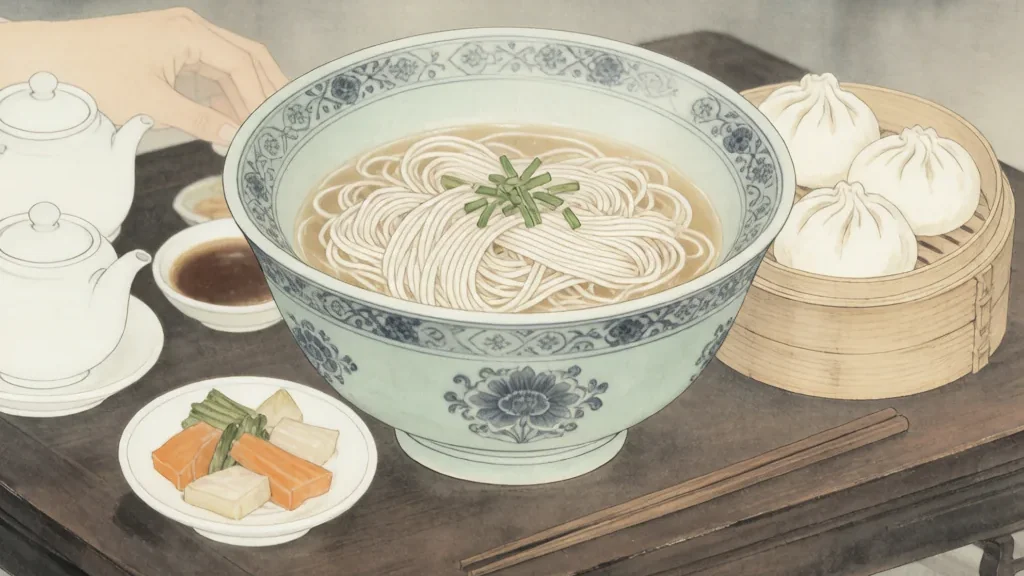
"Lao-ma-wan" (老妈碗) evokes a beloved strand of Sichuan street and homestyle snacking built around the figure of the "lao ma"—the "old mom" whose home kitchen stands for comfort, generosity, and unfussy skill. In Chengdu and across the province, small eateries and stalls trade on this maternal promise, serving hearty bowls of slow-braised pig trotters (蹄花, tíhuā) in clear, gelatinous broth, meant to be eaten with a fiery chili dipping sauce. The "wan" (碗, bowl) is the point: a steaming, restorative bowl of soft meat and rich soup that costs little and satisfies completely. More than a single recipe, lao-ma-wan represents the Sichuan ideal of home cooking elevated to a neighborhood institution.
What "Lao Ma" Means in Sichuan Food
The phrase "lao ma" (老妈, "old mom") is a term of affection and a powerful brand in Sichuan's food world. Countless small shops—old-mom noodle houses, old-mom tofu, old-mom pig-trotter—use it to signal home-style cooking rather than restaurant polish.
The promise is maternal: food made the way a mother makes it, seasoned by memory rather than a recipe card, generous and soothing. Customers read "lao ma" as a guarantee of honesty and warmth.
This naming turns a private domestic act into a public one, inviting strangers to sit at the "family table" for the price of a bowl.
The Signature Bowl: Braised Pig Trotters
The centerpiece of a lao-ma-wan meal is typically tíhuā—pig trotters (feet) cut and simmered for hours until the skin and connective tissue turn silky and the broth clouds with released gelatin. Served in a bowl, it is both meat and soup.
The trotters are usually blanched, then slow-cooked with ginger, scallion, and sometimes a mild spiced brine, never so aggressively seasoned that the pork's sweetness is lost. The result is tender enough to eat with a spoon.
What arrives at the table is humble and rich at once: pale, quivering meat in a broth that sets like jelly when cool, the very picture of restorative home food.
Broth, Gelatin, and Comfort
The magic of the dish is collagen. Long simmering draws gelatin from skin and bone, giving the broth its body and the meat its melt. In traditional thinking this "bu" (nourishing) quality makes the bowl especially good for the tired, the recovering, or the cold.
Because the broth is lightly seasoned, its flavor is clean and porky rather than loud. Diners often drink it straight from the bowl after finishing the meat, or ladle it over rice.
This is food as care, the culinary equivalent of a warm blanket, which is exactly the "lao ma" appeal.
The Dipping Sauce
Although the broth is mild, Sichuan never lets a bowl go un-chili'd for long. A small dish of "zhanshui" (dipping sauce) accompanies the trotters: chili oil, crushed garlic, scallion, and often a splash of the shop's fermented brine.
Diners dip each piece to taste, layering heat and pungency over the gentle meat. The contrast—cool gelatinous pork against hot oil—is the dialectic that makes the dish exciting rather than merely soothing.
Shops guard their sauce recipes, and regulars develop loyalties based as much on the dipping oil as on the broth.
Street Stall and Neighborhood Context
Lao-ma-wan belongs to the world of the small storefront and the late-night stall. In Chengdu such places open from midday into the small hours, catching workers, students, and night owls alike.
The setting is plain: low stools, plastic bowls, and a steamer or cauldron perpetually simmering at the back. The atmosphere is communal and unhurried, oriented to the bowl rather than the occasion.
This democratic accessibility is core to the "lao ma" identity—good food for ordinary people, served without pretense.
Homestyle Comfort and Social Role
Beyond the stall, the braised-trotter bowl is classic home sick-day and postpartum food in parts of Sichuan, valued for being easy to digest and rich in collagen. Families pass down their own brine and timing.
It also marks everyday celebration: a simple reward after a hard week, or a shared late supper among friends. Its role is emotional as much as nutritional.
In a cuisine famous for fire and numbness, lao-ma-wan is the gentle pole—proof that Sichuan comfort food is not only about heat.
Regional Anchoring in Chengdu
Chengdu is the spiritual home of this snack style, with "old-mom pig-trotter" shops clustered in older neighborhoods and near night-life districts. The city's slow-paced, snack-loving culture suits the format perfectly.
Neighboring areas of Sichuan share similar bowls under other names, but the Chengdu "lao ma" framing is the most widely recognized. The dish travels poorly, depending as it does on fresh simmering and local chili oil.
Visitors often encounter it as part of a broader crawl of Sichuan snacks, a calming interlude between hotter, sharper bites.
Technique: The Slow Simmer
Making the bowl is mostly patience. Trotters are cleaned, blanched to remove scum, then simmered at a bare bubble for a long stretch—often two hours or more—so collagen converts without the meat falling apart.
Skimming and gentle heat keep the broth clear and clean; rushing with a hard boil clouds and toughens it. Some shops maintain a perpetual master broth, replenished daily, the way ramen houses do.
The skill is therefore restraint: knowing when to stop, and trusting time to do the work that spice cannot.
Modern Life and Continuity
Today the "lao ma" bowl survives amid快餐 (fast food) and chains by leaning harder into authenticity. Shops emphasize hand-made broths, visible cauldrons, and the "old mom" story as a shield against homogenization.
Delivery has reached even this fragile dish, with insulated containers shipping the bowl across the city, though purists argue it is best eaten on a stool at the source. Some younger chefs refine presentation while keeping the flavor honest.
Through all the change, the appeal endures: a cheap, warming bowl that tastes like someone's mother cooked it just for you.
❓ Frequently Asked Questions
What is lao-ma-wan?
It refers to a style of Sichuan homestyle snacking centered on a hearty bowl ("wan") of slow-braised pig trotters, sold by "old mom" (lao ma) shops.
What does the food actually contain?
Typically pig trotters simmered until silky in a clear gelatinous broth, eaten with a chili-garlic dipping sauce.
Is it very spicy?
The broth is mild; the heat comes only from the optional dipping sauce, so you control the spice level bite by bite.
Why is it called "old mom"?
"Lao ma" signals home-style, motherly cooking—honest, generous, and comforting rather than restaurant-refined.
Where is it eaten?
Mainly in Chengdu and Sichuan neighborhood stalls and late-night eateries, where it is a cheap, warming snack.
Is it hard to make at home?
Not hard, just slow: blanch the trotters and simmer gently for a couple of hours until the broth gels and the meat is tender.