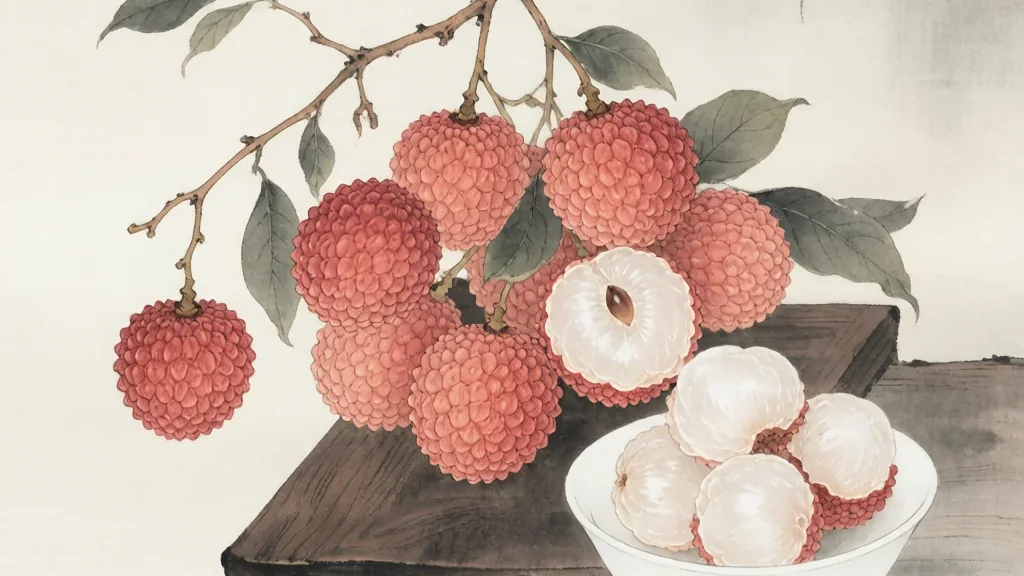
Lychee (荔枝, lìzhī) is one of southern China's most celebrated fruits—a small round berry with a rough pink-red shell, translucent white perfumed flesh, and a single glossy seed. Native to the humid subtropics of Guangdong, Guangxi, Fujian, and Hainan, the lychee has been cultivated for more than two thousand years and immortalized in Tang poetry for its role in the imperial court, where it was raced north by fast horse to please the favored concubine Yang Guifei. Known as the "king of fruits" in its season, the lychee is prized for an incomparable floral sweetness and a notorious perishability that has shaped how it is grown, shipped, and celebrated right up to the present day.
Botanical Identity
Lychee is the fruit of Litchi chinensis, an evergreen tree of the soapberry family that can live for hundreds of years and grow tall and broad in the warm south. The fruit hangs in loose clusters and is technically a drupe, with a leathery outer skin, a juicy aril (the edible part), and a single seed.
The shell is thin, knobbed, and brittle, splitting easily by hand. Inside, the flesh is translucent, faintly rose-tinged near the seed, and exudes the fruit's signature rose-like perfume as soon as it is opened.
Wild relatives and close cousins include longan (龙眼) and rambutan, but the lychee's fragrance is distinctively its own, often described as floral, wine-like, and musky at once.
A History of Tribute and Speed
Lychee cultivation in China is documented back more than two millennia, with early mentions in Han-era southern records. Because the fresh fruit spoiled quickly, it became a luxury of place, available only where it grew or where it could be rushed.
The fruit's fame rests largely on the Tang court. The poet Du Mu wrote of riders galloping through the dust to deliver fresh lychees to Chang'an for Yang Guifei, a line that has fixed the fruit in the Chinese imagination as a symbol of indulgence and the costs of empire.
Later emperors and literati continued the tribute tradition, and southern officials competed to send the finest early varieties north, embedding lychee in poetry, painting, and official correspondence for centuries.
Growing Regions
The heartland of Chinese lychee is Lingnan (岭南)—Guangdong, Guangxi, and Hainan—with Guangdong's Zengcheng and Conghua among the most famous producing areas. Fujian's Putian and parts of Sichuan's southern heel also grow notable crops.
Soils, rainfall, and local microclimate give each region its own signature. Coastal humid zones tend to yield larger, juicier fruit, while cooler inland pockets produce smaller, more aromatic berries that connoisseurs prize.
China remains the world's leading lychee producer by a wide margin, and the fruit's geography still dictates which markets see it fresh versus canned or dried.
Famous Varieties
Chinese growers have bred and selected dozens of cultivars, each with a nickname. "Feizixiao" (妃子笑, "concubine's smile") is an early, reliably sweet variety named for the Tang story; it is among the most widely planted.
"Guiwei" (桂味, "osmanthus flavor") is smaller and intensely fragrant, with a hint of osmanthus in the aroma, and is considered a connoisseur's choice. "Nuomici" (糯米糍, "glutinous rice cake") is large, seed-small, and exceptionally sweet and soft.
Others, such as "Heiye" (black leaf) and "Baitangying," vary in color, size, and keeping quality, giving the short season a sequence of changing pleasures from early summer onward.
The Fleeting Season
Lychees ripen in early to mid summer, generally June into July in most regions, with southern Hainan fruiting weeks earlier. The total fresh window is only a few weeks, and individual varieties peak for days rather than months.
This brevity is part of the allure. Families time outings to orchard areas, and the arrival of each new variety is noted in markets and on social media much as wine vintages are discussed elsewhere.
Because the season is so short, preserving the fruit—by canning, drying into lychee "nuts," or making wine—became essential ways to extend the pleasure through the year.
Flavor and How to Eat It
A ripe lychee offers perfumed sweetness with a faint tart edge and a floral aftertaste unlike any other fruit. The best are juicy but firm, never mushy, with flesh that separates cleanly from the seed.
Eating isSimple: crack the shell with a thumbnail, peel, and pop the flesh whole into the mouth, discarding the seed. Chilling heightens the perfume and makes the fruit more refreshing in summer heat.
Overripe lychee turns bland and slightly fermented, and underripe fruit is disappointingly sharp, so freshness and timing matter more than almost any other factor.
Culinary Uses Beyond Fresh
Beyond hand-eating, lychee appears in savory-sweet dishes, most famously lychee pork (荔枝肉) in Fujian cuisine, where pork is cut to resemble the fruit. It is also added to chicken salads, stuffed with fillings, or simmered in soups.
Canned lychee in syrup carried the fruit to global supermarkets long before cold chains made fresh export practical, and dried lychee (lychee nut) is a chewy snack and traditional remedy.
Lychee wine and liqueurs exist too, capturing the aroma in alcohol, while modern pastry and bubble-tea cultures use the flavor in everything from mochi to syrups.
Perishability and the Old Saying
Lychee's great weakness is its skin. Once picked, the shell browns within a day and the flesh darkens and sours soon after, a fragility captured in the old saying that the fruit "loses its color in one day, its fragrance in two, and its flavor in three."
Historically this meant the fruit had to be consumed near where it grew or transported with extraordinary speed by relay horse. Today refrigerated logistics and controlled-atmosphere packing let it travel across the country and abroad within days.
Even so, the finest eating is still within a day or two of the tree, and connoisseurs insist the difference between a same-day lychee and a week-old one is the difference between two fruits.
Cultural Meaning and Poetry
Lychee sits deep in Chinese literary culture as a token of southern abundance, imperial excess, and the bittersweet passing of beauty. Su Shi, the great Song poet, wrote of wanting "to be a Lingnan person for life" for the sake of its lychees.
It also functions socially as a gift fruit and a festival treat, associated with summer and with the pleasures of the warm south. In art it often appears beside longan and other "auspicious" fruits.
The fruit's story—from dusty imperial relay to today's express-delivery box—mirrors China's long relationship with its subtropical bounty.
Nutrition and Cautions
Lychee is rich in vitamin C and provides modest fiber and potassium for few calories. Its sweetness comes from natural sugars, and the fruit is mostly water, fitting its refreshing reputation.
Traditional and modern advice both counsel moderation. Eating very large amounts on an empty stomach has been linked to a rare metabolic reaction in some contexts, and the seed is not edible. As with yang-mei, rinse and enjoy in sensible handfuls.
Otherwise the fruit is a wholesome seasonal pleasure, best appreciated fresh and in season rather than as a year-round import.
❓ Frequently Asked Questions
What does lychee taste like?
It is perfumed and sweet with a faint tart edge and a floral, almost rose-like aftertaste. The texture is juicy and firm when fresh.
When is lychee in season?
Early to mid summer, roughly June into July, with southern Hainan fruiting earlier and the whole fresh window lasting only a few weeks.
Why was lychee famous in the Tang court?
Fresh lychees were rushed north by fast horse to please Yang Guifei; Du Mu's poem about the dusty riders made the fruit legendary.
What are the best lychee varieties?
Feizixiao (early, sweet), Guiwei (osmanthus-fragrant), and Nuomici (large, very sweet) are among the most esteemed.
How should lychee be stored?
Eat within a day or two of purchase; refrigerate to slow browning, but know that same-day fruit tastes best by far.
Is lychee used in cooking?
Yes—Fujian lychee pork, chicken salads, soups, and wines all use it, while canned and dried forms extend the season globally.